About the archive
The guide behind the map
Why this archive exists, who built it, and how every claim is checked. You are the hero of this work. Aaron is the guide. How we check things comes after the story, not instead of it.
Plate 08
The archive in numbers
Counts from the live record
453
Compounds
1,043
Studies in people
72
No human study
Safety and scope
I am a coach, not a physician
- I am a coach, not a physician. No clinical credential is claimed for me anywhere on this site.
- This archive is educational research. It is not diagnosis, treatment, or prescribing.
- You are the adult responsible for decisions about your body, made with your own clinician.
I have done medical-camp dentistry in Nepal. That still does not make me your physician.
Your guide
I have already walked the maze. You do not have to walk it alone.
I am Aaron Cuha. I am a peptide specialist with several certifications. I am also a PCC with more than 20,000 coaching hours. I have read more studies in people, and in animals, than most people will ever see in a feed. I have also lived through a big weight loss myself. My job here is to guide, not to play guru. You are the one making the call.
He is a coach, not a doctor. This site never claims he has a medical credential. No doctor or other clinician has reviewed these pages. The spot that would name one is left empty on purpose. Filling it would tell search engines and readers that a qualified person checked the medicine here. Nobody has, so it stays empty until somebody does. He cannot diagnose you. He does not know your history or what medicines you take. Nothing here replaces the person who writes your prescriptions.
This archive grew out of a long habit: finding out what is really true after being told something else, usually the expensive way. He left an abusive home at fourteen. He built DirectLender.com into one of the largest privately held mortgage brokerages in the country, with 280 offices and more than 3,000 people. In 2008 he lost all of it. What they did next matters more here than the part before it. Aaron and Debbie spent roughly a decade in Nepal running medical camps in the Himalayas. They ran them through their foundation, the Center for Global Change, and served more than 5,000 people. Ten years of seeing what basic medicine does for people, and what happens without it, is where the standard on this site comes from.
He came back and started over as a coach, a speaker, and the author of five books. He built this archive because he uses these compounds and routines himself. He went looking for honest facts about them and found an internet full of people selling things.
He went from 255 pounds at 37 percent body fat to 175 pounds at 13 percent, with 0.53 pounds of deep belly fat around the organs. There are body scans from the start and the end. The compounds were the last thing that mattered, not the first. You can step through those months in the record on my body. Here is what that is worth to you as evidence: nothing. One person is one story, however carefully he measured himself. It is shared for a smaller reason. It is why he knows which parts are hard. It is why this site puts things in the order it does. And it is what he has instead of a medical credential. The evidence is in the studies. They are linked so you can read them and disagree.
So nothing here tells you what to do. Any dose on this site is a record of what a study used, what a clinic used, or what people say they did. Each one has its source attached. The calculator only converts an amount that someone qualified already gave you. It never suggests one.
Meet Debbie
Meet Debbie
You are the hero of this work. Debbie is a guide for the midlife questions this archive now answers. She is not a doctor. Nothing on this page is a diagnosis, a prescription, or a stack to copy.
Debbie Cuha reports losing 41 pounds and significant improvement on her last bone scan, then fell on a hike, bruised, and did not fracture. Coach, not doctor. No photos.
This page has no before and after photos. It will not add empty photo boxes that hint at photo proof. The reports above are words she approved, and they stay words.
Why this exists
The problem
Peptide and longevity content is full of hype. It leaves out the studies that found nothing, and it hides the prices. A person trying to decide has no map they can trust. The loudest voice is usually the one selling the vial.
The map
A free archive held to one standard: what was measured in people, with the numbers. Live seller prices on the same site. An on-site coach who has lived the work. You decide. We hand you the map.
What makes it different
Live prices
Seller prices come from public online stores. Sellers are ranked by their lab certificate first and their price second. We show the full spread of prices, not an average.
OpenOn-site AI coach
Ask a question about this archive. The coach answers from the cited research. For learning only. Never dosing advice.
OpenGaps are shown
When nobody has run a study, the page says so. Pages with no study of that compound in people are counted. They are not dropped or padded out with lab theory.
OpenSources checked twice
Every source is looked up live before we cite it. A separate script looks them all up again and stops the site from building if anything does not match.
OpenNothing sold as medical advice
Knowledge stays free. This is a reference, not a clinic. No page here tells you what you should take.
OpenBehind the guide
The operating system behind the guide
VITAL OS is Aaron's functional longevity operating system. The Reciprocal Loop is Time-block, Habit, Leverage (knowledge plus accountability), and AI.
The Archive is the public evidence map. VITAL OS is the private system behind how Aaron coaches. This page is not a book funnel, and nothing here is for sale.
Book forthcoming
The record
The record on my body
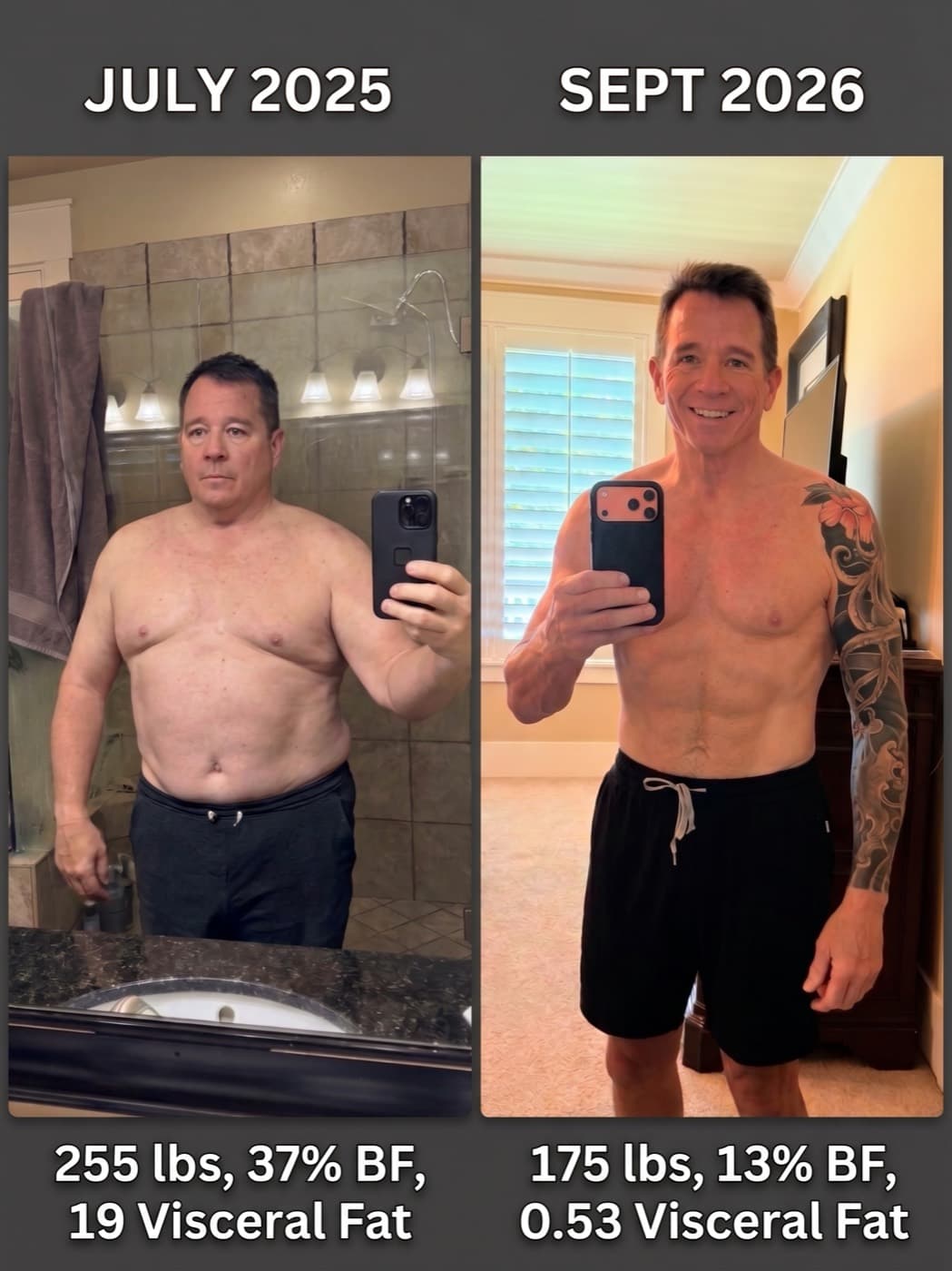
Before
Jul 2025
255 lb
37% body fat
After
Sep 2026
175 lb
13% body fat
About 14 months
The record
Personal numbers first, then the archive. The archive numbers are counted straight from the database, not typed in by hand. What each one means is explained on Methodology. The same numbers are free to download at /data.
- Weight
- 255 lb to 175 lb
- Body fat
- 37 to 13 percent
- Belly fat
- 0.53 lb
- Scans
- Both ends
- Blood panel
- Every 90 days
- Credential claimed
- None
- Compounds
- 453
- Studies in people
- 1,043
- Sources cited
- 1,587
- No human study yet
- 72
- Prices tracked
- 10,793
- Effects users report
- 1,698 across 392
How a page gets written and checked
1,587 checked sources across 453 compound pages. 1,043 studies in people, each counted once. 72 pages with no study of that compound in people. Six rules follow. After them come the checks that enforce them.
The six rules
- 01
Not approved is a legal fact, not a finding about whether it works.
A compound can lack approval because a study failed, or because nobody ever ran one. Those are different things, and every page says which.
- 02
No big drug study does not mean no results in people.
Small safety studies, studies that follow large groups of people, clinic reports, studies of a closely related molecule, and what users report are all results from real people. We report them, labelled for what they are, instead of writing "none".
- 03
Where nothing human exists, we say so precisely.
"No study in people of any kind" means exactly that, and we name where we looked.
- 04
Why a trial is missing is part of the answer.
Nobody pays for a 300-person study of a molecule nobody can patent. So when there is no study, that tells you how drug research is paid for, not whether the molecule works. It cuts both ways: with no study, a real harm and a real lack of benefit would both go unseen.
- 05
Negative results stay on the page.
If a study found nothing, we say so and give the numbers. We remove wrong dismissals, not results we do not like.
- 06
Open disputes are labeled as disputes.
Where research groups disagree about a result, we say the question is contested rather than picking a side and presenting it as settled.
The checks, step by step
- 01
Results in people come first, with numbers.
A page leads with what happened to people: who they were, how many, what they were compared with, and how big the change was. Animal and human results never share a paragraph, and where the result is in mice the sentence says mice.
- 02
Every study is looked up live before we write it down.
Each PubMed ID goes to the NCBI E-utilities record, each registration number to the ClinicalTrials.gov API, and Federal Register documents to the live HTML. The returned title is compared with the title on our page, the year is compared with the publication date, and the record is scanned for retraction markers. Nothing is written from memory.
- 03
A separate pass re-checks the citations after the fact.
An independent script walks every citation in the database, resolves it again at the source, and exits with an error on any mismatch. Fabricated citations have been caught on this project six times, including ones we produced ourselves. The re-check exists because of that, and it is the reason this page can make the claim it makes.
- 04
A validator runs over the whole database before anything ships.
It fails on a duplicate compound, a link to a profile that does not exist, a missing legal status, a citation year outside 1950 to 2026, a citation URL that is a search query rather than a record, and a review date that does not parse. It also fails on an em dash, which is a house style rule enforced in code so it cannot drift back in, and on any sentence that claims the site takes no commission while price rows exist.
- 05
Every page carries the date it was last reviewed.
The record moves. A profile that has not been looked at since last spring says so, and when a new finding changes what a page should say, the old wording is corrected in public with a date rather than quietly replaced.
Why nothing here gets a grade
This site used to grade things. Every page carried a research strength and an evidence level. Both were removed as verdicts. In their place is a number you can count: how many studies in people a page cites, how many people were in them, and what those studies measured. That number sits on every page. Where two research groups disagree, both are described and neither is called the winner. Where a study missed the main thing it set out to measure, the page says so right next to whatever it did find.
There is a second count. Most of these molecules cannot be patented. So no company will ever pay for the big study that would settle the question. Waiting for that study means waiting for something that is not coming. So we also count what people using them say: 1,698 reported effects across 392 compounds. Of those, 1,124 are side effects people really had. The two counts are kept apart and never added together. A thousand people saying a thing worked is not a study. But treating their reports as nothing was its own kind of dishonesty.
Compounds are not ranked against each other, and nothing is called the best. That depends on facts about you that a web page does not have. When a study in people compared two things head to head, that result is reported. A study result is evidence. A ranking is an opinion.
Every page links to the original research: studies in people, published papers checked by other scientists, and reviews. When a well-known study exists, we name it so you can check the claim yourself.
Money and conflicts
We never charge for knowledge. No vendor has a say in what a page says. The harder test is whether a page tells you what went against it. No sponsored compounds, no paid spots, no ads, no discount code of our own, no supplement line.
We never charge for knowledge. Every page, every guide and every tool here is free and stays free. Sellers are ranked by their lab certificate first and their price second. Any page is free to tell you not to buy at all.
The newsletter is free, it sells nothing, and one click unsubscribes. The tracker is free and keeps your records on your own device unless you switch sync on yourself. If any of that ever changes, it will be disclosed on this page before it appears anywhere else on the site.
Every site like this one claims to be independent. You cannot check that claim, so check something harder instead: do the pages show the results that went against them? These do. Failed studies, studies that found no effect, pulled papers, studies that finished and never shared results, and places where the owner is ahead of the evidence are all on the record. That includes the compounds that were tested properly and did not work.
How to tell us we are wrong
This is the part most sites leave out, so here it is plainly. If a sentence on this site is wrong, send three things: the page address, the sentence, and the PubMed ID or study registration number that shows it is wrong. That is enough to settle it. It is also the only kind of argument that works here, because a source can be checked and an opinion cannot.
What happens next is always the same. We look the ID up at the source. If it holds up, the page is fixed and the fix is dated on the page. The old wording is described, not deleted, so you can see what we used to say. If it does not hold up, we say that too. There is no comment section, because comments would make the argument about people instead of records.
Send it to ac@aaroncuha.com. That address goes straight to Aaron, not to a queue. The other open line is the Dispatch, an email every two weeks about what changed in the evidence, including the things we took back ourselves. Reply to any issue. Read past issues in full, free, and check whether a correction has ever really appeared in one before you believe the paragraph above it.
Educational use only. This database summarizes published research and is not medical advice. Where a dose appears it is a record of what a trial or clinic ran, or what people describe doing, with its source attached. Nothing here is a recommendation for personal use.