Research / Published Nov 7, 2026 / 11 min read
Vitamin C and DMSO for Skin Cancer: What the Studies Found
Written by Aaron CuhaReviewed Nov 7, 2026
The viral vitamin C and DMSO skin cancer result, checked against the papers: the 2025 squamous cell preprint, the 2022 basal cell trial against imiquimod, a 2026 review, who ran them, and what none of them show.
Key takeaways
- 01The '56 percent' figure is from a 2025 preprint on medRxiv, not yet peer reviewed. 17 people with 27 squamous cell carcinoma in situ lesions brushed on 30 percent ascorbic acid (vitamin C) in 95 percent DMSO twice a day for 12 weeks. 15 of 27 lesions cleared on repeat biopsy, which is 56 percent; 12 did not fully clear.
- 02The earlier study is a 2022 randomised trial of 25 people with 29 basal cell carcinomas. After 8 weeks, biopsy showed 13 of 15 lesions cleared with the vitamin C solution against 8 of 14 with imiquimod, a standard prescription cream.
- 03Both studies come from the same Boise, Idaho group, and both registered sponsors are the authors' own company. The 2022 trial was registered after it finished. The 2025 study's registration set its main result at 8 weeks in about 15 people; the preprint reports 12 weeks in 17, and prints the 2022 trial's registration number instead of its own.
- 04This is not a vitamin C serum. The studies used a 30 percent solution in DMSO made for the trial, on low-risk skin cancers, with every result checked by biopsy. No cosmetic serum was tested.
- 05A 2026 review in Dermatologic Surgery found four studies in total and concluded there is too little research to make clinical recommendations.
What is the vitamin C and DMSO skin cancer study?
Direct answer
It is two small studies from one research group in Boise, Idaho. A 2022 randomised trial compared 30 percent vitamin C in DMSO with imiquimod cream for basal cell carcinoma. A 2025 preprint, not yet peer reviewed, tested the same solution on squamous cell carcinoma in situ. In the preprint, 15 of 27 lesions cleared on biopsy after 12 weeks.
The figure spreading online, 56 percent, comes from the second study (medRxiv, 2025). It is a real number from a real study. It is also one open-label study of 17 people, posted as a preprint, which means no journal's reviewers have checked it yet. The first study, a randomised trial against a standard prescription cream, is the stronger of the two and got less attention (Biomedicine & Pharmacotherapy, 2022).
What the 2025 squamous cell study found
Direct answer
Squamous cell carcinoma in situ is a skin cancer confined to the top layer of skin. In the preprint, 19 patients were enrolled, 2 were lost to follow-up, and the 17 who finished, with 27 biopsy-confirmed lesions, applied 30 percent.
Squamous cell carcinoma in situ is a skin cancer confined to the top layer of skin. In the preprint, 19 patients were enrolled, 2 were lost to follow-up, and the 17 who finished, with 27 biopsy-confirmed lesions, applied 30 percent ascorbic acid in 95 percent DMSO twice daily for 12 weeks, and every lesion was biopsied again at week 12 (medRxiv, 2025).
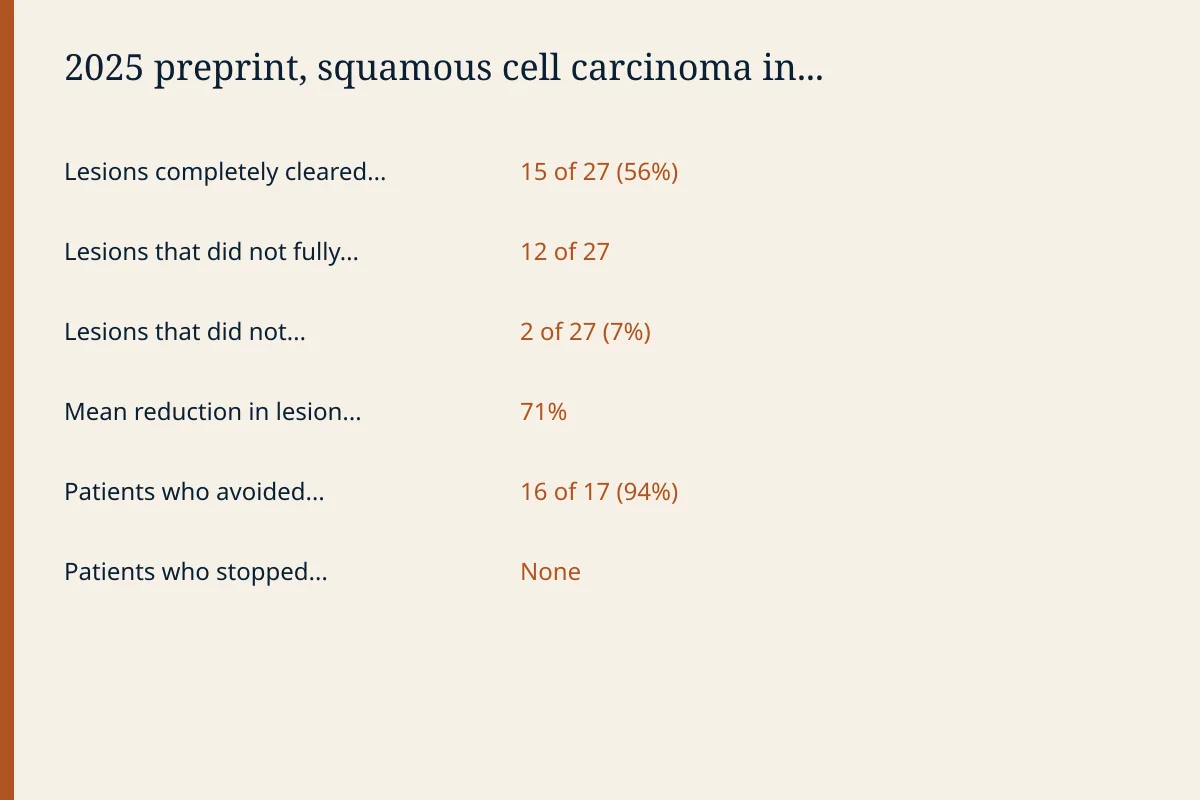
| Measure | Result |
|---|---|
| Lesions completely cleared on biopsy | 15 of 27 (56%) |
| Lesions that did not fully clear | 12 of 27 |
| Lesions that did not respond at all | 2 of 27 (7%) |
| Mean reduction in lesion area | 71% |
| Patients who avoided surgical excision | 16 of 17 (94%) |
| Patients who stopped because of side effects | None |
The authors report no pain, itching, burning or ulceration, only mild redness, and no loss of skin colour. Most of the lesions that did not fully clear showed sun-damage changes without cancer on the second biopsy, and were then treated with freezing (cryotherapy). The authors list their own limits: a small sample, no placebo or comparison group, DMSO alone never tested, little ethnic diversity, and no long-term data yet on whether the cancers come back.
What the 2022 basal cell trial found
Direct answer
In a randomised trial of 25 people with 29 low-risk basal cell carcinomas, 30 percent vitamin C in DMSO twice daily for 8 weeks cleared 13 of 15 lesions on biopsy, against 8 of 14 with imiquimod cream. The vitamin C group had fewer side effects, and none had lighter skin patches at 30 months, against 70 percent with imiquimod.
From the archive
See how this archive checks a study.
Read it on the archive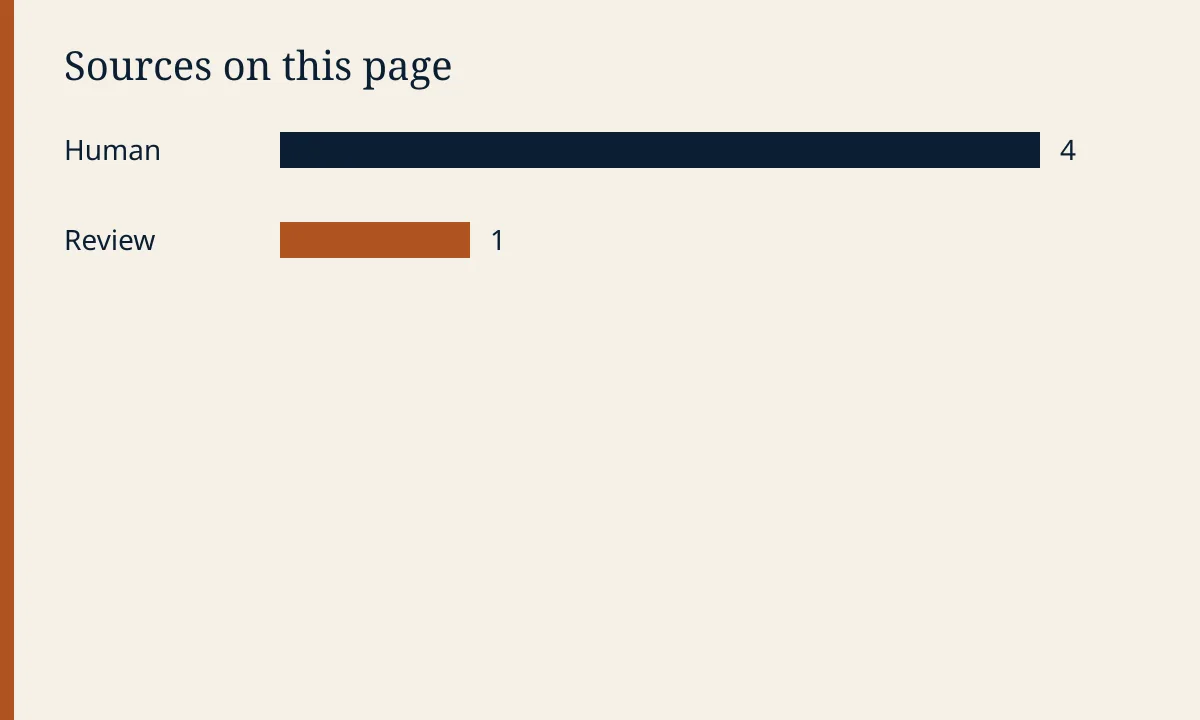
Basal cell carcinoma is the most common skin cancer. The 2022 trial randomly assigned 25 patients with 29 biopsy-confirmed nodular or superficial lesions to the vitamin C solution twice daily for 8 weeks or to imiquimod, a standard prescription cream. At 8 weeks, biopsy showed complete resolution in 86.7 percent of vitamin C lesions against 57.1 percent of imiquimod lesions. The authors call vitamin C superior at 8 weeks and non-inferior at 12 weeks (Biomedicine & Pharmacotherapy, 2022).
This is the more important of the two studies because it has a comparison group: people were randomly assigned, and the comparison was a real treatment, not nothing. It is still 29 lesions, and the lesions were low risk by design.
Who ran these studies, and who paid?
Direct answer
Both papers come from the same group. Briant Burke, of Boise, Idaho, is the corresponding author on both. On ClinicalTrials.gov, the 2022 trial's lead sponsor is the Center for Biomedical Research, Inc., classed as industry, the authors' own organisation (NCT04279535).
Both papers come from the same group. Briant Burke, of Boise, Idaho, is the corresponding author on both. On ClinicalTrials.gov, the 2022 trial's lead sponsor is the Center for Biomedical Research, Inc., classed as industry, the authors' own organisation (NCT04279535). The 2025 preprint declares no outside funding and no competing interests, and its review board was the Institute for Biomedical Sciences in Boise, the corresponding author's own institute.
Three things in the public record are worth knowing. First, the 2022 trial was registered on 19 February 2020, after it finished in June 2019. Registering before a trial starts is what stops researchers from changing the goal after seeing the results. Second, the squamous cell study was registered on time, in June 2023, as NCT05932511, sponsored by the same company. That registration names the main result as lesions free of tumour on biopsy at 8 weeks, in an estimated 15 people. The preprint reports its main result at 12 weeks, in 17, and does not explain the change. Third, the preprint prints NCT04279535 as its registration, which is the 2022 basal cell trial's number, not its own.
Is this the same as a vitamin C serum?
Direct answer
No. Both studies used a solution made for the trial: 30 percent ascorbic acid dissolved in 95 percent DMSO, a solvent that passes into skin. No cosmetic vitamin C serum was tested for skin cancer in either study, and the 2026 review found no study that did. A serum bought for wrinkles is a different product with no skin cancer result behind it.
From the archive
Get the weekly evidence update.
Read it on the archive
DMSO, dimethyl sulfoxide, is the part of the formula people tend to skip past. It carries what is dissolved in it through the outer layer of skin. The preprint's authors note that DMSO alone was never tested, so the studies cannot say how much of the effect is vitamin C and how much is DMSO.
What does the wider research say?
Direct answer
A 2026 scoping review in Dermatologic Surgery searched the major medical databases for topical vitamin C in the prevention and treatment of actinic keratoses (precancerous sun spots) and nonmelanoma skin cancers. It found four studies: two randomised trials, one observational.
A 2026 scoping review in Dermatologic Surgery searched the major medical databases for topical vitamin C in the prevention and treatment of actinic keratoses (precancerous sun spots) and nonmelanoma skin cancers. It found four studies: two randomised trials, one observational study and one case report, covering 40 people with actinic keratoses, 21 with basal cell carcinoma and 1 with squamous cell carcinoma. It concluded that highly concentrated vitamin C may have some benefit for actinic keratoses and low-risk nonmelanoma skin cancers, but that too few studies exist to make clinical recommendations (Dermatologic Surgery, 2026).
What these studies do not show
Direct answer
Anything about melanoma, the most dangerous skin cancer. Neither study included it. Anything about high-risk, deep or large skin cancers. Both studies enrolled low-risk or in situ lesions. Long-term results. The 2025 preprint reports no recurrence data yet. That it.
- Anything about melanoma, the most dangerous skin cancer. Neither study included it.
- Anything about high-risk, deep or large skin cancers. Both studies enrolled low-risk or in situ lesions.
- Long-term results. The 2025 preprint reports no recurrence data yet.
- That it works without a biopsy. Every result here was confirmed by looking at tissue under a microscope before and after.
- Any effect of an over-the-counter vitamin C serum.
The bottom line
Direct answer
Two small studies from one group found that a 30 percent vitamin C solution in DMSO cleared many low-risk skin cancers on biopsy, with fewer side effects than imiquimod in the one randomised comparison. That is worth a larger, independent.
Two small studies from one group found that a 30 percent vitamin C solution in DMSO cleared many low-risk skin cancers on biopsy, with fewer side effects than imiquimod in the one randomised comparison. That is worth a larger, independent trial, which is what the authors themselves call for. It is not yet evidence that vitamin C treats skin cancer, and it says nothing at all about vitamin C serums.
From the archive
Read how to weigh a preprint against a trial.
Read it on the archiveFrequently asked questions
Does vitamin C cure skin cancer?
Not on current evidence. Two small studies from one group found a 30 percent vitamin C solution in DMSO cleared many low-risk basal and squamous cell skin cancers on biopsy. Neither has been repeated by another group, and a 2026 review found too few studies for clinical recommendations.
What is the 56 percent vitamin C skin cancer study?
A 2025 medRxiv preprint, not yet peer reviewed. 17 people with 27 squamous cell carcinoma in situ lesions used 30 percent ascorbic acid in 95 percent DMSO twice daily for 12 weeks; 15 of 27 lesions cleared on biopsy. There was no comparison group.
Was the vitamin C and DMSO study peer reviewed?
The 2022 basal cell trial was, in Biomedicine & Pharmacotherapy. The 2025 squamous cell study is a preprint on medRxiv and had not been peer reviewed when this was written.
Can a vitamin C serum treat skin cancer?
No study has tested one. The trials used a 30 percent solution in DMSO made for the research, not a cosmetic serum.
Why is DMSO in the formula?
DMSO is a solvent that carries what is dissolved in it into the skin. The studies never tested DMSO alone, so they cannot separate its effect from vitamin C's.
Who funded the vitamin C DMSO skin cancer research?
Both registered sponsors are the authors' own organisation, the Center for Biomedical Research, Inc. The 2025 preprint declares no outside funding and no competing interests.
Sources
- Study in people2025
Topical 30% Ascorbic Acid in Dimethyl Sulfoxide for the Treatment of Cutaneous Squamous Cell Carcinoma In Situ
Open-label, 19 enrolled, 17 analysed with 27 lesions, twice daily for 12 weeks. 15 of 27 lesions cleared on biopsy (56 percent); mean area reduction 71 percent; 2 lesions did not respond; no one stopped for side effects. No outside funding and no competing interests declared. Prints NCT04279535, the 2022 basal cell trial's registration, as its own.
medRxiv (preprint, not peer reviewed) - Study in people2022
Randomized trial of topical ascorbic acid in DMSO versus imiquimod for the treatment of basal cell carcinoma
Randomised, 25 patients, 29 low-risk basal cell carcinomas, 8 weeks. Complete resolution on biopsy in 13 of 15 lesions with vitamin C in DMSO against 8 of 14 with imiquimod; fewer side effects; lighter skin patches at 30 months in 70 percent with imiquimod against none with vitamin C. No funding or conflict statement in the PubMed record.
Biomedicine & Pharmacotherapy - Study in people2020
Topical Ascorbic Acid for Treatment of Basal Cell Carcinoma (NCT04279535)
Registry record for the 2022 trial: completed June 2019, first submitted 19 February 2020, 25 enrolled, randomised, lead sponsor Center for Biomedical Research, Inc., classed as industry.
ClinicalTrials.gov - Study in people2023
Topical Ascorbic Acid for Treatment of Squamous Cell Skin Cancer (NCT05932511)
Registry record for the squamous cell study: started 12 June 2023, first submitted 21 June 2023, open-label single group, estimated 15 enrolled, primary outcome lesions tumour free on biopsy at 8 weeks, lead sponsor Center for Biomedical Research, Inc., classed as industry. Status unknown.
ClinicalTrials.gov - Review of studies2026
Topical Vitamin C in the Prevention and Treatment of Actinic Keratoses and Nonmelanoma Skin Cancers: A Systematic Scoping Review
Four studies found: two randomised trials, one observational study, one case report. Highly concentrated topical vitamin C may have some benefit for actinic keratoses and low-risk nonmelanoma skin cancers; too few studies for clinical recommendations.
Dermatologic Surgery
Read next
Longevity / Sep 8, 2026
Senolytics in 2026: Dasatinib plus Quercetin, Fisetin, and What Human Trials Have Shown
Every senolytic study in people that has reported as of September 2026: the fisetin studies (one failed, two still unfinished), foselutoclax in the eye, RLS-1496 on skin, and the small dasatinib plus quercetin tests in lung scarring and kidney disease. Plus why the capsules sold as senolytics have nothing to do with any of it. Plain English.
Safety / Sep 8, 2026
Peptide Side Effects by Class: What Is Documented, What Is Anecdotal
A group-by-group table that separates side effects counted in studies and on FDA labels (GLP-1 drugs, bremelanotide, MK-677, elamipretide) from the stories that fill forums about BPC-157, TB-500, copper peptides and brain peptides. Plain English.
Research / Sep 27, 2026
2026 Mouse Lifespan Retest: Eight Compounds, No Gains
In 2026 the US mouse lifespan testing program retested astaxanthin, meclizine, mitoglitazone, pioglitazone, alpha-ketoglutarate, mifepristone, methotrexate and atorvastatin with telmisartan. None made mice live longer. What changed, and why dose and starting age matter.
Educational use only. This database summarizes published research and is not medical advice. Where a dose appears it is a record of what a trial or clinic ran, or what people describe doing, with its source attached. Nothing here is a recommendation for personal use. Sellers named on the price pages are ranked by certificate tier, then price, and any affiliate income is disclosed there. Naming a seller is not a recommendation to buy or use anything.