Longevity / Published Nov 7, 2026 / 18 min read
What Reduces Arterial Plaque: Nattokinase, K2, D3, Berberine and the Surprises

Written by Aaron CuhaReviewed Nov 7, 2026
What shrank arterial plaque on a scan: nattokinase at 10,800 FU a day in 1,062 people, vitamin K2 and D3 trials from 2026, berberine, aged garlic, EPA, interval training, the Mediterranean diet, intensive lifestyle change and cocoa flavanols. Doses, numbers, bleeding risks, every study linked.
Key takeaways
- 01Dose is the story with nattokinase. In a 2022 Chinese study of 1,062 people, 10,800 FU a day for 12 months went with carotid plaque size falling 36.2 percent; in the 61 people on 3,600 FU a day, plaque size barely moved (3.5 percent).
- 02That 1,062-person study was a look back at medical records with no placebo group, and the tablets were made by the company that employed five of its authors. The only randomised plaque trial at a higher dose, 6,000 FU a day against simvastatin, also found plaque shrinking more on nattokinase.
- 03Vitamin K2 (MK-7) slowed coronary calcium buildup in two 2026 trials: 360 micrograms a day over two years, and 720 micrograms with 25 micrograms of vitamin D3 in 398 people with severe calcification. It slowed calcification; total plaque volume grew the same in both groups.
- 04Berberine lowers LDL cholesterol modestly, about 0.4 to 0.5 mmol/L across pooled trials. No trial in the search measured what it does to plaque itself.
- 05Aged garlic extract and prescription EPA (icosapent ethyl) have small randomised trials showing soft plaque shrinking on CT scans. Nattokinase thins blood clotting measurably, which matters for anyone on blood thinners.
Can nattokinase reduce arterial plaque?
Direct answer
At 10,800 FU a day for 12 months, carotid plaque size fell 36.0 percent and artery wall thickness 21.7 percent in the 683 people with plaque, in a 2022 study of 1,062 Chinese adults, while 3,600 FU a day did almost nothing. The study had no placebo group. A smaller randomised trial at 6,000 FU a day found plaque shrinking more than on a statin.
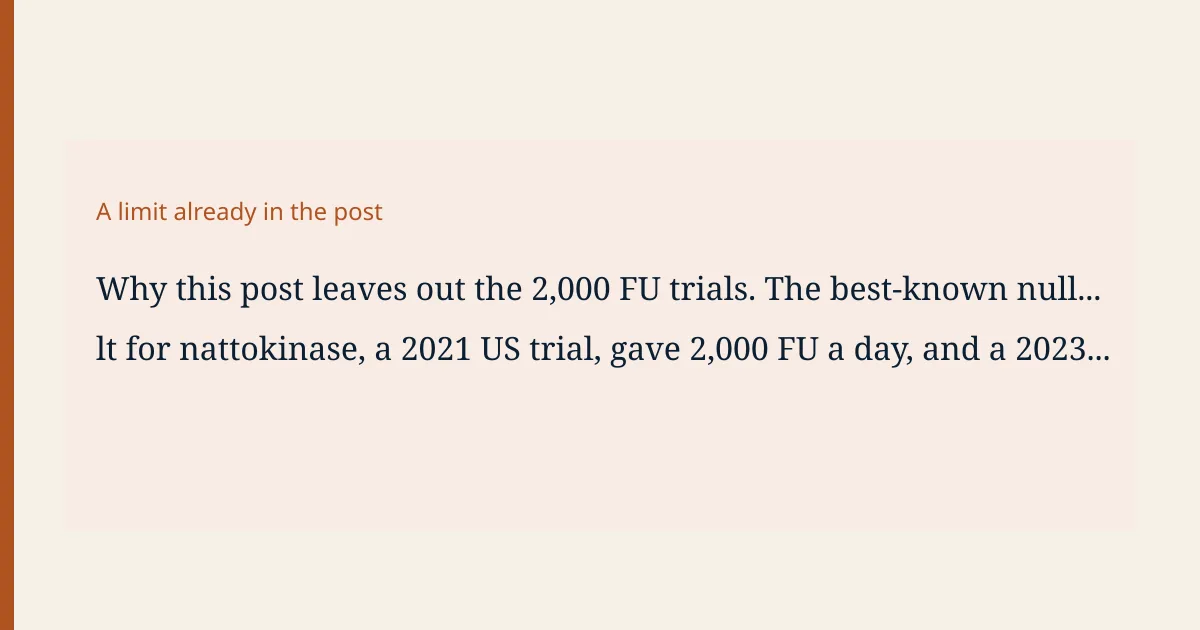
Nattokinase is an enzyme made when the bacterium Bacillus subtilis natto ferments soybeans into natto, a Japanese food. It breaks down fibrin, the protein mesh that holds blood clots together, and its strength is measured in fibrinolytic units, FU. The commonly recommended dose is 2,000 FU a day. The studies that found plaque shrinking used three to five times that, which is why this post sorts the evidence by dose. Our nattokinase profile covers its blood pressure and clotting research in full.
The 1,062-person study at 10,800 FU a day
Direct answer
Researchers at Sun Yat-sen University and nine community health centres in China reviewed the records of 1,062 adults, average age 67.5, who took nattokinase at 10,800 FU a day for 12 months between 2016 and 2020 (Frontiers in Cardiovascular Medicine.
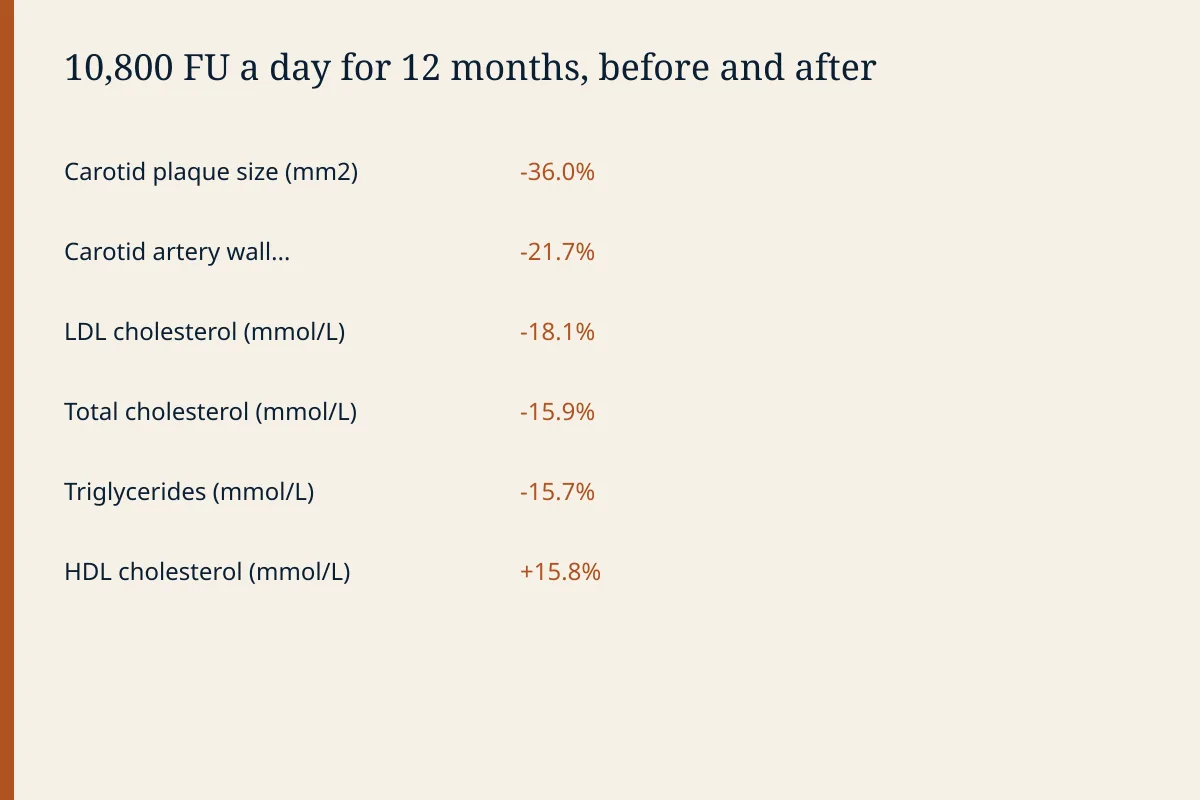
Researchers at Sun Yat-sen University and nine community health centres in China reviewed the records of 1,062 adults, average age 67.5, who took nattokinase at 10,800 FU a day for 12 months between 2016 and 2020 (Frontiers in Cardiovascular Medicine, 2022). All had high blood lipids, and 683 had carotid artery plaque on ultrasound. Each tablet held 3,600 FU, taken three a day.
| Measure | People | Before | After | Change |
|---|---|---|---|---|
| Carotid plaque size (mm2) | 683 | 24.9 | 15.94 | -36.0% |
| Carotid artery wall thickness, CCA-IMT (mm) | 683 | 1.33 | 1.04 | -21.7% |
| LDL cholesterol (mmol/L) | 1,062 | 3.58 | 2.93 | -18.1% |
| Total cholesterol (mmol/L) | 1,062 | 5.65 | 4.75 | -15.9% |
| Triglycerides (mmol/L) | 1,062 | 1.85 | 1.56 | -15.7% |
| HDL cholesterol (mmol/L) | 1,062 | 1.38 | 1.60 | +15.8% |
Plaque size improved in 66.5 percent of the people who had plaque, and artery wall thickness in 77.7 percent. The authors recorded no noticeable side effects. Among the 181 people who also took vitamin K2 at 180 micrograms a day, and the 96 on aspirin, the authors report the effects were larger.
The dose comparison inside the same study
The most useful table in the paper compares 61 people who took 3,600 FU a day with the 1,001 who took 10,800 FU. Same study, same measurements.
| Measure | 3,600 FU (61 people) | 10,800 FU (1,001 people) |
|---|---|---|
| Carotid plaque size | -3.5%, not significant | -36.2% |
| Artery wall thickness | -4.0%, not significant | -22.1% |
| LDL cholesterol | +2.3% | -17.1% |
| Triglycerides | -1.0% | -15.5% |
The authors conclude that 3,600 FU a day was ineffective and that their results challenge the commonly recommended 2,000 FU a day.
What the 1,062-person study cannot show
The authors state it plainly: it was a retrospective review of records, not a randomised controlled trial. Of 2,875 records screened, people were included only if they had complete records and took the full dose for 12 months, so anyone who stopped early was left out. There was no placebo group, so it cannot separate nattokinase from diet changes, other medicines or time. On money: the tablets were made by Sungen Bioscience, and five of the authors were employed by that company; one more worked for Sinopharm, a pharmaceutical company.
The randomised trial: nattokinase at 6,000 FU against a statin
Direct answer
A 2017 trial from the same hospital randomly assigned 82 patients to nattokinase at 6,000 FU a day or simvastatin 20 mg for 26 weeks; 76 finished (National Medical Journal of China, 2017). In the nattokinase group, carotid plaque size.
From the archive
Read the cholesterol and seed oil evidence page.
Read it on the archive
A 2017 trial from the same hospital randomly assigned 82 patients to nattokinase at 6,000 FU a day or simvastatin 20 mg for 26 weeks; 76 finished (National Medical Journal of China, 2017). In the nattokinase group, carotid plaque size fell from 0.25 to 0.16 square centimetres and artery wall thickness from 1.13 to 1.01 mm. Plaque size fell 36.6 percent on nattokinase against 11.5 percent on the statin. The statin lowered cholesterol and LDL more; nattokinase raised HDL and the statin did not. The plaque change on nattokinase did not track its cholesterol change, which the authors read as a separate mechanism. It was randomised, with no placebo group.
8,000 FU a day in people with narrowed arteries
A 2026 double-blind trial gave 120 people with narrowed brain or neck arteries 8,000 FU a day or placebo for six months (Journal of Stroke and Cerebrovascular Diseases, 2026). Overall thinking scores did not change. Visuospatial function, an exploratory measure, declined less on nattokinase (OR 0.35). The authors declare no conflicts.
Does vitamin K2 (MK-7) with vitamin D3 reduce arterial calcification?
Direct answer
Two 2026 randomised trials found vitamin K2 as MK-7 slowed the buildup of coronary artery calcium. In 398 people with severe calcification, 720 micrograms of K2 plus 25 micrograms of D3 a day for two years meant calcium scores rose 196 points against 248 on placebo. Total plaque volume grew the same in both groups.
Vitamin K2 activates matrix Gla protein, a protein in the artery wall that stops calcium settling there. MK-7 is the long-acting form of K2 found in natto. A note on names: K3 is menadione, a synthetic form not used as a supplement, so this section is about K2.
| Trial | Who | What they took | What happened |
|---|---|---|---|
| DANCODE, Circulation 2026 | 398 people with severe coronary calcium, median age 71 | K2 720 mcg + D3 25 mcg a day, 2 years | Calcium score rose 196 vs 248 on placebo; calcified plaque grew less; total plaque volume similar |
| VitaK-CAC, JAMA Cardiology 2026 | 180 people with coronary artery disease, calcium 50 to 400 | K2 (MK-7) 360 mcg a day, 2 years | Median calcium score 135 to 184 vs 145 to 214 on placebo (P = .02); no significant side effects |
| Danish men, JACC Advances 2023 | 304 men without heart disease | K2 720 mcg + D 25 mcg a day, 2 years | Overall no significant difference; in men with calcium 400 or more, 288 vs 380; fewer heart events, 1.9 vs 6.7 percent |
| AVADEC, Circulation 2022 | 365 men with aortic valve calcium | K2 720 mcg + D 25 mcg a day, 2 years | Valve calcium rose 275 vs 292, no significant difference |
| Knapen, Thrombosis and Haemostasis 2015 | 244 healthy postmenopausal women | K2 (MK-7) 180 mcg a day, 3 years | Arterial stiffness improved, most in the stiffest arteries |
Sources: DANCODE, VitaK-CAC, Danish men, AVADEC, Knapen. In a cohort of 16,057 women, every extra 10 micrograms a day of dietary K2 went with lower coronary heart disease risk (HR 0.91), mostly from the MK-7, MK-8 and MK-9 forms (Prospect-EPIC, 2009). The Danish trials were supported by the Danish Heart Foundation and the Novo Nordisk Foundation, a charity.
Vitamin D3 on its own did not prevent heart attacks or strokes in VITAL, which gave 25,871 US adults 2,000 IU a day for a median 5.3 years (HR 0.97; New England Journal of Medicine, 2019). The D3 in the K2 trials was taken with K2, which is how the combination was tested. Our vitamin K2 and vitamin D profiles hold the rest of their research.
Does berberine lower cholesterol and help with plaque?
Direct answer
Berberine lowers LDL cholesterol by about 0.4 to 0.5 mmol/L across pooled randomised trials. It also lowers triglycerides and raises HDL in women. No trial in the search measured what berberine does to plaque itself, so its plaque case rests on cholesterol, not scans.
Berberine is a plant compound from goldenseal, barberry and Chinese goldthread. Across 16 trials and 2,147 people it lowered LDL by 0.38 mmol/L, total cholesterol by 0.47 and triglycerides by 0.28, though most of the trials were of low quality (Phytomedicine, 2018). A 2023 analysis limited to placebo-controlled trials found LDL down 0.46 mmol/L across 14 studies and 1,447 people, and apolipoprotein B down 0.25 g/L; stomach side effects ran 2 to 23 percent on berberine against 2 to 15 percent on placebo (Drugs, 2023). More in our berberine profile.
Other supplements with plaque scans: aged garlic and EPA
Direct answer
Aged garlic extract. In 55 people with metabolic syndrome, 2,400 mg a day for about a year shrank soft, low-attenuation plaque (-1.5 percent against +0.2 percent on placebo), with no difference in total plaque (Journal of Nutrition, 2016). A trial.
Aged garlic extract. In 55 people with metabolic syndrome, 2,400 mg a day for about a year shrank soft, low-attenuation plaque (-1.5 percent against +0.2 percent on placebo), with no difference in total plaque (Journal of Nutrition, 2016). A trial in 80 people with diabetes at the same dose found the same soft plaque regressing against placebo (2020). A 2023 review of 49 randomised trials and 9,901 people found aged garlic the most promising of everything tested for slowing artery calcification, across 6 studies, but noted the trials were small and short (Journal of the American Heart Association, 2023). That same review found the vitamin K trials available before 2023 did not slow calcification; the two 2026 trials above came after it.
EPA (icosapent ethyl). This is a prescription purified fish oil, not an over-the-counter capsule. In 80 people already on statins, 4 g a day for 18 months shrank soft plaque by 17 percent, while on placebo it more than doubled, up 109 percent (European Heart Journal, 2020). Ordinary fish oil supplements are a different product with a different record; see our omega-3 profile.
Red yeast rice. Its active ingredient, monacolin K, is the same molecule as the statin lovastatin. Across 53 trials and 8,535 people it did not raise muscle problems (OR 0.94) (Pharmacological Research, 2019). In a 28-day head-to-head trial, though, a low-dose statin lowered LDL by 35.2 percent more than placebo while none of six popular supplements, red yeast rice among them, lowered it significantly; that trial was funded by AstraZeneca, a statin maker (Journal of the American College of Cardiology, 2023).
From the archive
Get the weekly evidence update.
Read it on the archive
What else shrinks arterial plaque? The surprises
Direct answer
The strongest plaque results outside drugs come from exercise and diet. Six months of high-intensity interval training cut coronary atheroma volume measured by ultrasound inside the artery. A Mediterranean diet rich in olive oil thinned carotid artery walls over seven years in 939 heart patients, and an intensive lifestyle programme reversed coronary narrowing over five years.
High-intensity interval training. In 60 people with coronary artery disease after a stent, two supervised sessions a week at 85 to 95 percent of peak heart rate for 6 months reduced percent atheroma volume by 1.2 points and total atheroma volume by 9 cubic millimetres, measured by intravascular ultrasound, a camera inside the artery. The control group following standard prevention advice did not change (European Journal of Preventive Cardiology, 2023). Funded by Norwegian public health bodies; no conflicts declared.
Mediterranean diet with extra virgin olive oil. In CORDIOPREV, 939 people with coronary heart disease were randomised to a Mediterranean diet or a low-fat diet. Carotid artery wall thickness fell by 0.027 mm at 5 years and 0.031 mm at 7 years on the Mediterranean diet, and did not change on the low-fat diet; carotid plaque height also fell more (Stroke, 2021). In an earlier PREDIMED trial of 187 high-risk adults, the diet thinned artery walls only in people who started with thicker walls, by 0.079 mm with olive oil and 0.072 mm with nuts (Atherosclerosis, 2011).
Intensive lifestyle change. The Lifestyle Heart Trial randomised 48 people with coronary disease to a very low-fat vegetarian diet, exercise, stress management and stopping smoking, or usual care. After a year, 82 percent of the lifestyle group showed regression on angiography (Lancet, 1990). At five years, narrowing had improved 3.1 percentage points on the programme and worsened 11.8 on usual care, with 25 cardiac events against 45 (JAMA, 1998). In a 2021 Polish trial of 92 people, adding dietitian follow-up on the DASH diet to standard medicine cut noncalcified plaque volume by 51.3 against 21.3 cubic millimetres on medicine alone, measured on CT (JACC Cardiovascular Imaging, 2021).
Pomegranate juice. In 10 people with carotid narrowing, a year of pomegranate juice reduced carotid wall thickness by up to 30 percent, while it rose 9 percent in a control group that did not drink it; LDL oxidation fell 90 percent (Clinical Nutrition, 2004). Ten people, not randomised. Striking, and in need of a proper trial.
Cocoa flavanols. COSMOS gave 21,442 older adults 500 mg of cocoa flavanols a day or placebo for a median 3.6 years. Total cardiovascular events were not significantly lower (HR 0.90), but cardiovascular deaths were (HR 0.73) (American Journal of Clinical Nutrition, 2022). A 2026 reanalysis that weighted events by severity found a significant benefit (European Journal of Epidemiology, 2026). COSMOS measured events, not plaque.
Omega-3 on top of a statin. Pooling eight randomised imaging trials, adding omega-3 to a statin slowed total plaque volume growth more than a statin alone and thickened the fibrous cap that keeps plaque stable, by 29.45 micrometres (American Journal of Cardiology, 2021).
Safety: bleeding, allergies and blood thinners
Direct answer
Nattokinase works on clotting, and that is measurable. In 100 adults with high cholesterol, 8 weeks of nattokinase lengthened two clotting times, collagen-epinephrine closure time and aPTT, compared with placebo (Food and Function, 2019). A 2025 review flags bleeding risk.
Nattokinase works on clotting, and that is measurable. In 100 adults with high cholesterol, 8 weeks of nattokinase lengthened two clotting times, collagen-epinephrine closure time and aPTT, compared with placebo (Food and Function, 2019). A 2025 review flags bleeding risk when nattokinase, garlic, omega-3 or berberine are combined with blood thinners (International Journal of Molecular Sciences, 2025). One case of anaphylaxis from nattokinase has been reported in a person allergic to natto (Allergology International, 2022). In toxicology testing of one maker's product, rats showed no adverse effects up to 1,000 mg/kg a day for 90 days, and healthy people tolerated 10 mg/kg a day for 4 weeks (Food and Chemical Toxicology, 2016).
Where the evidence stands
Direct answer
Nattokinase has the most striking plaque numbers of anything here, and they come at doses of 6,000 to 10,800 FU a day, not the 2,000 FU commonly recommended. Its own largest study found the lower dose did nothing. The weakness.
Nattokinase has the most striking plaque numbers of anything here, and they come at doses of 6,000 to 10,800 FU a day, not the 2,000 FU commonly recommended. Its own largest study found the lower dose did nothing. The weakness is design: the 10,800 FU result comes from records with no placebo group and from authors tied to the maker, and the one randomised plaque trial compared it with a statin, not a placebo. A placebo-controlled trial at 10,800 FU would settle what the records suggest.
Vitamin K2 with D3 now has two 2026 randomised trials showing slower calcium buildup in the coronary arteries, without plaque shrinking. Berberine lowers cholesterol modestly. Aged garlic and prescription EPA have small randomised trials showing soft plaque regressing on CT. None of these has been tested against heart attacks or deaths.
The biggest surprise is that the clearest plaque regression measured inside the artery came from exercise, and the longest-running plaque benefit from a Mediterranean diet. Supplements sit on top of those, not in place of them.
From the archive
Read the nattokinase compound profile.
Read it on the archiveFrequently asked questions
What reduces arterial plaque naturally?
In randomised trials, high-intensity interval training cut coronary atheroma volume in 6 months, a Mediterranean diet with olive oil thinned carotid walls over 7 years, and intensive lifestyle change reversed coronary narrowing over 5 years. Among supplements, nattokinase at 10,800 FU, aged garlic extract and prescription EPA have plaque scan results.
How much nattokinase was used in the studies that showed plaque reduction?
10,800 FU a day for 12 months in the 1,062-person study, and 6,000 FU a day for 26 weeks in the randomised trial against simvastatin. In the 1,062-person study, 3,600 FU a day did not change plaque or cholesterol.
Does nattokinase dissolve arterial plaque?
In the 1,062-person study, carotid plaque size fell 36.0 percent over 12 months at 10,800 FU a day. That study had no placebo group, so it cannot prove nattokinase caused the change. A randomised trial at 6,000 FU found plaque shrinking more than on a statin.
Is 2,000 FU of nattokinase enough?
The plaque studies used 6,000 to 10,800 FU a day. In the study that compared doses, 3,600 FU a day was ineffective and 10,800 FU was not, so 2,000 FU has no plaque result behind it.
Can nattokinase be taken with vitamin K2?
In the 1,062-person study, 181 people took vitamin K2 at 180 micrograms a day alongside nattokinase, and the authors report better results with the combination. That comparison was not randomised. K2 and nattokinase both bear on clotting, which matters for anyone on blood thinners.
Does vitamin K2 reverse arterial calcification?
It slowed it in two 2026 randomised trials, but did not reverse it: calcium scores still rose, just less than on placebo. In the larger trial, total plaque volume grew the same in both groups.
What dose of vitamin K2 and D3 did the trials use?
DANCODE and the Danish men's trial used 720 micrograms of K2 (MK-7) and 25 micrograms of vitamin D3 a day. VitaK-CAC used 360 micrograms of MK-7 a day. The arterial stiffness trial used 180 micrograms.
Does berberine work like a statin?
It lowers LDL cholesterol modestly, about 0.4 to 0.5 mmol/L in pooled trials. No trial in the search measured its effect on plaque or on heart attacks.
Is nattokinase safe with blood thinners?
Nattokinase lengthened clotting times against placebo in an 8-week trial, and reviews flag bleeding risk with blood thinners. Anyone on one has a question for their prescriber.
Compound profiles mentioned
- NattokinaseStrong. At least two finished studies in people, and at least 1,000 people who took it. 9 completed trials, 1,795 people given it.Longevity
- Vitamin K2Preliminary. Studied in people, but no published study has had people take it. 2 human studies where nobody was given it.Longevity
- Vitamin DStrong. At least two finished studies in people, and at least 1,000 people who took it. 2 completed trials, 25,871 people given it.Longevity
- BerberineModerate. At least one finished study in people, and at least 100 people who took it. 3 completed trials, 186 people given it.Metabolic
- Omega-3Strong. At least two finished studies in people, and at least 1,000 people who took it. 3 completed trials, 34,050 people given it.Longevity
Sources
- Study in people2022
Effective management of atherosclerosis progress and hyperlipidemia with nattokinase: A clinical study with 1,062 participants
Retrospective records review, no placebo group. 1,062 adults at 10,800 FU a day for 12 months: carotid plaque size down 36.0 percent and wall thickness down 21.7 percent in 683 with plaque; 3,600 FU a day was ineffective. Tablets made by Sungen Bioscience, which employed five authors; one more worked for Sinopharm.
Front Cardiovasc Med - Study in people2022
Corrigendum: Effective management of atherosclerosis progress and hyperlipidemia with nattokinase: A clinical study with 1,062 participants
Published correction to the 1,062-participant study. Listed so readers can see it exists; the numbers above are from the corrected open-access full text.
Front Cardiovasc Med - Study in people2017
[A clinical study on the effect of nattokinase on carotid artery atherosclerosis and hyperlipidaemia]
Randomised, 82 patients, nattokinase 6,000 FU or simvastatin 20 mg for 26 weeks, 76 completed. Plaque size fell 36.6 percent on nattokinase against 11.5 percent on simvastatin; the statin lowered LDL more. No funding or conflict statement in the PubMed record.
Zhonghua Yi Xue Za Zhi - Study in people2026
Nattokinase supplementation for cognitive enhancement in asymptomatic intracranial/carotid stenosis: A randomized controlled trial
Double-blind, 120 people with narrowed arteries, 8,000 FU a day or placebo for 6 months. No change in overall cognition; less visuospatial decline (OR 0.35). No conflicts declared.
J Stroke Cerebrovasc Dis - Study in people2026
Vitamin K2 and D3 Supplementation in Patients With Severe Coronary Artery Calcification: The DANCODE Trial
Double-blind, 398 people with coronary calcium of 400 or more, K2 720 mcg plus D3 25 mcg a day for 24 months. Calcium score rose 196 against 248 on placebo; total plaque volume similar; calcified plaque grew less. No conflicts declared.
Circulation - Study in people2026
Two Years of Menaquinone-7 Supplementation and Coronary Artery Calcification: A Randomized Clinical Trial
Placebo-controlled, 180 people with coronary artery disease, MK-7 360 mcg a day for 2 years. Median calcium score 135 to 184 against 145 to 214 on placebo (P = .02). No funding or conflict statement in the PubMed record.
JAMA Cardiol - Study in people2023
Effects of Vitamin K2 and D Supplementation on Coronary Artery Disease in Men: A RCT
304 men without heart disease, K2 720 mcg plus D 25 mcg a day for 2 years. No significant overall difference; less progression with calcium of 400 or more; fewer heart events, 1.9 against 6.7 percent. Supported by the Danish Heart Foundation, the Region of Southern Denmark and the Novo Nordisk Foundation.
JACC Adv - Study in people2022
Vitamin K2 and D in Patients With Aortic Valve Calcification: A Randomized Double-Blinded Clinical Trial
365 men with aortic valve calcium, K2 720 mcg plus D 25 mcg a day for 24 months. Valve calcium rose 275 against 292, no significant difference. PubMed tags it as non-government funded.
Circulation - Study in people2015
Menaquinone-7 supplementation improves arterial stiffness in healthy postmenopausal women. A double-blind randomised clinical trial
244 healthy postmenopausal women, MK-7 180 mcg a day for three years. Arterial stiffness improved, most in women with the stiffest arteries. PubMed tags it as non-government funded.
Thromb Haemost - Study in people2009
A high menaquinone intake reduces the incidence of coronary heart disease
Observational, 16,057 Dutch women, 8.1 years. Each extra 10 mcg a day of dietary K2 went with lower coronary heart disease risk (HR 0.91). No funding or conflict statement in the PubMed record.
Nutr Metab Cardiovasc Dis - Study in people2019
Vitamin D Supplements and Prevention of Cancer and Cardiovascular Disease
VITAL: 25,871 adults, vitamin D3 2,000 IU a day for a median 5.3 years. Major cardiovascular events HR 0.97, no benefit. NIH funded.
N Engl J Med - Review of studies2018
Efficacy and safety of berberine for dyslipidaemias: A systematic review and meta-analysis of randomized clinical trials
16 trials, 2,147 people. LDL down 0.38 mmol/L, total cholesterol 0.47, triglycerides 0.28; trial quality mostly low. No funding or conflict statement in the PubMed record.
Phytomedicine - Review of studies2023
Overall and Sex-Specific Effect of Berberine for the Treatment of Dyslipidemia in Adults: A Systematic Review and Meta-Analysis of Randomized Placebo-Controlled Trials
Placebo-controlled trials only. LDL down 0.46 mmol/L across 14 studies and 1,447 people; ApoB down 0.25 g/L; stomach side effects 2 to 23 percent against 2 to 15 percent. No funding or conflict statement in the PubMed record.
Drugs - Study in people2016
Aged Garlic Extract Reduces Low Attenuation Plaque in Coronary Arteries of Patients with Metabolic Syndrome in a Prospective Randomized Double-Blind Study
55 people with metabolic syndrome, aged garlic extract 2,400 mg a day or placebo for about a year. Soft plaque -1.5 against +0.2 percent; total plaque no difference. PubMed tags it as non-government funded.
J Nutr - Study in people2020
Aged garlic extract reduces low attenuation plaque in coronary arteries of patients with diabetes: A randomized, double-blind, placebo-controlled study
80 people with diabetes, 2,400 mg a day or placebo for a year, 66 completed. Soft plaque regressed against placebo; total plaque no difference. No funding or conflict statement in the PubMed record.
Exp Ther Med - Review of studies2023
Interventions to Attenuate Cardiovascular Calcification Progression: A Systematic Review of Randomized Clinical Trials
49 randomised trials, 9,901 people. Aged garlic extract, 6 studies, consistently slowed calcification; vitamin K, 5 studies, did not. PubMed tags it as non-government funded.
J Am Heart Assoc - Study in people2020
Effect of icosapent ethyl on progression of coronary atherosclerosis in patients with elevated triglycerides on statin therapy: final results of the EVAPORATE trial
80 statin-treated patients, icosapent ethyl 4 g a day or placebo for 18 months. Low-attenuation plaque down 17 percent against up 109 percent on placebo. PubMed tags it as non-government funded.
Eur Heart J - Review of studies2019
Safety of red yeast rice supplementation: A systematic review and meta-analysis of randomized controlled trials
53 trials, 8,535 people. Monacolin K was not linked to more muscle problems (OR 0.94). No funding or conflict statement in the PubMed record.
Pharmacol Res - Study in people2023
Comparative Effects of Low-Dose Rosuvastatin, Placebo, and Dietary Supplements on Lipids and Inflammatory Biomarkers
190 adults, 28 days. Rosuvastatin 5 mg lowered LDL 35.2 percent more than placebo; none of six supplements, red yeast rice among them, lowered LDL significantly. Funded by AstraZeneca.
J Am Coll Cardiol - Study in people2019
The effects of nattokinase supplementation on collagen-epinephrine closure time, prothrombin time and activated partial thromboplastin time in nondiabetic and hypercholesterolemic subjects
100 adults with high cholesterol, nattokinase or placebo for 8 weeks. Clotting times lengthened on nattokinase. No funding or conflict statement in the PubMed record.
Food Funct - Review of studies2025
Navigating the Effects of Anti-Atherosclerotic Supplements and Acknowledging Associated Bleeding Risks
Review: omega-3, berberine, garlic and nattokinase have vascular effects and may raise bleeding risk with blood thinners. No conflicts declared.
Int J Mol Sci - Study in people2022
Anaphylaxis from nattokinase in a patient with fermented soybean (natto) allergy
Case report of anaphylaxis from nattokinase in a person allergic to natto. No funding or conflict statement in the PubMed record.
Allergol Int - Review of studies2016
Toxicological assessment of nattokinase derived from Bacillus subtilis var. natto
Toxicology of one maker's product: no adverse effects in rats up to 1,000 mg/kg a day for 90 days; 10 mg/kg a day for 4 weeks tolerated in healthy people. PubMed tags it as non-government funded.
Food Chem Toxicol - Study in people2023
High-intensity interval training induces beneficial effects on coronary atheromatous plaques: a randomized trial
60 people with coronary disease after a stent, supervised HIIT twice a week for 6 months or standard care. Percent atheroma volume fell 1.2 points and total atheroma volume 9 mm3 on intravascular ultrasound. Funded by Norwegian public health bodies; no conflicts declared.
Eur J Prev Cardiol - Study in people2021
Mediterranean Diet Reduces Atherosclerosis Progression in Coronary Heart Disease: An Analysis of the CORDIOPREV Randomized Controlled Trial
939 coronary patients, Mediterranean diet with extra virgin olive oil or low-fat diet. Carotid wall thickness fell 0.027 mm at 5 years and 0.031 mm at 7 years on the Mediterranean diet; no change on low-fat. PubMed tags it as non-government funded.
Stroke - Study in people2011
Carotid intima-media thickness changes with Mediterranean diet: a randomized trial (PREDIMED-Navarra)
187 high-risk adults for a year. No overall difference; in those starting with thicker walls, -0.079 mm with olive oil and -0.072 mm with nuts against control. PubMed tags it as non-government funded.
Atherosclerosis - Study in people1990
Can lifestyle changes reverse coronary heart disease? The Lifestyle Heart Trial
48 people with coronary disease, intensive lifestyle change or usual care. 82 percent of the lifestyle group showed regression on angiography at a year. NIH funded.
Lancet - Study in people1998
Intensive lifestyle changes for reversal of coronary heart disease
Five-year follow-up, 35 completed. Narrowing improved 3.1 percentage points on the programme and worsened 11.8 on usual care; 25 cardiac events against 45. NIH funded.
JAMA - Study in people2021
High-Risk Coronary Plaque Regression After Intensive Lifestyle Intervention in Nonobstructive Coronary Disease: A Randomized Study
92 people, DASH diet with dietitian follow-up plus standard medicine, or medicine alone. Noncalcified plaque volume fell 51.3 against 21.3 mm3 on CT. Funded by the Institute of Cardiology in Warsaw; no relevant relationships.
JACC Cardiovasc Imaging - Study in people2004
Pomegranate juice consumption for 3 years by patients with carotid artery stenosis reduces common carotid intima-media thickness, blood pressure and LDL oxidation
10 people with carotid narrowing, not randomised. Carotid wall thickness fell by up to 30 percent in a year against a 9 percent rise in controls. No funding or conflict statement in the PubMed record.
Clin Nutr - Study in people2022
Effect of cocoa flavanol supplementation for the prevention of cardiovascular disease events: the COcoa Supplement and Multivitamin Outcomes Study (COSMOS) randomized clinical trial
21,442 older adults, 500 mg cocoa flavanols a day or placebo, median 3.6 years. Total cardiovascular events HR 0.90, not significant; cardiovascular death HR 0.73. NIH funded.
Am J Clin Nutr - Study in people2026
Cocoa flavanol supplementation and prevention of cardiovascular disease: a novel analysis of the COSMOS randomized trial using "win ratio"
Reanalysis weighting events by severity: win ratio 0.84, significant, where the standard analysis gave HR 0.90. NIH and Japanese funding; one author reports grants and honoraria from supplement industry bodies.
Eur J Epidemiol - Review of studies2021
Meta-Analysis Comparing the Effect of Combined Omega-3 + Statin Therapy Versus Statin Therapy Alone on Coronary Artery Plaques
Eight randomised imaging trials. Omega-3 with a statin slowed total plaque volume growth more than a statin alone and thickened the fibrous cap by 29.45 micrometres. PubMed tags it as non-government funded.
Am J Cardiol
Read next
Longevity / Sep 8, 2026
Senolytics in 2026: Dasatinib plus Quercetin, Fisetin, and What Human Trials Have Shown
Every senolytic study in people that has reported as of September 2026: the fisetin studies (one failed, two still unfinished), foselutoclax in the eye, RLS-1496 on skin, and the small dasatinib plus quercetin tests in lung scarring and kidney disease. Plus why the capsules sold as senolytics have nothing to do with any of it. Plain English.
Research / Nov 7, 2026
Vitamin C and DMSO for Skin Cancer: What the Studies Found
The viral vitamin C and DMSO skin cancer result, checked against the papers: the 2025 squamous cell preprint, the 2022 basal cell trial against imiquimod, a 2026 review, who ran them, and what none of them show.
Longevity / Sep 8, 2026
Peptides for Longevity: What the Evidence Actually Shows in 2026
A full review of every peptide and related compound sold for aging: GLP-1 drugs, rapamycin, the growth hormone peptides, epitalon, thymalin, klotho, humanin, senolytics, SS-31, GHK-Cu, MOTS-c and FOXO4-DRI. What happened in people, what happened in animals and the legal status of each, in one table. Plain English.
Educational use only. This database summarizes published research and is not medical advice. Where a dose appears it is a record of what a trial or clinic ran, or what people describe doing, with its source attached. Nothing here is a recommendation for personal use. Sellers named on the price pages are ranked by certificate tier, then price, and any affiliate income is disclosed there. Naming a seller is not a recommendation to buy or use anything.