Supplements / Published / Reviewed / 13 min read
Creatine Benefits: What the Muscle and Brain Trials Show
Written by Aaron CuhaReviewed Nov 20, 2026
Creatine benefits show up in human muscle and memory trials. Brose 2003 tested 5 g a day with lifting. Prokopidis 2023 found dose did not change the memory result. Kondo 2016 recorded a bigger brain energy rise at 10 g a day.

In this article
- What are the real creatine benefits for muscle and brain?
- What do the 5 g creatine trials show for muscle and strength?
- Does creatine work if you don't lift weights?
- What do the creatine brain trials show?
- Does the dose matter for the brain?
- Did the "creatine debunked" trial use a low dose?
- Where I land on creatine
- Review
- Frequently asked questions
- Sources
Before we start: I am not a doctor, and I'm not suggesting anything. This is for research purposes only.
You've seen the "creatine, debunked" posts. Now you're wondering if the one supplement you finally trusted is a scam. It isn't. I use creatine, and the effect for me is huge. So I went back to the human trials. This post sits inside my bigger guide to longevity supplements, where creatine is one of the few with decades of human data behind it.
A debunked headline is a magic trick. The word is huge. The trial it stands on is still in the bibliography, and I went and read it.
From the archive
See which longevity supplements have real human trials behind them. Browse the supplement guide
Read it on the archive
What are the real creatine benefits for muscle and brain?
Direct answer
Two trials, two amounts. Brose and colleagues (2003) tested 5 g a day with lifting and found more lean mass and more strength. Prokopidis and colleagues (2023) found a memory gain, and the dose did not change that result.
Creatine is a fuel buffer. Your muscles and your brain both use it to remake ATP, the energy molecule cells burn, when demand spikes. Muscle soaks it up easily. The brain is pickier, because creatine has to cross the blood-brain barrier first.
Then someone writes "creatine doesn't work for the brain." Cool. Very helpful. The memory pool those headlines skip found a gain, and the dose did not change it.
Here's what the evidence stack looks like when you line it up:
- Muscle and strength: randomized trials and pooled trial analyses, mostly with resistance training, many in adults over 50.
- Memory and thinking: randomized trials and two meta-analyses, with the clearest gains in older adults.
- Brain energy: brain scans showing creatine and phosphocreatine rising, with bigger rises at higher doses.
What do the 5 g creatine trials show for muscle and strength?
Direct answer
They show more lean mass and more strength than training alone. In Brose and colleagues (2003), adults over 65 who got 5 g a day during 14 weeks of lifting gained more fat-free mass and more strength than the other group.
Start with the classic. According to Brose and colleagues (Journal of Gerontology, 2003), 28 healthy men and women over 65 lifted three days a week for 14 weeks. Half got 5 g of creatine a day and half got a sugar the other group. The creatine group gained more fat-free mass, more total body mass and more knee strength.
Then zoom out. According to Chilibeck and colleagues (Open Access Journal of Sports Medicine, 2017), 22 randomized trials in 721 older adults found that creatine plus lifting added 1.37 kg (about 3 lb) of lean tissue over lifting alone. Chest press and leg press strength also went up more.
Three pounds of lean tissue might not sound like much. Past 50, I'd fight for every ounce of it. If you're on a GLP-1 drug and watching the scale fall, my post on tirzepatide muscle loss and strength training shows why holding muscle matters so much.
Does creatine work if you don't lift weights?
Direct answer
In Chun and colleagues (2026), yes. Adults aged 45 to 65 who got 10 g a day without any exercise program gained about 1.1 kg of lean tissue in 12 weeks. They also got stronger on bench press and leg press.
This is the Texas A&M trial published in August 2026. According to Chun and colleagues (Journal of the International Society of Sports Nutrition, 2026), 64 sedentary adults aged 45 to 65 finished the 12 weeks. Each person picked a track, either no exercise or an exercise and diet plan. Then each was randomly assigned to creatine (5 g twice a day, so 10 g total) or a look-alike the other group.
The numbers from the full paper:
- No exercise, creatine: lean tissue up 0.99 kg at 6 weeks and 1.1 kg at 12 weeks. The other groups barely moved.
- Exercise and diet, creatine: lean tissue up 1.69 kg at 6 weeks and 1.27 kg at 12 weeks, while dieting.
- Body fat: the exercise group on creatine dropped 3.24 percentage points of body fat, versus 1.87 points with exercise and the comparison.
Read that second bullet again. These people were eating less and still added lean tissue. That's the result everyone over 45 is chasing.
Who paid? An unrestricted gift from the WoodNext Foundation funded the study. AlzChem, a creatine maker, supplied the powder, and the senior author chairs its science advisory board. That doesn't make it wrong. It means you read the numbers, and the numbers are good.
From the archive
Get the weekly evidence update: new human trials, no hype. Get The Dispatch
Read it on the archiveWhat do the creatine brain trials show?
Direct answer
Better memory under stress. Prokopidis and colleagues (2023) found memory gains, largest in adults aged 66 to 76. Gordji-Nejad and colleagues (2024) tested one 0.35 g per kilogram dose during sleep loss. Smith and colleagues (2025) tested 20 g a day in an Alzheimer's pilot, and brain creatine rose.
Start with the pooled data. According to Prokopidis and colleagues (Nutrition Reviews, 2023), creatine improved memory across randomized trials in healthy people. In adults aged 66 to 76 the effect was large, with a standardized effect size of 0.88. The trials tested anywhere from about 2.2 g to 20 g a day.
A second pool agrees. According to Xu and colleagues (Frontiers in Nutrition, 2024), 16 randomized trials in 492 adults showed creatine helped memory, attention time and processing speed. The authors rated the memory evidence as moderate certainty.
Now the higher-dose studies:
- 01Sleep loss. According to Gordji-Nejad and colleagues (Scientific Reports, 2024), 15 healthy young adults got one dose of 0.35 g per kilogram of body weight during a 21-hour stretch without sleep. That 0.35 g per kilogram figure is the dose the trial gave, once. Word memory and processing speed improved versus the other group, and brain scans showed energy chemistry shifting. It was a small, randomized crossover trial.
- 02Alzheimer's. According to Smith and colleagues (Alzheimer's and Dementia: Translational Research and Clinical Interventions, 2025), 20 people with Alzheimer's got 20 g a day for 8 weeks in a single-arm pilot with no comparison group (NCT05383833). Brain creatine rose 11 percent. Scores on several thinking tests went up.
Small studies? Yes. Uncontrolled in the Alzheimer's case? Also yes. I still count them. Real people, real brain scans, real test scores.
Does the dose matter for the brain?
Direct answer
For memory, no. Prokopidis and colleagues (2023) found the dose, about 2.2 g to 20 g a day, did not change the memory result. For brain energy, Kondo and colleagues (2016) recorded about twice the phosphocreatine rise at 10 g a day as at 2 g or 4 g.
Kondo measured stored brain energy, not a memory score. According to Kondo and colleagues (Amino Acids, 2016), 34 teenage girls with depression that hadn't responded to an SSRI were randomized to the other group or creatine at 2, 4 or 10 g a day for 8 weeks. Twenty-eight had complete brain scans. Here's what happened to phosphocreatine, the brain's stored energy, in the frontal lobe:
| Daily amount tested (Kondo 2016) | Change in frontal lobe phosphocreatine |
|---|---|
| the other group | down 0.7% |
| 2 g a day | up 4.6% |
| 4 g a day | up 4.1% |
| 10 g a day | up 9.1% |
Source: Kondo DG et al, Amino Acids 2016, PMID 26907087. randomized, 8 weeks.
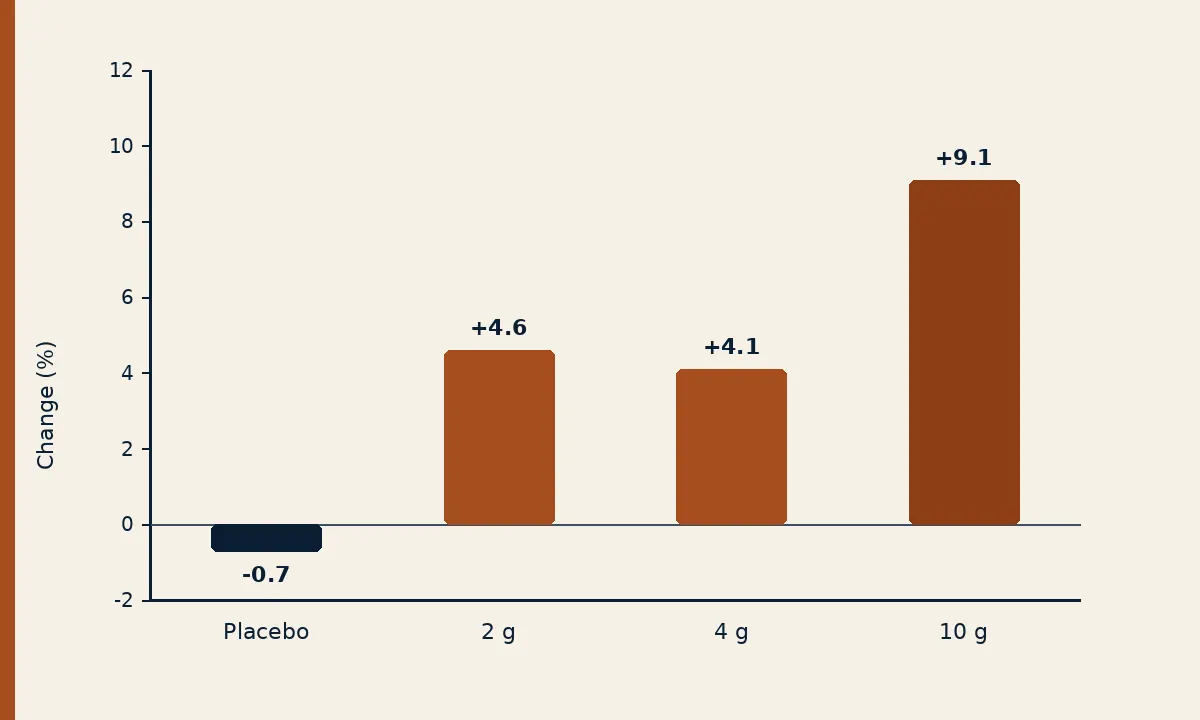
Two and 4 g looked the same. Ten grams doubled it. Lower brain phosphocreatine also tracked with worse depression scores across the group. So if a brain trial uses a muscle dose, don't be shocked by a muscle-sized brain result.
Here's how the main human trials in this post line up by the dose each one tested:
| Trial | Who | Dose tested | Length | What moved |
|---|---|---|---|---|
| Brose 2003 (RCT) | 28 adults over 65, lifting | 5 g a day | 14 weeks | More fat-free mass and strength |
| Sandkühler 2023 (RCT, crossover) | 123 adults | 5 g a day | 6 weeks | Small memory benefit favored |
| Kondo 2016 (RCT) | 34 teen girls with depression | 2, 4 or 10 g a day | 8 weeks | Brain energy up 9.1% at 10 g |
| Chun 2026 (RCT) | 64 adults aged 45 to 65 | 10 g a day | 12 weeks | Lean tissue, strength, memory markers |
| Smith 2025 (single-arm) | 20 people with Alzheimer's | 20 g a day | 8 weeks | Brain creatine up 11%, test scores up |
| Gordji-Nejad 2024 (RCT, crossover) | 15 healthy adults, no sleep | 0.35 g/kg once | One night | Memory and processing speed |
Sources: PMIDs 12560406, 37968687, 26907087, 42578920, 40395689, 38418482.
Did the "creatine debunked" trial use a low dose?
Direct answer
Not Chun and colleagues (2026), the 64-person trial. It tested 10 g a day and came out positive. The lower amount sits in Sandkühler and colleagues (2023): 5 g a day for 6 weeks, which still leaned toward a small memory benefit.
The Texas A&M trial (PMID 42578920) keeps showing up in the "creatine debunked" coverage, so I checked its dose first. It wasn't low. The authors wrote that their dose "is higher than typical low-dose supplementation or maintenance dosages," and that they picked it because higher daily doses may be needed for cognition. That's 10 g a day. It's the trial that found lean tissue gains without exercise.
The low-dose brain trial is a different paper, and it's cited in that same coverage. According to Sandkühler and colleagues (BMC Medicine, 2023), 123 adults got 5 g a day for 6 weeks. Even at that dose, the authors reported that Bayesian evidence "supported a small beneficial effect of creatine," with working memory just missing the usual cutoff (p = 0.064).
Now compare the numbers:
- 5 g a day in the brain trial that gets read as "meh."
- 10 g a day in the dose study where brain energy rose twice as much.
- 20 g a day in the Alzheimer's pilot where brain creatine rose 11 percent.
- 0.35 g per kilogram, once, the dose the sleep-loss trial gave.
Debunked is a headline verb. It is not a row in the results table.
If the headline needed creatine to fail, it had to look past the trial that came out the other way. I did not.
My opinion: low-dose brain studies make for easy "it doesn't work" headlines, and that skews what people believe about creatine. A trial that tested 5 g a day is a different question from a trial that tested 10 g a day. And when a trial does go higher, like the 10 g Texas A&M study, the result looks a lot better.
Where I land on creatine
Direct answer
Creatine is underrated. Brose and colleagues (2003) tested 5 g a day with lifting. Prokopidis and colleagues (2023) found dose did not change the memory result. Kondo and colleagues (2016) recorded a bigger brain energy rise at 10 g a day. I use it myself.
I'm a certified peptide specialist and a coach who reads the trials himself. And "creatine, debunked" is not what the human trials show.
If you want to see where creatine fits with the rest of your stack, start with your blood. My rule is simple: bloodwork before supplements. Know your baseline numbers first, then decide. The same test-first logic runs through my posts on ergothioneine and longevity and vitamin D and cancer mortality. You can also read the full creatine profile for every trial we track.
For a gut-made molecule in the same stack, read what the human urolithin A trials show.
Review
- Across 22 trials in older lifters, creatine meant roughly three extra pounds of lean mass.
- Ten grams daily built lean tissue in sedentary 45 to 65 year olds, no gym required.
- Memory gains were largest in people aged 66 to 76.
- Brain phosphocreatine rose 9.1% at 10 g versus about 4% at lower amounts.
- The trial tied to the "debunked" talk used 10 g and found benefits.
Again: I am not a doctor, and nothing here is a suggestion to use anything. This is for research purposes only. Talk to a licensed clinician before you start, stop, or change anything.
Frequently asked questions
How much creatine did the muscle and strength trials use?
The classic strength trial in older adults, Brose and colleagues (2003), tested exactly 5 g a day during 14 weeks of lifting in people over 65. The 2026 Texas A&M trial, Chun and colleagues, tested 10 g a day and also saw strength gains.
How much creatine did the brain trials use?
Kondo and colleagues (2016) found the largest brain energy rise at 10 g a day. The Alzheimer's pilot, Smith and colleagues (2025), tested 20 g a day. The sleep-loss study, Gordji-Nejad and colleagues (2024), gave 0.35 g per kilogram in one dose.
Does creatine build muscle without exercise?
In the 2026 Chun and colleagues trial, it did. Sedentary adults aged 45 to 65 on 10 g a day gained 0.99 kg of lean tissue by week 6 and 1.1 kg by week 12, with no exercise program, and got stronger on bench and leg press.
Does creatine help memory in older adults?
Yes, in pooled randomized trials. Prokopidis and colleagues (Nutrition Reviews, 2023) found the memory effect was largest in adults aged 66 to 76, with an effect size of 0.88, and dose did not change that result. Xu and colleagues (2024) also found memory gains across 16 trials.
Is creatine good for people over 45?
The trials in that age range are positive. Chilibeck and colleagues (2017) pooled 22 trials in 721 older adults and found 1.37 kg more lean tissue with lifting. Chun and colleagues (2026) found lean tissue and strength gains in adults aged 45 to 65, with or without exercise.
Did a new study debunk creatine?
No. Chun and colleagues (2026), the 64-person trial often mentioned in that coverage, tested 10 g a day and found more lean tissue, more strength and better memory markers. Sandkühler and colleagues (2023) tested 5 g a day for 6 weeks and still leaned toward a small benefit.
Does creatine actually get into the brain?
Brain scans say yes. In the Alzheimer's pilot, Smith and colleagues (2025), brain creatine rose 11 percent after 8 weeks at 20 g a day. In Kondo and colleagues (2016), frontal lobe phosphocreatine rose 9.1 percent at 10 g a day. Our blood test plan builder helps you organize your baseline labs.
From the archive
Test your blood before you buy a supplement, then decide with real numbers. Start with a blood test plan
Read it on the archiveCompound profiles mentioned
Sources
- Study in people2026
Effects of creatine supplementation with and without exercise and diet intervention on body composition, cognitive function, and markers of health in middle-aged and older adults.
64 adults aged 45 to 65, 2 x 5 g/d (10 g/d) for 12 weeks; lean tissue +0.99 kg (6 wk) and +1.1 kg (12 wk) without exercise, +1.69 and +1.27 kg with exercise and diet; body fat -3.24 vs -1.87 points (Ex+CrM vs Ex+PLA); funded by WoodNext Foundation gift, AlzChem supplied product.
Journal of the International Society of Sports Nutrition - Study in people2003
Creatine supplementation enhances isometric strength and body composition improvements following strength exercise training in older adults.
28 adults over 65, 5 g/d plus resistance training for 14 weeks; greater fat-free mass, total mass and isometric strength versus the other group.
Journals of Gerontology Series A - Review of studies2017
Effect of creatine supplementation during resistance training on lean tissue mass and muscular strength in older adults: a meta-analysis.
22 RCTs, 721 adults (mean age 57 to 70); lean tissue +1.37 kg; chest press SMD 0.35; leg press SMD 0.24.
Open Access Journal of Sports Medicine - Review of studies2023
Effects of creatine supplementation on memory in healthy individuals: a systematic review and meta-analysis of randomized controlled trials.
memory SMD 0.29 overall; 0.88 in adults aged 66 to 76; doses about 2.2 to 20 g/d.
Nutrition Reviews - Review of studies2024
The effects of creatine supplementation on cognitive function in adults: a systematic review and meta-analysis.
16 RCTs, 492 adults; memory SMD 0.31 (moderate certainty), attention time and processing speed improved.
Frontiers in Nutrition - Study in people2024
Single dose creatine improves cognitive performance and induces changes in cerebral high energy phosphates during sleep deprivation.
15 healthy adults, single 0.35 g/kg dose during 21 h sleep deprivation; improved word memory and processing speed; brain PCr/Pi and pH changes.
Scientific Reports - Study in people2025
Creatine monohydrate pilot in Alzheimer's: Feasibility, brain creatine, and cognition.
20 patients, 20 g/d for 8 weeks; brain total creatine +11%; global and fluid cognition composites improved. NCT05383833.
Alzheimer's and Dementia (New York) - Study in people2016
Creatine target engagement with brain bioenergetics: a dose-ranging phosphorus-31 magnetic resonance spectroscopy study of adolescent females with SSRI-resistant depression.
34 enrolled, 28 with complete scans; frontal PCr +4.6%, +4.1%, +9.1% at 2, 4, 10 g/d vs -0.7% the other group over 8 weeks.
Amino Acids - Study in people2023
The effects of creatine supplementation on cognitive performance-a randomised controlled study.
123 adults, 5 g/d for 6 weeks; Bayesian evidence supported a small beneficial effect; backward digit span p = 0.064.
BMC Medicine
Read next
Research /
Tirzepatide Muscle Loss: A New Trial Shows Lifting Keeps Strength Up
Tirzepatide muscle loss is a real concern. A new 40-week randomized trial in 120 adults found supervised lifting kept more lean mass and raised strength, while weight loss stayed the same.

Supplements /
Ergothioneine and Longevity: The Molecule AI Found in 5 Anti-Aging Treatments
Ergothioneine, a compound you get mostly from mushrooms, was the one molecule that all five proven mouse longevity treatments raised in a new AI study. Here is what that means for you, and what the human data says.

Supplements /
Vitamin D and Cancer Death: Why the Big Trials Missed It
Vitamin D did nothing for cancer death in the two biggest trials because most volunteers already had enough. A new 2026 reanalysis found the benefit sits in people who start low.
Educational use only. This database summarizes published research and is not medical advice. Where a dose appears it is a record of what a trial or clinic ran, or what people describe doing, with its source attached. Nothing here is a recommendation for personal use. Sellers named on the price pages are ranked by certificate tier, then price. No seller pays this site anything today. Naming a seller is not a recommendation to buy or use anything.