Research / Published / Reviewed / 13 min read
Tirzepatide Muscle Loss: A New Trial Shows Lifting Keeps Strength Up
Written by Aaron CuhaReviewed Nov 10, 2026
Tirzepatide muscle loss is a real concern. A new 40-week randomized trial in 120 adults found supervised lifting kept more lean mass and raised strength, while weight loss stayed the same.
In this article
- What did the new tirzepatide muscle loss trial find?
- Why the strength result may matter more
- Who was in the trial and what did they do?
- How big is tirzepatide muscle loss without exercise?
- Is lifting better than muscle-sparing drugs?
- What does this trial not show?
- Questions to bring to your clinician about muscle on tirzepatide
- What comes next for GLP-1 drugs and muscle research?
- Frequently asked questions
- Sources
If you are on tirzepatide, or thinking about it, you have probably heard the worry: you lose weight, but some of it is muscle. A new randomized trial gives the clearest answer yet on what lifting weights does about that, and the most useful news is about strength, not just muscle. The GLP-1 field guide puts this trial next to the rest of the class. The nearest reads are the retatrutide phase 3 results and the oral GLP-1 pills.
From the archive
See our plain-English guide to training while on a GLP-1 medicine.
Read it on the archiveWhat did the new tirzepatide muscle loss trial find?
Direct answer
Adults on tirzepatide who did supervised resistance training three times a week for 40 weeks lost about the same weight and fat, but kept about 1.1 kg more lean mass and got stronger. The tirzepatide-only group got weaker.
The trial is called T-REx. It was published in Nature Medicine on November 9, 2026 by a team at the University of Western Australia. It is the first randomized trial to test resistance exercise alongside tirzepatide from the start of weight loss, according to the authors.
According to the T-REx paper, both groups lost about 22 kg (roughly 49 pounds) of body weight over 40 weeks. Fat loss was nearly the same, about 17 to 18 kg in each group.
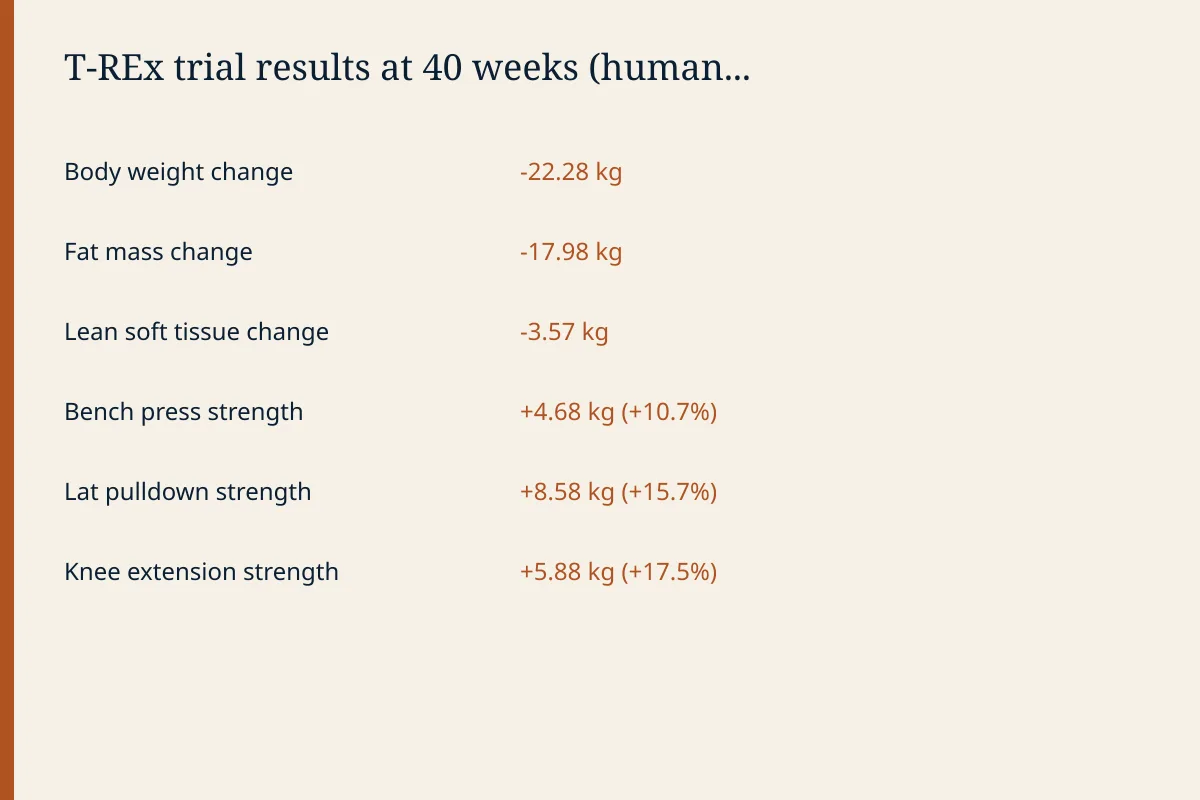
The difference showed up in lean mass, which includes muscle, and this is where tirzepatide muscle loss was measured. The tirzepatide-only group lost 4.67 kg of lean soft tissue. The group that also lifted lost 3.57 kg. That gap of 1.09 kg (about 2.4 pounds) was the main result.
| Measure | Tirzepatide only | Tirzepatide plus lifting |
|---|---|---|
| Body weight change | -22.61 kg | -22.28 kg |
| Fat mass change | -17.19 kg | -17.98 kg |
| Lean soft tissue change | -4.67 kg | -3.57 kg |
| Bench press strength | -4.09 kg (-8.4%) | +4.68 kg (+10.7%) |
| Lat pulldown strength | -4.42 kg (-6.5%) | +8.58 kg (+15.7%) |
| Knee extension strength | -4.42 kg (-9.0%) | +5.88 kg (+17.5%) |
Source: Green and colleagues, Nature Medicine, 2026. Numbers are group averages reported in the paper.
Why the strength result may matter more
Direct answer
Strength is the part you feel in daily life: climbing stairs, carrying bags, getting up from a chair. In T-REx, strength fell on tirzepatide alone and rose with lifting. Large studies in older adults link strength, more than muscle size, to survival.
By our arithmetic from the paper's numbers, about 21% of the weight the tirzepatide-only group lost was lean tissue. In the lifting group, it was about 16%. That is a real gain, but it is not dramatic.
The strength numbers tell a bigger story. Every strength test went down in the group that did not train, by 6.5% to 9%. Every test went up in the group that did, by 10.7% to 17.5%. The net gap between the groups was about 19% to 23%, according to the paper.
Why care about strength? According to the Health ABC study in the Journal of Gerontology, 2,292 adults aged 70 to 79 were followed for about 4.9 years, and leg strength was strongly linked to death risk while muscle size was not. That study is observational: it shows an association, not cause.
So the honest takeaway is this. Lifting did not stop all lean mass loss on tirzepatide, but it turned a strength loss into a strength gain, and that is the part most closely tied to how well people age.
Who was in the trial and what did they do?
Direct answer
The trial enrolled 120 adults aged 50 to 70 with overweight or obesity, half women, mostly sedentary, with no diabetes or heart disease. Everyone got tirzepatide. Half were randomly assigned to supervised gym sessions three times a week.
Here is the design in plain terms, as the paper describes it:
- Who: men and postmenopausal women aged 50 to 70, average age 57.7, with a BMI of 30 or more, or 27 or more with a weight-related condition.
- Drug: weekly tirzepatide injections given at the clinic, raised in steps. Most people finished on the highest dose the trial allowed.
- Exercise group: three 1-hour supervised group sessions a week in a gym, run by accredited exercise physiologists, getting harder in five 8-week blocks.
- Comparison group: usual activities, with a weekly clinic visit for the injection.
- Measures: body composition by DXA scan every 8 weeks, and strength by one-repetition maximum tests.
- Diet: everyone was told to keep up protein intake, but there was no set diet plan.
People stuck with it. Attendance at the exercise sessions averaged 91%, and 93% of people finished the trial, according to the paper. That is unusually high, and the sessions were supervised and free, which most people at home will not have.
Side effects were the familiar ones. About half of participants reported nausea, and about a third reported vomiting, constipation, diarrhea or indigestion, at similar rates in both groups.
From the archive
Get the weekly evidence update, with new trials explained in plain English.
Read it on the archiveHow big is tirzepatide muscle loss without exercise?
Direct answer
Studies using DXA scans show lean mass falls by roughly 11% to 14% on incretin drugs for obesity. Some of that is expected with any large weight loss. The open question is how much is muscle and whether it hurts function.
The T-REx authors summarize earlier trials this way: incretin drugs cut body weight by 15% to 24% and body fat by 25% to 34%, with 11% to 14% losses in lean soft tissue. That comes from the T-REx paper's own review of prior trials.
For scale, according to the SURMOUNT-1 trial in the New England Journal of Medicine, 2,539 adults with obesity lost 15.0% to 20.9% of body weight over 72 weeks on tirzepatide, versus 3.1% in the other group. Eli Lilly, which makes tirzepatide, funded that trial.
MRI data add detail. In a post-hoc analysis of SURPASS-3 in The Lancet Diabetes and Endocrinology, people with type 2 diabetes on tirzepatide lost thigh muscle volume over 52 weeks, but less fat sat inside the muscle. The authors found the muscle loss was about what you would expect for that much weight loss. That analysis was also Lilly-sponsored.
Tirzepatide muscle loss is usually reported as lean mass, and lean mass on a DXA scan is not the same as muscle. It also counts water, organs and other non-fat tissue. That is one reason strength tests are such a useful second measure.
Is lifting better than muscle-sparing drugs?
Direct answer
Nobody has tested them head to head. Experimental antibodies such as apitegromab and bimagrumab are being studied to protect muscle during GLP-1 weight loss. They are not approved for this use. Lifting is cheap, available now, and also improves strength.
In a phase 2 trial called EMBRAZE, published in Nature Medicine, 102 adults on tirzepatide got either the antibody apitegromab or a comparison product. At 24 weeks, the apitegromab group lost 1.9 kg less lean mass. The trial was run and paid for by Scholar Rock, which is developing apitegromab.
In the BELIEVE phase 2 trial, also in Nature Medicine, 507 adults got bimagrumab, semaglutide, both, or the comparison for 48 weeks. Common side effects of bimagrumab included muscle spasms, diarrhea and acne. Eli Lilly, which now develops bimagrumab, supported the trial.
| Approach | Example trial | Who paid | Status |
|---|---|---|---|
| Supervised resistance training | T-REx, 120 adults, 40 weeks | University and state research funds; Lilly gave the drug | Available now |
| Myostatin-blocking antibody | EMBRAZE (apitegromab), 102 adults, 24 weeks | Scholar Rock (developer) | Investigational, not approved |
| Activin receptor antibody | BELIEVE (bimagrumab), 507 adults, 48 weeks | Eli Lilly (developer) | Investigational, not approved |
For tirzepatide muscle loss in particular, only T-REx and EMBRAZE used tirzepatide. These trials used different people, lengths and measures, so the numbers cannot be lined up fairly. Our apitegromab profile and bimagrumab profile track both drugs and their trials.
What does this trial not show?
Direct answer
It does not show that lifting prevents falls, fractures or early death on tirzepatide. It did not test people with diabetes or heart disease, and it did not compare against the other group. The authors say routine-care feasibility still needs testing.
- No the other group arm. Everyone got tirzepatide, so the trial compares lifting versus no lifting, not drug versus no drug.
- People knew which group they were in, and the testers sometimes also ran training sessions. The authors say they used standard procedures to limit bias.
- A narrow group. Adults 50 to 70, mostly sedentary, without diabetes, heart disease, or blood pressure or cholesterol drugs.
- Short term. Forty weeks says nothing about what happens to muscle or weight after people stop the drug.
- Gym access. Sessions were supervised in a dedicated gym. Results at home may differ.
Funding is worth knowing too. Eli Lilly supplied the tirzepatide, reviewed the protocol and saw a draft for safety and intellectual property, but made no changes, according to the paper. Some authors report speaker fees from Lilly.
Questions to bring to your clinician about muscle on tirzepatide
Direct answer
If you use or plan to use tirzepatide, ask how your clinic tracks muscle and strength, not just weight. A short list of questions can turn this trial into a useful conversation about your own plan.
- 01Can we check my body composition or strength at the start, so we have a baseline?
- 02Is a supervised resistance program, like the one in the T-REx trial, safe for me given my health history?
- 03How much protein is right for me while my appetite is lower?
- 04Which blood tests should we repeat while I am losing weight?
- 05What is the plan for keeping muscle and strength if I stop the medicine?
Our GLP-1 muscle guide covers protein and food choices, and our aging muscle page explains why strength matters more after 50.
What comes next for GLP-1 drugs and muscle research?
Direct answer
More trials are starting. A German study will test resistance training on tirzepatide for brain and behavior outcomes, and another will test exercise plus protein in people with type 2 diabetes on semaglutide or tirzepatide.
Two new registry records appeared on ClinicalTrials.gov this week:
- NCT07929571, sponsored by the Technical University of Munich, is an add-on study to a trial called RESIST. It plans 150 adults on tirzepatide, randomized to resistance training or usual care for 24 weeks, and will look at attention, food craving, sleep and fatigue. It is not yet recruiting.
- NCT07926152, sponsored by the German Diabetes Center, plans 94 adults with type 2 diabetes on semaglutide or tirzepatide. It will test supervised exercise plus a daily protein supplement against usual care, measuring thigh muscle volume over 24 weeks. It is not yet recruiting.
Older work points the same way. According to a 2021 trial in the New England Journal of Medicine, after a diet that cut 13.1 kg, combining exercise with the GLP-1 drug liraglutide roughly doubled the drop in body-fat percentage compared with either one alone. That trial was funded by the Novo Nordisk Foundation and others.
For anyone worried about tirzepatide muscle loss, the pattern across these studies is steady: the drug drives the weight loss, and training shapes what that weight loss is made of.
Key takeaways
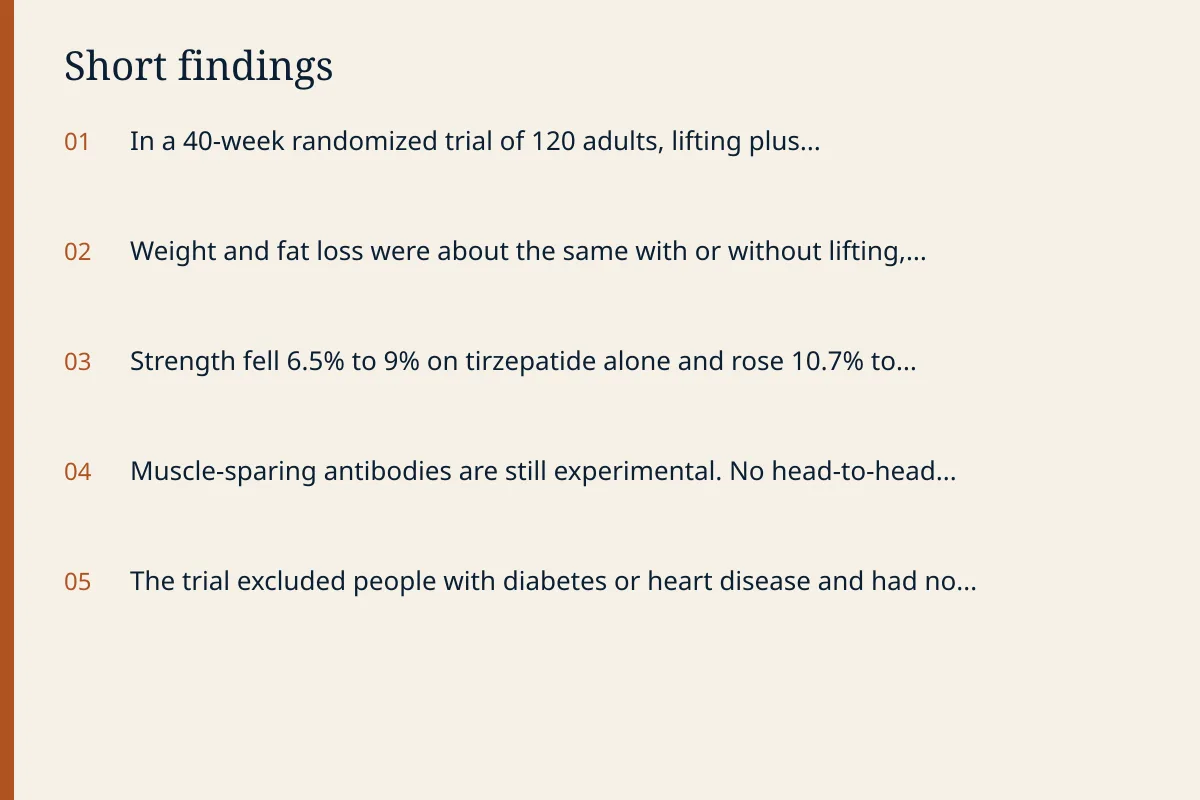
- 01In a 40-week randomized trial of 120 adults, lifting plus tirzepatide kept 1.09 kg more lean mass.
- 02Weight and fat loss were about the same with or without lifting, roughly 22 kg each.
- 03Strength fell 6.5% to 9% on tirzepatide alone and rose 10.7% to 17.5% with supervised lifting.
- 04Muscle-sparing antibodies are still experimental. No head-to-head trial against exercise exists.
- 05The trial excluded people with diabetes or heart disease and had no the other group arm.
Frequently asked questions
Does tirzepatide cause muscle loss?
Some lean mass loss is part of large weight loss on tirzepatide. In the T-REx trial, people on tirzepatide alone lost 4.67 kg of lean soft tissue over 40 weeks, about 21% of the weight they lost. Lean mass on a DXA scan includes muscle plus water and organs.
Can strength training prevent muscle loss on tirzepatide?
It reduced it but did not stop it. In T-REx, the lifting group lost 3.57 kg of lean tissue versus 4.67 kg without lifting. The bigger change was strength, which rose with lifting and fell without it.
How often did people lift in the tirzepatide exercise trial?
Participants in the exercise group attended three supervised 1-hour group sessions a week for 40 weeks. The program got harder in five 8-week blocks and was run by accredited exercise physiologists. Attendance averaged 91%.
Did lifting change how much weight people lost on tirzepatide?
No. Both groups lost about 22 kg of body weight and about 17 to 18 kg of fat. Lifting changed what the weight loss was made of, not how much was lost.
Who paid for the T-REx trial?
The paper lists Australian state and university research support. Eli Lilly supplied tirzepatide through an investigator-initiated program and reviewed a draft for safety and intellectual property, with no changes made.
Are there drugs that protect muscle on GLP-1 medicines?
Some are in trials, such as apitegromab and bimagrumab, but none is approved for this use. In the company-funded EMBRAZE phase 2 trial, apitegromab cut lean mass loss by 1.9 kg at 24 weeks.
Does the trial apply to people with type 2 diabetes?
Not directly. T-REx excluded people with diabetes and heart disease. A new German trial, NCT07926152, plans to test exercise plus protein in people with type 2 diabetes on semaglutide or tirzepatide.
From the archive
Read the full tirzepatide profile, with every trial we track.
Read it on the archiveCompound profiles mentioned
- TirzepatideStrong. At least two finished studies in people, and at least 1,000 people who took it. 9 completed trials, 22,802 people given it.Metabolic
- SemaglutideStrong. At least two finished studies in people, and at least 1,000 people who took it. 12 completed trials, 42,363 people given it.Metabolic
- ApitegromabPreliminary. Studied in people, but no published study has had people take it. 2 human studies where nobody was given it.Muscle & Performance
- BimagrumabModerate. At least one finished study in people, and at least 100 people who took it. 2 completed trials, 507 people given it.Metabolic
Sources
- Study in people2026
Resistance exercise to attenuate lean mass loss during tirzepatide therapy for obesity: a randomized controlled trial
120 adults, 40 weeks: lifting kept 1.09 kg more lean mass and raised strength; weight and fat loss similar.
Nature Medicine - Study in people2022
Tirzepatide Once Weekly for the Treatment of Obesity (SURMOUNT-1)
2,539 adults: 15.0% to 20.9% weight loss at 72 weeks versus 3.1% with the comparison. Lilly funded.
New England Journal of Medicine - Study in people2025
Tirzepatide and muscle composition changes in people with type 2 diabetes (SURPASS-3 MRI): a post-hoc analysis
Thigh muscle volume fell with weight loss, in line with expected changes; muscle fat infiltration fell.
The Lancet Diabetes and Endocrinology - Study in people2026
Apitegromab for lean mass preservation during tirzepatide-induced weight loss: a randomized randomized phase 2 trial
102 adults: 1.9 kg less lean mass loss at 24 weeks versus the other group. Sponsor Scholar Rock.
Nature Medicine - Study in people2026
Bimagrumab plus semaglutide alone or in combination for the treatment of obesity: a randomized phase 2 trial
507 adults, 48 weeks: combination produced the largest weight loss; muscle spasms, diarrhea and acne common with bimagrumab.
Nature Medicine - Study in people2021
Healthy Weight Loss Maintenance with Exercise, Liraglutide, or Both Combined
Exercise plus liraglutide cut body-fat percentage about twice as much as either alone.
New England Journal of Medicine - Study in people2006
Strength, but not muscle mass, is associated with mortality in the health, aging and body composition study cohort
Observational, 2,292 adults aged 70 to 79: strength, not muscle size, tracked with mortality.
Journal of Gerontology: Medical Sciences - Study in people2026
Functional, Cognitive, and Behavioral Correlates of Resistance Training During Tirzepatide-Induced Weight Loss (RESIST-MIND)
Planned 150 adults, 24 weeks, resistance training versus usual care on tirzepatide. Not yet recruiting.
ClinicalTrials.gov - Study in people2026
Exercise and Protein to Reduce Muscle Loss During GLP-1-Based Treatment in Type 2 Diabetes
Planned 94 adults with type 2 diabetes, 24 weeks, exercise plus protein versus usual care.
ClinicalTrials.gov
Read next
Research /
Retatrutide Trial Results Are Now in the Journals
Retatrutide phase 3 results are now in peer-reviewed journals. Three Lilly-funded human trials report weight loss, blood sugar, knee pain, and side effects. The drug is still investigational and is not FDA approved.
Metabolic /
Oral GLP-1s in 2026: Wegovy Pill vs Foundayo (Orforglipron) vs Rybelsus, and What Is Coming
The three approved GLP-1 pills, why one needs an empty stomach and another doesn't, how much weight people lost in the studies behind each approval, the warning box they all carry, and what's coming: aleniglipron, elecoglipron, HRS-7535, and the pill Pfizer walked away from. Plain English.
Research /
Walking Speed and Longevity: AI Found Your Walk Says Far More
Walking speed longevity is already a known pattern: faster walking tracks longer life in older adults. A new AI model found the whole way you move carries health signals that simple gait scores missed.
Educational use only. This database summarizes published research and is not medical advice. Where a dose appears it is a record of what a trial or clinic ran, or what people describe doing, with its source attached. Nothing here is a recommendation for personal use. Sellers named on the price pages are ranked by certificate tier, then price. No seller pays this site anything today. Naming a seller is not a recommendation to buy or use anything.