Research / Published / Reviewed / 13 min read
Walking Speed and Longevity: AI Found Your Walk Says Far More
Written by Aaron CuhaReviewed Nov 13, 2026
Walking speed longevity is already a known pattern: faster walking tracks longer life in older adults. A new AI model found the whole way you move carries health signals that simple gait scores missed.
In this article
- What does walking speed longevity research already show?
- What did the 2011 survival count find?
- What did the 2018 review add about death and heart disease?
- What did the new camera study record?
- Did whole body motion beat simple gait scores?
- How many health measures did the walk match?
- Which part of the walk carried which signal?
- What this study does not show about your lifespan
- Who built the camera, and who consults?
- How does a slow walk relate to falls?
- Frequently asked questions
- Sources
From the archive
See what a blood panel records. A walk model is a different kind of measure.
Read it on the archiveWhat does walking speed longevity research already show?
Direct answer
Faster walking has lined up with longer survival in large groups of older adults. Those studies watch people. They do not assign a walking plan. A 2026 paper asks what else a full walk can match.
You already have the basic idea. In older adults, a faster usual walk has lined up with longer life. That older link is what people mean by walking speed longevity. Those studies watched people. They did not assign a new walk. The wider longevity research pages keep human studies like this separate from mouse lifespan work. The fitness number is the sibling piece on VO2 max and longevity.
- Survival numbers from two human reviews of older adults.
- What the 2026 camera model matched, and what it beat.
- What the model does not show: cause, treatment, or added years.
- Who works for the camera company, and who consults for Pheno.AI.
What did the 2011 survival count find?
Direct answer
In a pool of 34,485 older adults, faster gait lined up with fewer deaths. Each 0.1 meters per second faster carried a hazard ratio of 0.88. That is an association in people who were watched, not a plan that was assigned.
Studenski and colleagues pooled nine cohorts in JAMA in 2011. The adults were 65 or older and lived in the community. Follow up ran from 6 to 21 years. Walks were recorded from 1986 to 2000.
According to Studenski and colleagues in JAMA, 0.88 was the pooled hazard ratio for death per 0.1 meters per second of faster gait.
The 95 percent confidence interval was 0.87 to 0.90. The authors report a P value less than 0.001. There were 17,528 deaths. Survival for the whole pool was 84.8 percent at 5 years and 59.7 percent at 10 years. Those rates mix every speed.
The average age was 73.5 years. Women were 59.6 percent of the pool. The group was 79.8 percent white. The average gait speed was 0.92 meters per second.
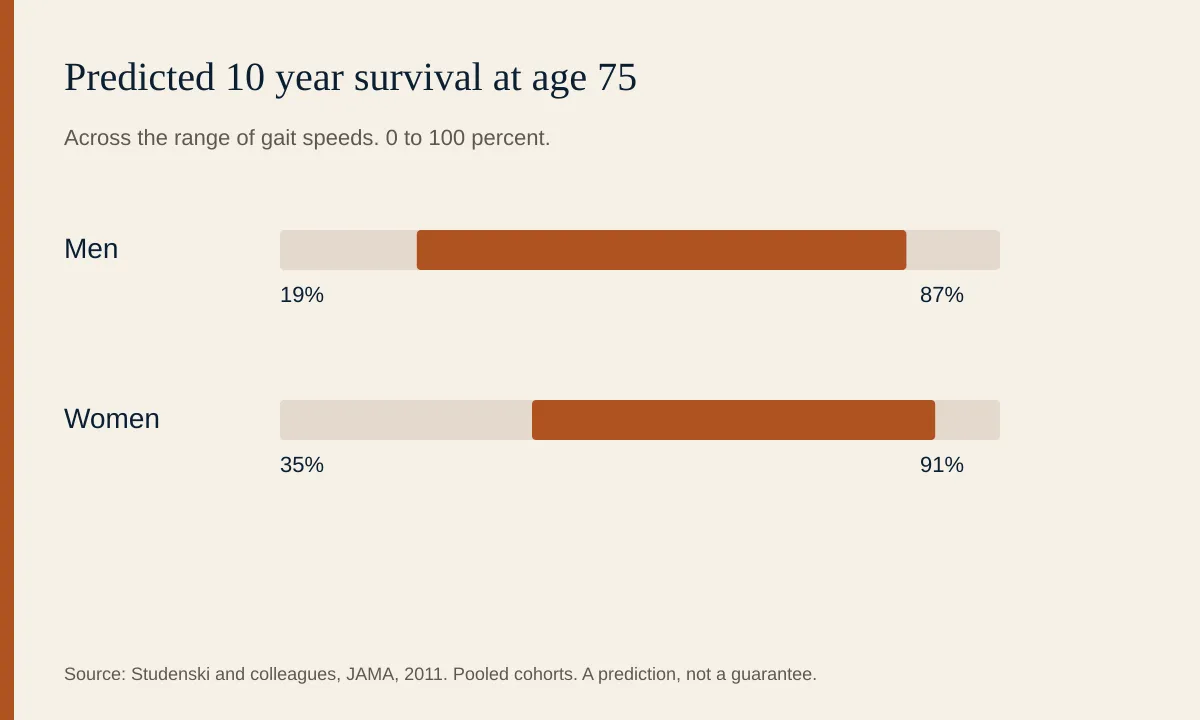
At age 75, predicted 10 year survival ran from 19 percent to 87 percent in men and from 35 percent to 91 percent in women. Age, sex, and gait speed predicted about as well as a longer illness list.
The paper does not show that a faster walk caused the extra years. The walking speed longevity papers counted a stopwatch speed.
What did the 2018 review add about death and heart disease?
Direct answer
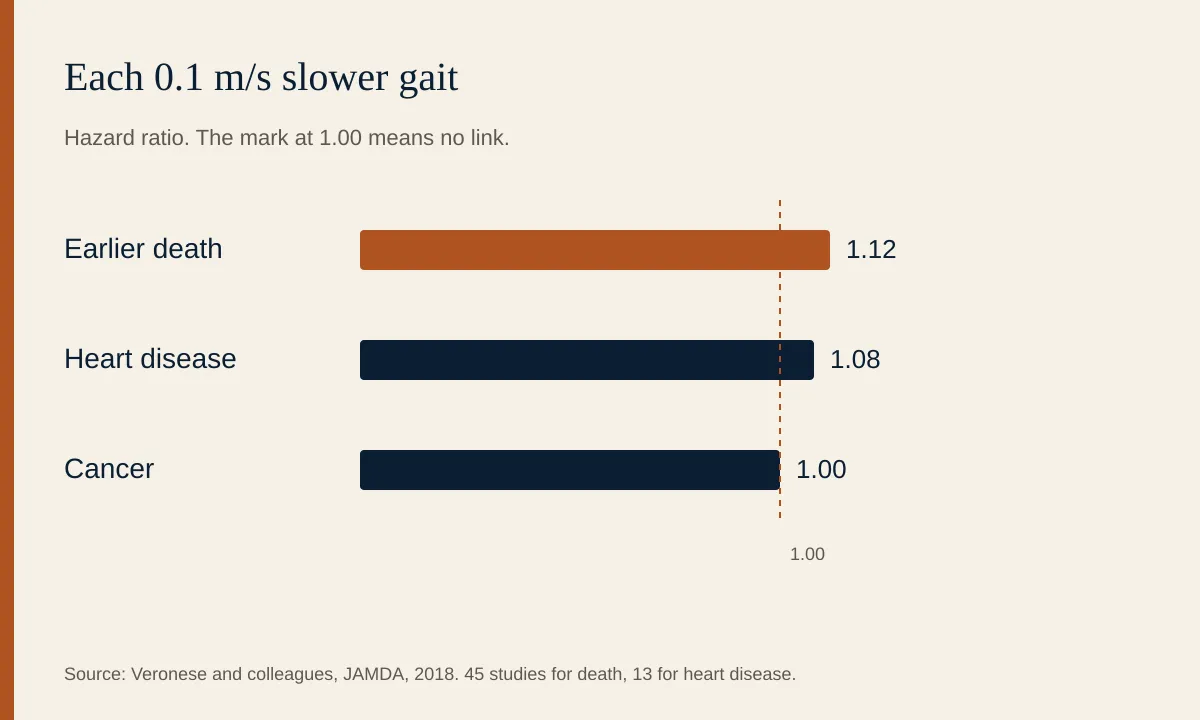
A review of prospective cohorts tied a slower walk to earlier death and to heart disease. Each 0.1 meters per second slower lined up with a death hazard ratio of 1.12. Cancer did not show a link. The studies on death did not agree tightly.
According to Veronese and colleagues, 1.12 was the hazard ratio for earlier death per 0.1 meters per second of slower gait.
That 1.12 is from 45 studies. The interval was 1.09 to 1.14. I squared was 90 percent, so the studies did not agree tightly. The authors adjusted for publication bias and for a median of 9 other factors.
Heart disease moved less. Thirteen studies gave a hazard ratio of 1.08, with an interval of 1.03 to 1.13. Cancer did not move. The hazard ratio was 1.00, with an interval of 0.97 to 1.04.
The review covered 44 articles, 48 cohorts, and 101,945 people. Mean age was 72.2 years. Women were 55 percent. Median follow up was 5.4 years. Studenski's hazard was for a faster walk. This one is for a slower walk. They are not the same people.
What did the new camera study record?
Direct answer
One depth camera filmed 3,328 adults during five motor tasks. A model turned the whole motion into learned scores. The adults were already deeply measured on health. This is a prediction study in people. It is not a treatment trial.
On 6 November 2026, Nature Medicine published the gait paper by Gabet and colleagues. Eran Segal is the senior author. The author addresses are at the Weizmann Institute of Science in Rehovot, Israel.
One depth camera, five motor tasks, and 3,328 adults. The abstract says they were deeply measured. It does not name the five tasks. This page does not guess them.
The reference list includes the Human Phenotype Project paper from the same group. The gait abstract does not repeat that project name.
According to Reicher and colleagues in Nature Medicine, about 28,000 people had enrolled in the Human Phenotype Project, and more than 13,000 had completed a first visit.
A usual gait score uses a few calculated numbers, such as cadence and stride length. The new model stores how the joints move together. The paper calls those numbers learned embeddings.
Did whole body motion beat simple gait scores?
Direct answer
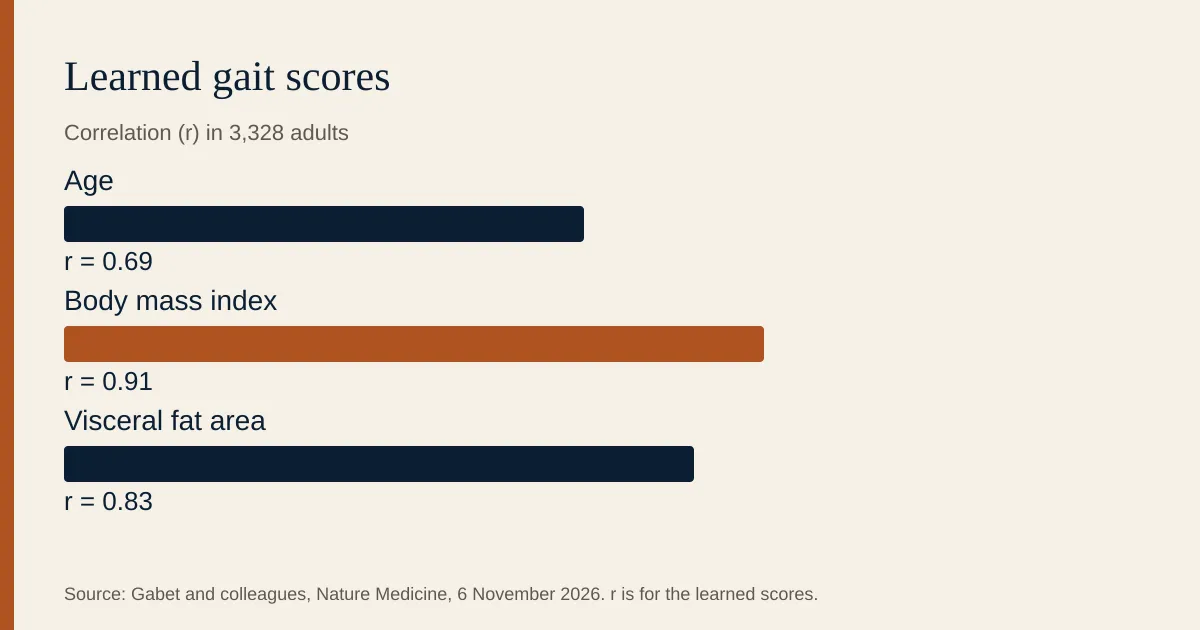
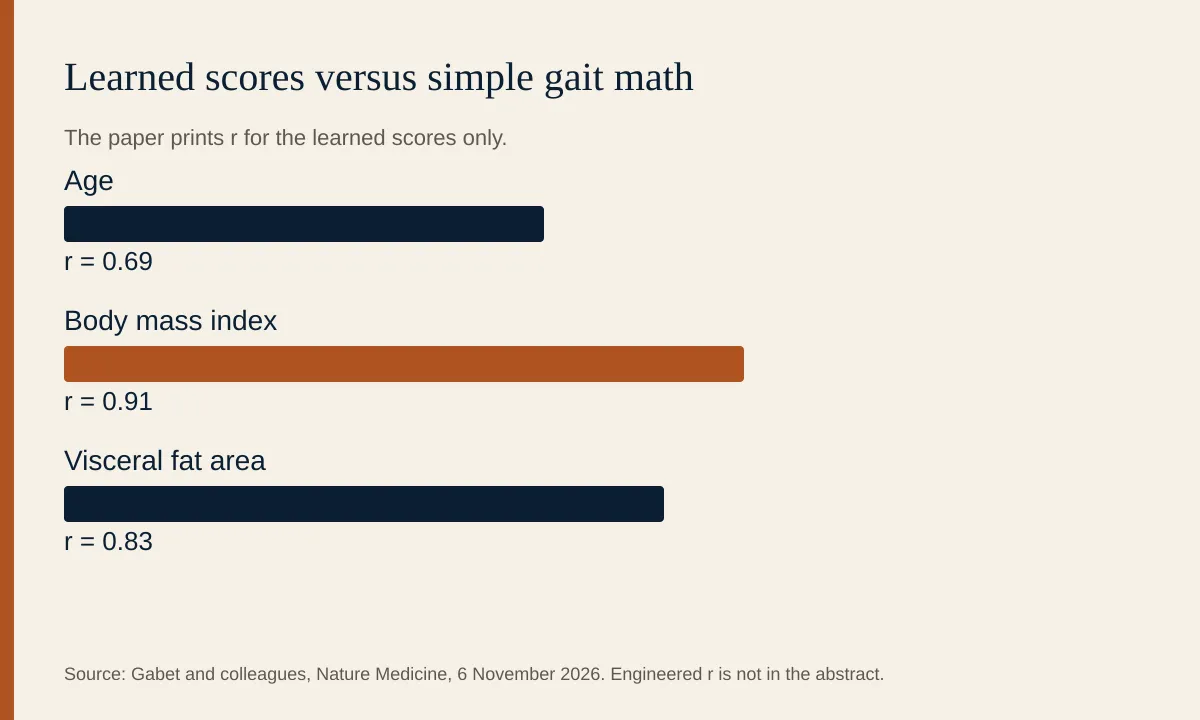
Yes, for three measures the paper reports. The learned scores beat engineered gait features, such as cadence and stride length, for age, body mass index, and visceral fat area. The paper prints those correlations. It does not print a lifespan result.
According to Gabet and colleagues in Nature Medicine, 0.91 was the correlation, called r, between the learned scores and body mass index.
The same abstract gives r = 0.69 for age and r = 0.83 for visceral adipose tissue area, the deep belly fat area on a scan. Learned scores beat engineered features on all three. Cadence and stride length are the examples. The abstract does not print the engineered r.
| Measure | r from learned scores | What the paper compared |
|---|---|---|
| Age | 0.69 | Beat engineered features. Their r is not printed |
| Body mass index | 0.91 | Same comparison |
| Visceral fat area | 0.83 | Paper term: visceral adipose tissue area |
From the archive
Get the weekly evidence update. It is a reading list, not a plan.
Read it on the archiveHow many health measures did the walk match?
Direct answer
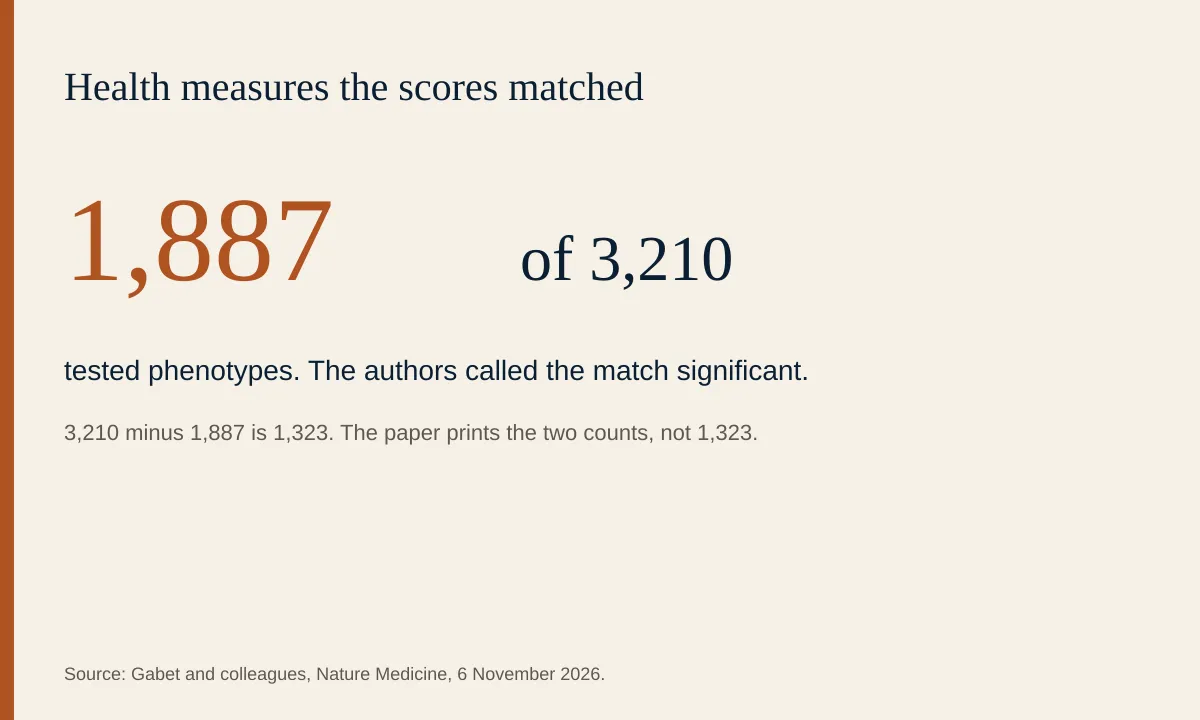
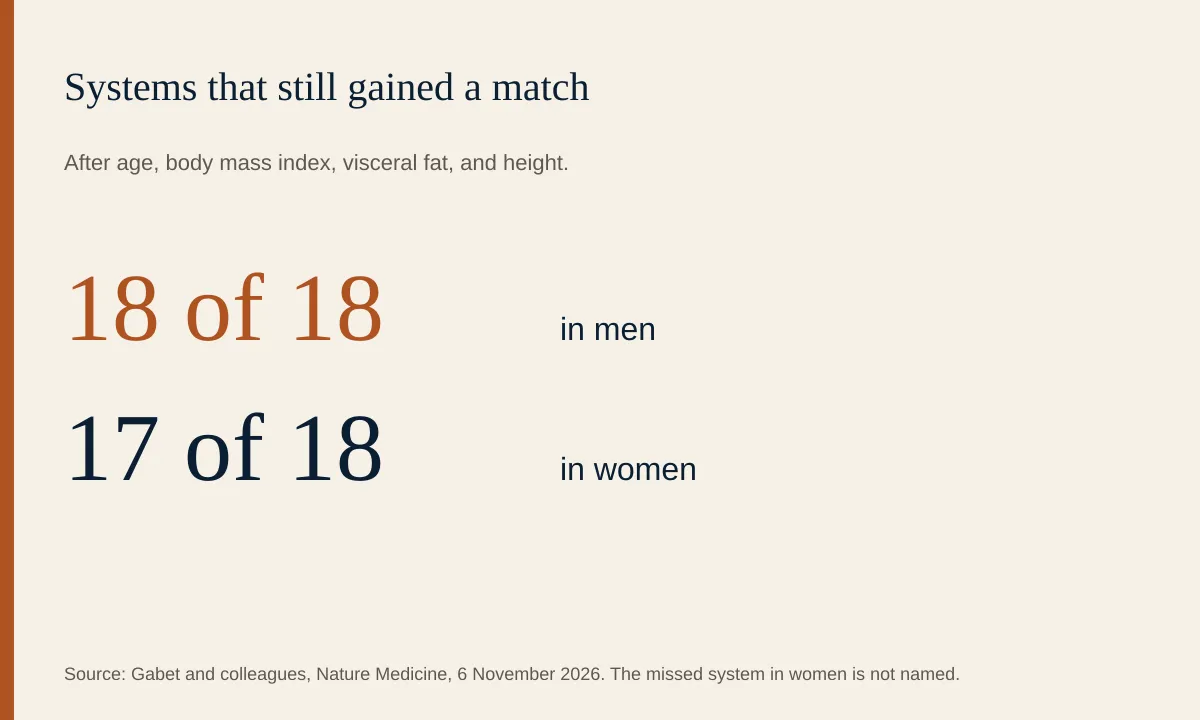
The learned scores matched 1,887 of 3,210 tested measures. Past age, body mass, visceral fat, and height, they improved prediction in all 18 body systems in men and in 17 of 18 in women. The abstract does not name the system that did not improve in women.
The model was not only a body size tool. The abstract says the embeddings predicted 1,887 of 3,210 tested phenotypes. A phenotype here is a measured trait. Grip strength and sleep quality are the examples the authors name.
The paper calls 1,887 of those predictions significant. It does not list the names. 3,210 minus 1,887 is 1,323. The paper does not print 1,323.
The same step also improved the match to recorded diagnoses and to medicine use. The abstract does not report a later diagnosis or a death count.
Which part of the walk carried which signal?
Direct answer
Leg motion carried most of the signal for metabolic health and frailty. Torso motion carried sleep and lifestyle measures. Grip strength and sleep quality are examples the authors name. This is a split inside one model. It is not a cause.
They tested this by turning body regions off inside the model. The paper calls that an anatomical ablation. Leg dynamics dominated the metabolic and frailty predictions. Torso dynamics encoded sleep and lifestyle. Grip has no separate r in the abstract. Sleep quality is the example tied to the torso. This body split is not the walking speed longevity finding, which counted survival rather than joint motion.
The authors say the result supports gait checks in routine care, with no blood draw. That is their hope. The abstract does not show a cleared test. The paper does not treat the body split as a cause.
What this study does not show about your lifespan
Direct answer
It does not show that changing your walk changes your health or your lifespan. It is not a treatment. It is not a cleared clinical test. The sample is one group of 3,328 adults. The abstract does not report a second group outside this one.
| The study shows | The study does not show |
|---|---|
| A walk matched many measures in 3,328 adults | That changing a walk changes health or lifespan |
| Learned scores beat simple gait features for age, body mass, and visceral fat | The engineered r, which is not in the abstract |
| A gain in 18 systems in men and 17 of 18 in women | The system missed in women, which is unnamed |
The new model is not a walking speed longevity trial. It did not follow people to death. A headline that blends the 2011 survival result with this 2026 model has mixed two studies.
Mouse lifespan tests are a different record. The 2026 mouse retest is in mice. The compounds in that retest did not lengthen life in those mice.
Other human pages stay separate. Read the method page, the training pages, training on a GLP-1, the tirzepatide strength trial, and the 2026 longevity peptide post. The gait paper tried to predict grip. It did not study those drugs.
Who built the camera, and who consults?
Direct answer
Three authors work at Newton VR Ltd, the company that made the Movement Lab camera system. One of them is also at BioPilot AI. Two senior authors are paid consultants for Pheno.AI. The paper states this. Read the results with that in view.
The gait paper prints a competing interests note. Assaf Rotem, Ohad Doron, and Yuval Brodsky are employees of Newton VR Ltd. The note says that company developed the Movement Lab system used to capture the gait. Assaf Rotem is also affiliated with BioPilot AI, in Newton, Massachusetts.
Adina Weinberger and Eran Segal are paid consultants of Pheno.AI. The note's initials A.W. and E.S. match those two names.
- Assaf Rotem, Ohad Doron, and Yuval Brodsky work for Newton VR Ltd.
- Assaf Rotem is also with BioPilot AI.
- Adina Weinberger and Eran Segal are paid consultants of Pheno.AI.
- The PubMed record for the gait paper does not list a grant agency.
The cohort paper says some authors are Pheno.AI employees, and that A.W. and E.S. are paid consultants. Weinberger and Segal are on that list too. A real result can still come from a team tied to the camera and the cohort company.
How does a slow walk relate to falls?
Direct answer
A 2024 review, not a new trial, says falls are common and that gait and balance problems are a risk that can change. It reports a guideline speed. It does not test the 2026 gait model. It is not a walking plan from this site.
The review is by Colón-Emeric and colleagues in JAMA in 2024. It covers falls in older adults who live in the community. Label it as a review. It does not test learned embeddings. It does not use the Weizmann camera.
More than 14 million US adults age 65 or older report a fall each year (Colón-Emeric and colleagues, JAMA). More than 25 percent of older adults fall each year. Falls are the leading cause of injury related death from age 65.
The review says guidelines use a gait speed under 0.8 to 1 meter per second, a fall in the past year, or worry about falling. This site does not set a walking speed.
- 01Keep survival numbers with the 2011 pool and the 2018 review.
- 02Keep the camera matches with the 2026 paper.
- 03Keep cause and treatment out until a study of them exists.
Keep walking speed longevity as the name for the survival studies. Use the 2026 paper for a different claim: in this one group, the whole walk matched many health measures better than simple gait features. The paper does not show that changing the walk changes those measures.
Key takeaways
- 01Faster gait has lined up with longer survival in large groups of older adults.
- 02A 2026 model read the whole walk, not only cadence or stride length.
- 03In 3,328 adults it beat simple gait scores for age, body mass, and visceral fat.
- 04It predicted many health measures. It did not test a treatment or a longer life.
- 05Three authors work for the camera firm. Two senior authors consult for Pheno.AI.
Frequently asked questions
Does walking speed longevity mean a faster walk adds years?
No. Large human studies found that faster gait lined up with longer survival. They watched people. They did not assign a faster walk. The link is an association, not a cause.
What did the 2026 gait model actually record?
One depth camera, five motor tasks, and 3,328 deeply measured adults. The model stored how the joints moved together. The authors are at the Weizmann Institute in Rehovot, Israel.
Did the model beat cadence and stride length?
For age, body mass, and visceral fat area, yes. The correlations were r = 0.69, 0.91, and 0.83. Cadence and stride length are examples of the engineered features. Their r is not in the abstract.
Did the model predict how long people live?
No. It reports matches to health measures, diagnoses, and medicine use. It does not report deaths. The survival numbers here come from the 2011 and 2018 papers.
Can a clinic use this as a diagnostic test?
Not from this paper. The authors hope gait could join routine care. The abstract does not show a cleared test or a second sample outside these 3,328 adults.
Who has a financial stake in the camera study?
Three authors work for Newton VR Ltd, which made the capture system. Assaf Rotem is also with BioPilot AI. Adina Weinberger and Eran Segal consult for Pheno.AI. The paper states this.
Did slower gait line up with cancer?
In the 2018 review, no. The cancer hazard ratio was 1.00. Death and heart disease did show a link. The death studies did not agree tightly.
From the archive
Ask the archive coach. It answers from this site, for learning only.
Read it on the archiveSources
- Study in people2011
Gait speed and survival in older adults.
Pooled 9 cohorts, 34,485 community dwelling adults age 65 or older, followed 6 to 21 years. Mean age 73.5, 59.6 percent women, 79.8 percent white, mean gait speed 0.92 m/s. 17,528 deaths. Five year survival 84.8 percent, 10 year survival 59.7 percent. Hazard ratio for death 0.88 per 0.1 m/s faster (95 percent CI 0.87 to 0.90, P less than 0.001). At age 75, predicted 10 year survival ran from 19 to 87 percent in men and 35 to 91 percent in women. Association, not a cause.
JAMA - Review of studies2018
Association Between Gait Speed With Mortality, Cardiovascular Disease and Cancer: A Systematic Review and Meta-analysis of Prospective Cohort Studies.
Review of prospective cohorts through 15 March 2018. 44 articles, 48 cohorts, 101,945 people, mean age 72.2, 55 percent women, median follow up 5.4 years, median of 9 confounders, with a publication bias adjustment. Per 0.1 m/s slower: death HR 1.12 (45 studies, 95 percent CI 1.09 to 1.14, I squared 90 percent), cardiovascular disease HR 1.08 (13 studies, 1.03 to 1.13, I squared 81 percent), cancer HR 1.00 (0.97 to 1.04, I squared 15 percent).
Journal of the American Medical Directors Association - Study in people2026
A gait foundation model for prediction of multisystem health phenotypes from 3D skeletal motion.
One depth camera, five motor tasks, 3,328 deeply phenotyped adults, Weizmann Institute authors in Rehovot, Israel. Learned embeddings beat engineered features such as cadence and stride length: age r = 0.69, BMI r = 0.91, visceral adipose tissue area r = 0.83. Embeddings predicted 1,887 of 3,210 phenotypes. Past age, BMI, visceral fat, and height, scores improved prediction in 18 of 18 systems in males and 17 of 18 in females, plus diagnoses and medication use. Leg dynamics dominated metabolic and frailty predictions. Torso dynamics encoded sleep and lifestyle. Newton VR Ltd employees: Rotem, Doron, Brodsky. Rotem also BioPilot AI. Weinberger and Segal are paid consultants of Pheno.AI. No second cohort is reported in the abstract. Not a treatment and not a lifespan result.
Nature Medicine - Study in people2025
Deep phenotyping of health-disease continuum in the Human Phenotype Project.
Human Phenotype Project cohort paper from the same Weizmann group. About 28,000 enrolled and more than 13,000 completed a first visit, with history, lifestyle, blood tests, glucose and sleep monitoring, imaging, and multi-omics. The gait paper cites this paper. Conflict note: some authors are Pheno.AI employees, and A.W. and E.S. are paid consultants. Adina Weinberger and Eran Segal are on the author list.
Nature Medicine - Review of studies2024
Risk Assessment and Prevention of Falls in Older Community-Dwelling Adults: A Review.
Review, not a trial of the 2026 gait model. More than 14 million US adults age 65 or older report a fall each year. More than 25 percent of older adults fall each year. Falls are the leading cause of injury related death at age 65 or older. Gait and balance disorders are listed as major modifiable risks. Guidelines in the review: fall prevention if gait speed is under 0.8 to 1 m/s, if the person fell in the past year, or if they worry about falling.
JAMA
Read next
Research /
2026 Mouse Lifespan Retest: Eight Compounds, No Gains
In 2026 the US mouse lifespan testing program retested astaxanthin, meclizine, mitoglitazone, pioglitazone, alpha-ketoglutarate, mifepristone, methotrexate and atorvastatin with telmisartan. None made mice live longer. What changed, and why dose and starting age matter.
Longevity /
Peptides for Longevity: What the Evidence Actually Shows in 2026
A full review of every peptide and related compound sold for aging: GLP-1 drugs, rapamycin, the growth hormone peptides, epitalon, thymalin, klotho, humanin, senolytics, SS-31, GHK-Cu, MOTS-c and FOXO4-DRI. What happened in people, what happened in animals and the legal status of each, in one table. Plain English.
Research /
Tirzepatide Muscle Loss: A New Trial Shows Lifting Keeps Strength Up
Tirzepatide muscle loss is a real concern. A new 40-week randomized trial in 120 adults found supervised lifting kept more lean mass and raised strength, while weight loss stayed the same.
Educational use only. This database summarizes published research and is not medical advice. Where a dose appears it is a record of what a trial or clinic ran, or what people describe doing, with its source attached. Nothing here is a recommendation for personal use. Sellers named on the price pages are ranked by certificate tier, then price. No seller pays this site anything today. Naming a seller is not a recommendation to buy or use anything.