Research / Published / Reviewed / 16 min read
Retatrutide Trial Results Are Now in the Journals

Written by Aaron CuhaReviewed Nov 11, 2026
Retatrutide phase 3 results are now in peer-reviewed journals. Three Lilly-funded human trials report weight loss, blood sugar, knee pain, and side effects. The drug is still investigational and is not FDA approved.
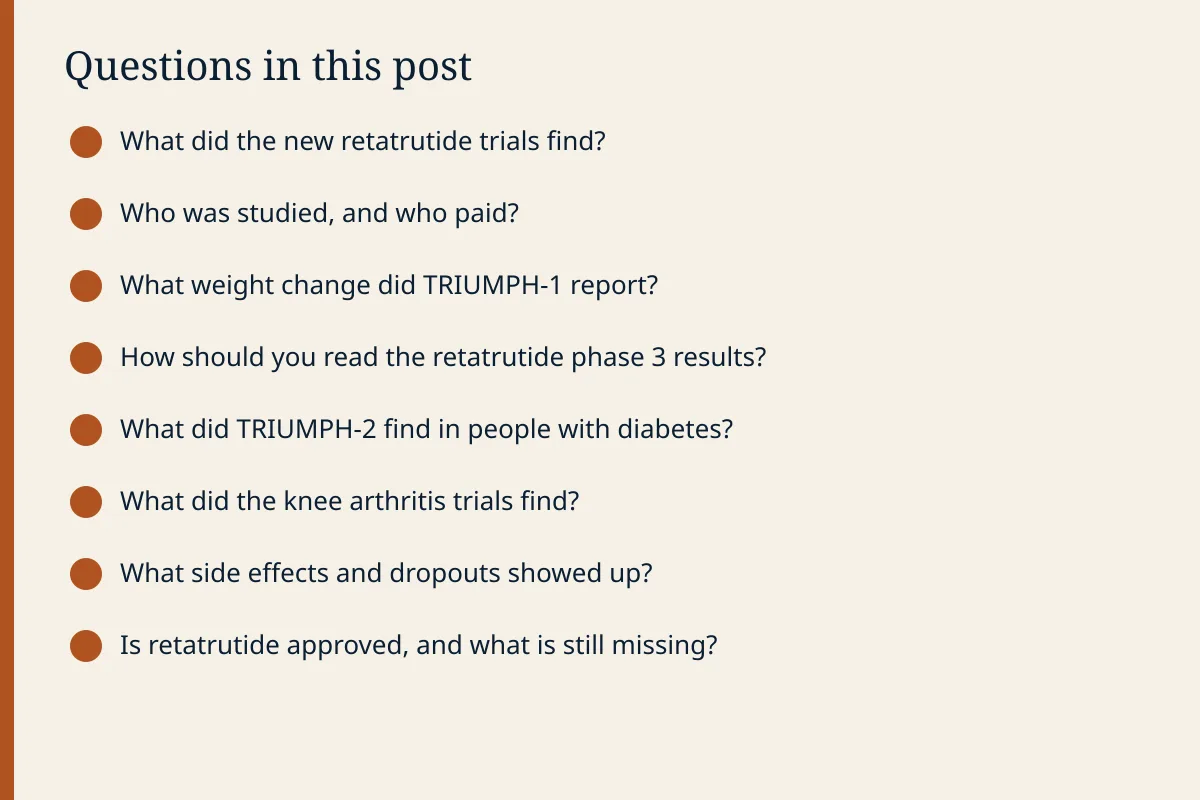
In this article
- What did the new retatrutide trials find?
- Who was studied, and who paid?
- What weight change did TRIUMPH-1 report?
- How should you read the retatrutide phase 3 results?
- What did TRIUMPH-2 find in people with diabetes?
- What did the knee arthritis trials find?
- What side effects and dropouts showed up?
- What else has reported since the three papers?
- Is retatrutide approved, and what is still missing?
- Frequently asked questions
- Sources
From the archive
Read the full retatrutide profile, including what is still missing.
Read it on the archiveWhat did the new retatrutide trials find?
Direct answer
Three large human trials of retatrutide now have journal papers. People lost more weight than in the other group. Knee pain and sleep apnea also moved. The drug is still investigational, and Lilly paid for the trials.
If you have been waiting on a number you can check, this is that moment. The papers are in the New England Journal of Medicine and The Lancet. They are randomized trials in adults. They are not an approval, and they are not a dose to copy.
Retatrutide is a weekly injection that activates three hormone receptors: GIP, GLP-1, and glucagon. According to the TRIUMPH-1 paper, that is the drug these trials tested. It is not on the FDA approved list. A vial sold under the same name, outside a Lilly trial, is not the drug in these papers.
Every number below is from a human trial. This page has no mouse data and no cell data.
- TRIUMPH-1: adults with obesity and no diabetes. Journal paper, 5 November 2026.
- TRIUMPH-2: adults with obesity and type 2 diabetes. Journal paper, 10 October 2026.
- TRIUMPH-4: adults with obesity and painful knee arthritis, and no diabetes. Journal paper, 8 November 2026.
Who was studied, and who paid?
Direct answer
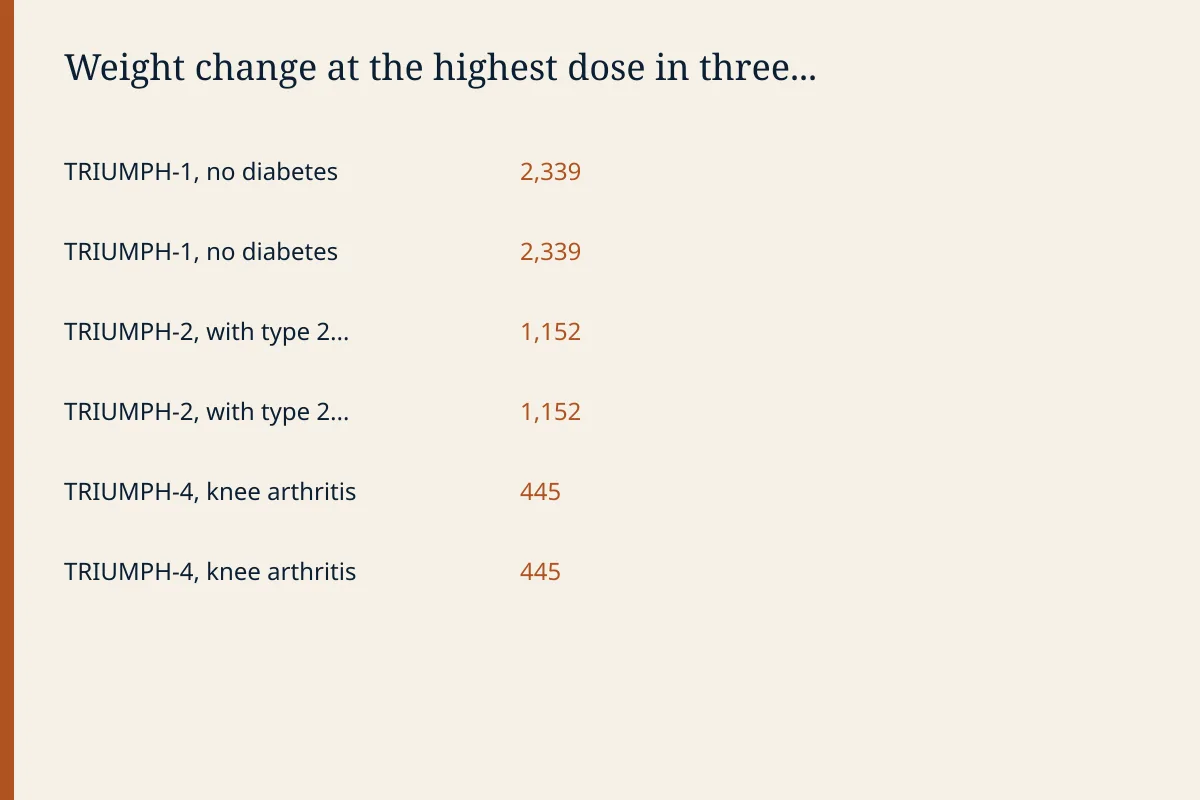
TRIUMPH-1 studied 2,339 adults with obesity and no diabetes for 80 weeks. TRIUMPH-2 studied 1,152 adults with obesity and type 2 diabetes for 80 weeks. TRIUMPH-4 studied 445 adults with obesity and knee arthritis, and no diabetes, for 68 weeks. Eli Lilly funded all three.
According to the TRIUMPH-1 paper, the 2,339 people were randomized to one of three retatrutide arms or the comparison. A subgroup of 574 also had knee osteoarthritis. A subgroup of 243 had obstructive sleep apnea. The main weight results use a treatment-regimen count, which the paper also calls intention to treat. That count keeps everyone who was randomized.
According to the TRIUMPH-2 paper, the 1,152 people had a body mass index of 27 or higher plus type 2 diabetes. Average age was 55.1 years. About 48 percent were women. Average A1C at the start was 7.71 percent. The trial ran at 92 centers in eight countries. Of the 1,152 people, 965 (84 percent) completed the study drug.
According to the TRIUMPH-4 paper, 445 adults had painful knee osteoarthritis and a body mass index of at least 27. The registry record, NCT05931367, says diabetes was an exclusion and that Lilly was the sponsor. The trial ran 68 weeks. Several authors on the meeting abstracts list Eli Lilly and Company as their workplace.
What weight change did TRIUMPH-1 report?
Direct answer
Using the count that keeps everyone who was randomized, weight fell 17.6 percent, 23.7 percent, and 25.0 percent across the three retatrutide arms, versus 3.9 percent in the other group. Those are the New England Journal of Medicine figures at 80 weeks.
The trial assigned a lowest dose, a middle dose, and a highest dose. In the study design those arms were 4 mg, 9 mg, and 12 mg once a week. That is a record of what the trial tested. It is not a dose for you. Retatrutide has no FDA-approved dose.
The paper's main weight comparisons were the middle and highest doses against the other group. The gaps were 19.8 and 21.0 percentage points. Both were statistically significant on the paper's test. The lowest dose also fell 17.6 percent, against 3.9 percent in the other group.
The same human trial measured two other problems inside subgroups. In the 574 people with knee osteoarthritis, pain scores fell more than in the other group. On the paper's hybrid count the changes were 3.2, 3.5, and 3.6 points, versus 1.9 in the other group. On the everyone-randomized count they were 3.4, 3.9, and 4.1, versus 2.5. The paper describes that score as running from 1 to 10, and a higher score means worse pain.
In the 243 people with obstructive sleep apnea, pauses in breathing fell more than in the other group. On the hybrid count the drops were 22.9, 34.3, and 31.7 events per hour, versus 9.9 in the other group. The everyone-randomized count was close to those figures. This does not show an effect in people who were not in that subgroup.
The paper says the most common adverse events were gastrointestinal. The abstract does not print the rates. Company-reported rates are in the side effect section below, with the release named in the same sentence.
| Trial | How it was counted | Highest dose | the other group | Weeks | People |
|---|---|---|---|---|---|
| TRIUMPH-1, no diabetes | Everyone randomized (journal) | 25.0% | 3.9% | 80 | 2,339 |
| TRIUMPH-1, no diabetes | Efficacy estimate (company, 21 May 2026) | 28.3% | 2.2% | 80 | 2,339 |
| TRIUMPH-2, with type 2 diabetes | Everyone randomized (journal) | 18.8% | 5.1% | 80 | 1,152 |
| TRIUMPH-2, with type 2 diabetes | Efficacy estimate (company, 29 Sep 2026) | 20.8% | 4.0% | 80 | 1,152 |
| TRIUMPH-4, knee arthritis | Everyone randomized (journal) | 23.7% | 4.6% | 68 | 445 |
| TRIUMPH-4, knee arthritis | Efficacy estimate (ACR abstract, 8 Nov 2026) | 28.7% | 2.1% | 68 | 445 |
How should you read the retatrutide phase 3 results?
Direct answer
They count the same TRIUMPH-1 trial in two ways. Lilly's 28.3 percent is the estimate if people had stayed on the assigned drug. The journal's 25.0 percent keeps everyone who was randomized, including people who stopped.
Lilly's 21 May 2026 release prints both counts. The efficacy table shows 19.0 percent, 25.9 percent, and 28.3 percent, versus 2.2 percent in the other group. The treatment-regimen lines show 17.6 percent, 23.7 percent, and 25.0 percent, versus 3.9 percent in the other group. The journal's weight results match that second set.
Here is the plain version. The efficacy count asks what the average would have been if everyone randomized had stayed on the assigned treatment. Dose changes were allowed. Other weight-loss treatments were not. Lilly's footnote says that. It is not a simple average of only the people who reached the end, even when a headline calls it the completer number.
The treatment-regimen count asks what happened to everyone who was assigned a group, whether they stayed on the drug or not. That is the more cautious number. When a headline says 28.3 percent and the journal says 25.0 percent, both figures are in the company release. They answer different questions. The journal chose the cautious one for its main weight result.
The same release says 45.3 percent of people on the highest dose lost at least 30 percent of their body weight, on the efficacy count. The journal abstract does not print that 45.3 percent. Treat it as company-reported.
From the archive
Get the weekly evidence update.
Read it on the archive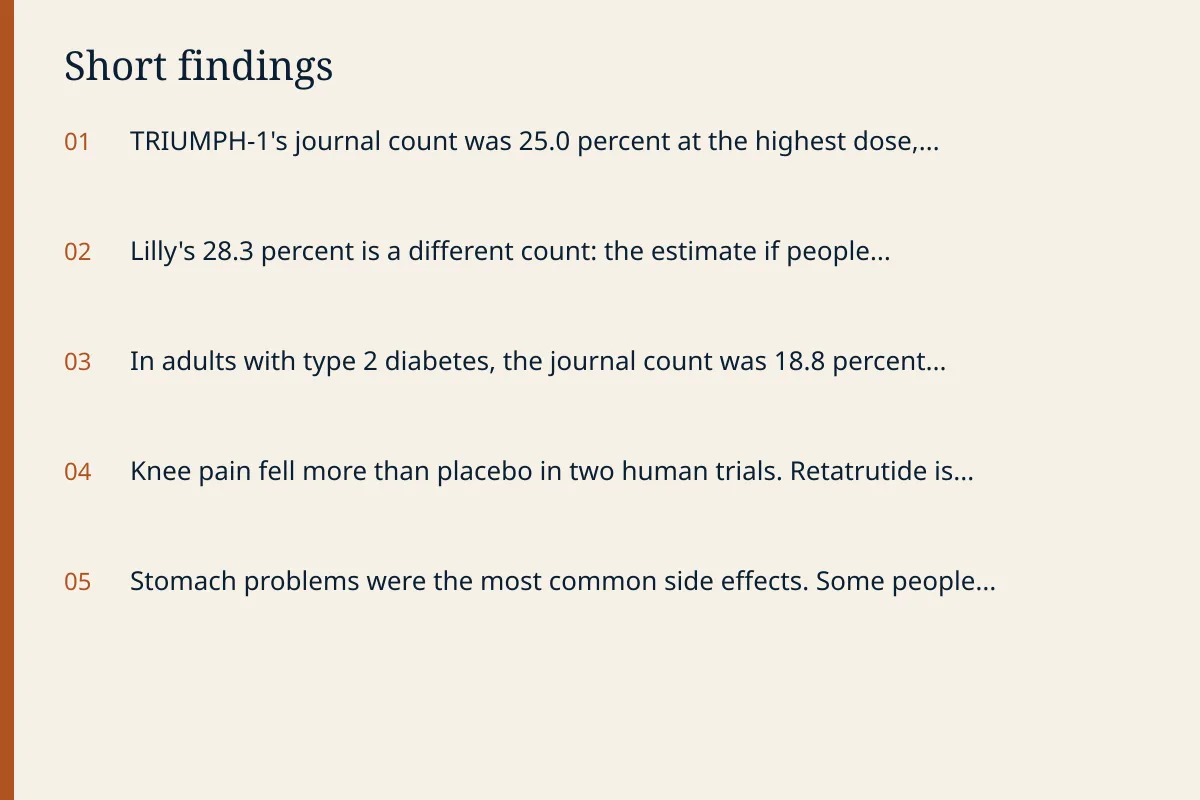
What did TRIUMPH-2 find in people with diabetes?
Direct answer
In adults with obesity and type 2 diabetes, the journal's everyone-randomized count was 11.9 percent, 16.8 percent, and 18.8 percent, versus 5.1 percent in the other group, at 80 weeks. Weight loss was smaller than in the trial without diabetes. Blood sugar improved. The abstract does not print the A1C change.
The gaps versus the other group were 6.9, 11.8, and 13.8 percentage points. The paper reports each one as statistically significant. This was a randomized trial. It does not show that retatrutide beats tirzepatide, because tirzepatide was not in this trial.
The paper says treatment was associated with better blood sugar control. It does not give the A1C change in the abstract. Lilly's 29 September 2026 release says every figure in that release is the efficacy count. On that count, A1C fell 1.4, 1.6, and 1.5 percentage points, versus 0.2 in the other group, from a starting average of 7.7 percent on that company table. Up to 40.0 percent of people on the middle dose reached an A1C under 5.7 percent. Those A1C figures are company-reported. They are not the journal's everyone-randomized numbers.
On that same company efficacy count, weight fell 12.7 percent, 19.1 percent, and 20.8 percent, versus 4.0 percent in the other group. The pattern is the same as in TRIUMPH-1. The efficacy numbers sit a bit above the journal's everyone-randomized numbers.
People with type 2 diabetes lost less weight, on these counts, than the adults without diabetes in TRIUMPH-1. That is a common pattern for this drug class. It is not a reason to rank one drug against another. The two trials enrolled different people.
What did the knee arthritis trials find?
Direct answer
TRIUMPH-4's journal weight count was 23.7 percent at the higher dose versus 4.6 percent in the other group. The meeting abstract's efficacy count was 28.7 percent versus 2.1 percent. Knee pain fell more than the other group on both counts. These were adults with knee arthritis and obesity.
TRIUMPH-4 randomized 445 adults without diabetes. It tested two arms, a middle dose and a highest dose, not the lowest dose used in TRIUMPH-1. For weight, the journal used a treatment-policy strategy. That is the treatment-regimen count: everyone randomized, whether or not they stayed on the drug. Weight fell 20.0 percent and 23.7 percent, versus 4.6 percent in the other group.
Pain used a hybrid count. If someone stopped for a reason that looked like the treatment had failed, the analysis did not credit a later benefit. On that hybrid count, pain scores fell 3.96 and 3.74 points, versus 2.12 in the other group. The everyone-randomized gaps versus the other group were 1.70 and 1.38 points. In this paper the score runs from 0 to 10, and a higher score means worse pain.
The 8 November 2026 ACR abstract labels its figure as the efficacy count. Pain fell 4.48 and 4.41 points, versus 2.43 in the other group. Weight fell 26.4 percent and 28.7 percent, versus 2.1 percent. Lilly's 11 December 2025 release prints those same efficacy weight numbers, and it prints the treatment-regimen weight numbers the journal later used. The 28.7 percent figure is the efficacy estimate, not a raw average of only the people who finished.
A second abstract, presented 10 November 2026, covers the 574-person knee group inside TRIUMPH-1. It also uses the efficacy count. Pain fell 3.66, 4.19, and 4.30 points, versus 2.24 in the other group. Weight is reported only as a range, from 18.6 percent to 28.7 percent, versus 1.5 percent in the other group. The abstract does not say which dose produced which end of that range, so this page does not either.
The journal's everyone-randomized pain changes for that same 574-person group were 3.4, 3.9, and 4.1 points, versus 2.5 in the other group. Different count, different number. Neither knee analysis shows that retatrutide replaces exercise, other pain care, or surgery. Lilly funded both trials.
What side effects and dropouts showed up?
Direct answer
Stomach problems were the most common side effects in the journal reports. In the diabetes trial, diarrhea, nausea, low blood pressure, and skin tingling were more common than in the other group. Stops for side effects were higher on some doses. Investigators judged the deaths unrelated.
According to the Lancet paper, in TRIUMPH-2, diarrhea occurred in 27 percent, 34 percent, and 34 percent across the lowest, middle, and highest doses, versus 13 percent in the other group. Nausea occurred in 14 percent, 21 percent, and 28 percent, versus 8 percent. Low blood pressure occurred in 1 percent, 5 percent, and 6 percent, versus under 1 percent. Dysesthesia, a change in skin feeling such as tingling, occurred in 4 percent, 6 percent, and 7 percent, versus 1 percent.
| What was reported | Lowest dose | Middle dose | Highest dose | the other group |
|---|---|---|---|---|
| Diarrhea | 27% | 34% | 34% | 13% |
| Nausea | 14% | 21% | 28% | 8% |
| Low blood pressure | 1% | 5% | 6% | under 1% |
| Skin tingling (dysesthesia) | 4% | 6% | 7% | 1% |
| Stopped for a side effect or death | 4% | 12% | 8% | 5% |
Seven people died: two on the lowest dose, three on the middle dose, one on the highest dose, and one in the other group. The investigators judged every death unrelated to the study drug. That is the paper's judgment. A trial this size can include deaths that the drug did not cause. It also does not prove the drug is free of serious harm.
For TRIUMPH-1, the journal abstract says stomach and gut effects were the most common, and it does not print rates. Lilly's 21 May 2026 release, which is company-reported, lists nausea at 28.6 percent, 38.4 percent, and 42.4 percent, versus 14.8 percent in the other group. Dysesthesia was 5.1 percent, 12.3 percent, and 12.5 percent, versus 0.9 percent. Stops for side effects were 4.1 percent, 6.9 percent, and 11.3 percent, versus 4.9 percent. The release says the skin events were mostly mild or moderate, and that most people stayed on the drug.
For TRIUMPH-4, the journal says serious adverse events were more common with retatrutide than with the comparison, and that stomach and gut events were the most common. The abstract does not print the rates. Lilly's 11 December 2025 release, company-reported, lists dysesthesia at 8.8 percent and 20.9 percent on the two doses, versus 0.7 percent in the other group. Stops for side effects were 12.2 percent and 18.2 percent, versus 4.0 percent. The release says some stops were for weight loss the person felt was too much, and that the stop rate was lower among people whose starting body mass index was 35 or higher.
What else has reported since the three papers?
Direct answer
Four more retatrutide results are public. Two are journal papers: a 40-week diabetes trial in the Lancet and a sleep apnea paper in the New England Journal of Medicine. Two are company releases with no paper yet: TRIUMPH-3 in people with heart disease, and TRANSCEND-T2D-2 against Ozempic. Lilly paid for all four.
TRANSCEND-T2D-1: retatrutide as a first diabetes medicine
537 adults with type 2 diabetes on no diabetes medicine took retatrutide or the comparison for 40 weeks (Lancet, 2026). Average HbA1c started at 7.9 percent. Counting everyone randomized, it fell 1.69, 1.86 and 1.94 points on the 4, 9 and 12 mg arms. The differences from the other group were 0.88, 1.04 and 1.12 points. Weight fell 11.5, 13.9 and 15.3 percent, against 2.6 percent in the other group. Stops for side effects were 2 to 5 percent on the drug and 0 percent in the other group, and no severe low blood sugar was reported. Forty weeks is short for a diabetes medicine, and this paper does not show heart, kidney or eye outcomes.
Sleep apnea in people with diabetes
The sleep apnea paper (New England Journal of Medicine, 2026) adds a second group to the TRIUMPH-1 subgroup above: 448 people with type 2 diabetes inside TRIUMPH-2, with an average of 55.9 breathing pauses an hour. At 80 weeks the hybrid count fell 19.2, 24.7 and 25.4 events per hour on the three doses, against 10.3 in the other group. That is a smaller drop than in the people without diabetes, where the 9 mg arm fell 34.3. Weight fell 12.1 to 18.5 percent, against 5.6 percent in the other group.
TRIUMPH-3: people who already have heart disease
Lilly's 23 July 2026 release reports TRIUMPH-3: 1,949 adults with a BMI of 35 or more and established heart or blood vessel disease, 80 weeks. On the efficacy count, which assumes everyone stayed on the drug, weight fell 21.6 percent on 9 mg and 22.6 percent on 12 mg, against 3.2 percent in the other group. The release also counts heart events. There were 44 of the broad five-part kind (death, heart attack, stroke, heart failure event or a reopened artery) on retatrutide and 52 in the other group, a hazard ratio of 0.82 with a 95 percent range of 0.55 to 1.22. For the narrower three-part count (heart death, heart attack or stroke) it was 27 against 23, a hazard ratio of 1.12, range 0.64 to 1.96. Both ranges cross 1, so the trial does not show the drug lowered or raised heart events. Lilly says events were rarer than expected in both arms. Stops for side effects were 9.8 and 13.5 percent, against 4.8 percent in the other group.
TRANSCEND-T2D-2: head to head against Ozempic
This is the first trial to put retatrutide against another approved drug in the same people. Lilly's 28 October 2026 release reports 1,298 adults with type 2 diabetes on metformin, with or without an SGLT2 inhibitor, given retatrutide 9 or 12 mg or semaglutide (Ozempic) 2 mg for 80 weeks. Everyone knew which drug they were on. HbA1c fell 2.2 points on both retatrutide doses and 1.8 on Ozempic, from an average of 8.3 percent. Weight fell 19.5 and 20.9 percent, against 9.4 percent on Ozempic. All of those are the efficacy count; the release does not print the everyone-randomized count. Stops for side effects were 4.8 and 7.9 percent on retatrutide and 2.7 percent on Ozempic. Lilly makes retatrutide and not Ozempic, and it paid for the trial.
Still waiting: TRIUMPH-5, the trial against tirzepatide (NCT06662383), was listed as active and not recruiting on ClinicalTrials.gov on 11 November 2026. Lilly says it plans to file with the FDA in the first quarter of 2027.
Is retatrutide approved, and what is still missing?
Direct answer
No. The November 2026 papers still call retatrutide investigational. Lilly said on 29 September 2026 that it plans to file with the FDA in the first quarter of 2027, and that the drug cannot legally be sold for human use. A filing plan is not an approval.
No trial in these papers put retatrutide and tirzepatide in the same people. A separate comparison is registered as NCT06662383. Until that trial reports, a percent from a retatrutide trial and a percent from a tirzepatide trial are not a race both drugs ran. The 2026 field guide keeps each number next to its own trial.
- These papers do not show heart attack or kidney outcomes. TRIUMPH-3 counted heart events, too few to tell the arms apart, and only in a company release so far.
- They do not show what happens after people stop the drug.
- They do not set a dose. Retatrutide has no FDA-approved dose. The milligram arms above are what the trials assigned.
- ClinicalTrials.gov still had no results tables for NCT05929066, NCT05929079, or NCT05931367 on 10 November 2026. The journals published first.
- An earlier note on this site said the results were not public. That note is updated here: the September dispatch.
If you want the legal status of peptides that are already sold, the legal status tracker is the page for that. Retatrutide is not an approved medicine on that list.
Key takeaways
- 01TRIUMPH-1's journal count was 25.0 percent at the highest dose, versus 3.9 percent in the other group.
- 02Lilly's 28.3 percent is a different count: the estimate if people had stayed on the assigned drug.
- 03In adults with type 2 diabetes, the journal count was 18.8 percent versus 5.1 percent in the other group.
- 04Knee pain fell more than the other group in two human trials. Retatrutide is not FDA approved.
- 05Stomach problems were the most common side effects. Some people stopped because of side effects.
- 06Since then: a Lancet paper on diabetes, a sleep apnea paper, and two company releases, one in heart disease and one head to head against Ozempic.
Frequently asked questions
Is retatrutide FDA approved?
No. The New England Journal of Medicine paper published on 8 November 2026 still calls retatrutide investigational. Lilly's 29 September 2026 release said the company plans to submit an application in the first quarter of 2027, and that the drug cannot legally be sold for human use. A plan to file is not an approval.
What were the TRIUMPH-1 weight loss results?
In 2,339 adults with obesity and no diabetes, the journal's everyone-randomized count at 80 weeks was 17.6 percent, 23.7 percent, and 25.0 percent across the three dose arms, versus 3.9 percent in the other group. Lilly's efficacy estimate for the highest dose was 28.3 percent, versus 2.2 percent in the other group. The two figures count the same trial differently.
Why does Lilly say 28.3 percent if the journal says 25.0 percent?
Lilly's 21 May 2026 release uses 28.3 percent for the efficacy count: the estimate if everyone randomized had stayed on the assigned drug. The journal uses 25.0 percent for the treatment-regimen count, which keeps people who stopped. The same release prints 25.0 percent for that second count, and the journal matches it.
Did retatrutide reduce knee pain?
In two human trials of adults with painful knee osteoarthritis and obesity, pain scores fell more than in the other group. In TRIUMPH-4, the journal's everyone-randomized weight result was 23.7 percent at the higher dose versus 4.6 percent in the other group. The 8 November 2026 meeting abstract's efficacy weight result was 28.7 percent versus 2.1 percent. Pain fell on both counts. This does not replace other knee care.
What were the side effects in the retatrutide trials?
The journals say stomach and gut problems were the most common. In the diabetes trial, the Lancet paper reports more diarrhea, nausea, low blood pressure, and skin tingling than in the other group. Stops for side effects were higher on some doses. Seven deaths occurred across the four groups, and the investigators judged all of them unrelated to the drug.
Did people with diabetes lose as much weight?
Not on these counts. In TRIUMPH-2, adults with obesity and type 2 diabetes lost 18.8 percent at the highest dose on the journal's everyone-randomized count, versus 5.1 percent in the other group. In TRIUMPH-1, adults without diabetes lost 25.0 percent at the highest dose, versus 3.9 percent in the other group. These were different trials, not a head-to-head test.
How did retatrutide compare with Ozempic?
In TRANSCEND-T2D-2, a Lilly-funded open-label trial in 1,298 adults with type 2 diabetes, Lilly's 28 October 2026 release reports HbA1c falling 2.2 points on both retatrutide doses against 1.8 on Ozempic 2 mg, and weight falling 19.5 and 20.9 percent against 9.4 percent at 80 weeks. Those are efficacy-count figures from a company release. No journal paper had appeared on 11 November 2026.
Did retatrutide lower heart attacks in TRIUMPH-3?
The trial did not show that. Lilly's 23 July 2026 release reports 44 five-part heart events on retatrutide against 52 in the other group (hazard ratio 0.82, range 0.55 to 1.22) and 27 three-part events against 23 (hazard ratio 1.12, range 0.64 to 1.96). Both ranges cross 1. Weight fell 22.6 percent on 12 mg against 3.2 percent in the other group.
Are the retatrutide phase 3 results on ClinicalTrials.gov?
Not as results tables, when we checked on 10 November 2026. NCT05929066, NCT05929079, and NCT05931367 were marked completed, and none had results posted. The peer-reviewed papers are public. The registry pages are not the place those numbers are written yet.
From the archive
Plan blood tests with a clinician before any medicine change.
Read it on the archiveCompound profiles mentioned
- RetatrutideStrong. At least two finished studies in people, and at least 1,000 people who took it. 12 completed trials, 9,065 people given it.Metabolic
- TirzepatideStrong. At least two finished studies in people, and at least 1,000 people who took it. 9 completed trials, 22,802 people given it.Metabolic
Sources
- Study in people2026
Efficacy and safety of retatrutide, a GIP, GLP-1, and glucagon receptor agonist, in people with type 2 diabetes and inadequate glycaemic control with diet and exercise (TRANSCEND-T2D-1): a double-blind, randomised, phase 3 trial.
TRANSCEND-T2D-1. Randomized 40 weeks, 537 adults with type 2 diabetes on no diabetes medicine. Lilly funded it. Treatment-regimen HbA1c change -1.69, -1.86, -1.94 points; weight -11.5, -13.9, -15.3 percent versus -2.6 percent in the other group. Stops for adverse events 2 to 5 percent versus 0 percent.
The Lancet - Study in people2026
Retatrutide Once Weekly for Treatment of Obstructive Sleep Apnea.
TRIUMPH-1-OSA (243, no diabetes) and TRIUMPH-2-OSA (448, type 2 diabetes), 80 weeks. Lilly funded it. Apnea-hypopnea index change, hybrid count: -22.9, -34.3, -31.7 versus -9.9; and -19.2, -24.7, -25.4 versus -10.3 events per hour.
New England Journal of Medicine - Study in people2026
Lilly's triple agonist, retatrutide, successful in two additional Phase 3 obesity trials, delivering significant improvements in weight and A1C
Company release, 23 July 2026, no journal paper yet for TRIUMPH-3. 1,949 adults with BMI 35 or more and cardiovascular disease, 80 weeks. Efficacy-count weight -21.6 and -22.6 percent versus -3.2 percent. MACE-5 hazard ratio 0.82 (0.55 to 1.22); MACE-3 1.12 (0.64 to 1.96). FDA filing planned for the first quarter of 2027.
Eli Lilly - Study in people2026
Lilly's retatrutide delivered greater A1C reduction and more than double the weight loss of Ozempic's highest approved dose in head-to-head trial
Company release, 28 October 2026, no journal paper yet. TRANSCEND-T2D-2, open-label, 1,298 adults with type 2 diabetes, 80 weeks, efficacy count only. HbA1c -2.2 points on both retatrutide doses versus -1.8 on Ozempic 2 mg; weight -19.5 and -20.9 percent versus -9.4 percent. Stops for adverse events 4.8 and 7.9 percent versus 2.7 percent.
Eli Lilly - Study in people2026
Retatrutide, a Triple Hormone Receptor Agonist, for Treatment of Obesity.
TRIUMPH-1. Randomized 80 weeks, 2,339 adults with obesity and no diabetes. Lilly funded it. Treatment-regimen weight change: 17.6 percent, 23.7 percent, and 25.0 percent versus 3.9 percent in the other group. Knee pain and sleep apnea subgroups also improved versus the other group. Most common adverse events were gastrointestinal.
New England Journal of Medicine - Study in people2026
Retatrutide in adults with obesity and type 2 diabetes (TRIUMPH-2): a double-blind, parallel-group, randomised, placebo-controlled, phase 3 trial.
TRIUMPH-2. 1,152 adults with obesity and type 2 diabetes, 80 weeks, Lilly funded. Treatment-regimen weight change: 11.9 percent, 16.8 percent, and 18.8 percent versus 5.1 percent in the other group. Diarrhea, nausea, hypotension, and dysesthesia were more common than in the other group. Stops for adverse events or death were 4 percent, 12 percent, and 8 percent versus 5 percent. Seven deaths, judged unrelated by the investigators.
The Lancet - Study in people2026
Retatrutide Once Weekly in Adults with Knee Osteoarthritis Pain and Obesity.
TRIUMPH-4 and the TRIUMPH-1 knee group. Lilly funded both. In 445 adults, treatment-regimen weight change at 68 weeks was 20.0 percent and 23.7 percent versus 4.6 percent in the other group. Hybrid pain scores fell 3.96 and 3.74 points versus 2.12. Serious adverse events were more common than in the other group. The drug is called investigational.
New England Journal of Medicine - Study in people2026
A Study of Retatrutide (LY3437943) Once Weekly in Participants Who Have Obesity or Overweight and Osteoarthritis of the Knee
NCT05931367, TRIUMPH-4. Lilly sponsored. Completed. Actual enrollment 445 adults. No diabetes. Primary completion 14 November 2025. No results table posted as of 10 November 2026.
ClinicalTrials.gov - Study in people2026
Lilly's triple agonist, retatrutide, delivered powerful weight loss in pivotal Phase 3 obesity trial
Company release, 21 May 2026, before the journal paper. Efficacy count at 80 weeks: 19.0 percent, 25.9 percent, and 28.3 percent versus 2.2 percent in the other group. Treatment-regimen count: 17.6 percent, 23.7 percent, and 25.0 percent versus 3.9 percent. Company-reported nausea and dysesthesia rates, and stops for adverse events, are in the release. Retatrutide is called investigational.
Eli Lilly, via PR Newswire - Study in people2026
Lilly's triple agonist, retatrutide, delivered substantial weight loss and A1C reduction, underscoring its potential promise for people with obesity and type 2 diabetes
Company release, 29 September 2026. The release says all of its figures are the efficacy count. A1C change: 1.4, 1.6, and 1.5 percentage points versus 0.2 in the other group. Efficacy weight change: 12.7 percent, 19.1 percent, and 20.8 percent versus 4.0 percent. Plans a filing in the first quarter of 2027. Says the drug cannot legally be sold for human use.
Eli Lilly - Study in people2025
Lilly's triple agonist, retatrutide, delivered weight loss of up to an average of 71.2 lbs along with substantial relief from osteoarthritis pain in first successful Phase 3 trial
Company release, 11 December 2025. TRIUMPH-4 efficacy weight change: 26.4 percent and 28.7 percent versus 2.1 percent in the other group. Treatment-regimen weight change: 20.0 percent and 23.7 percent versus 4.6 percent. Company-reported dysesthesia 8.8 percent and 20.9 percent versus 0.7 percent. Stops for adverse events 12.2 percent and 18.2 percent versus 4.0 percent.
Eli Lilly - Study in people2026
Retatrutide Once Weekly for the Treatment of Knee Osteoarthritis Pain and Obesity: Results From a 68-Week Phase 3 Randomized Clinical Trial
Plenary abstract, 8 November 2026. TRIUMPH-4, 445 adults. Figure labeled efficacy count: pain fell 4.48 and 4.41 points versus 2.43 in the other group. Weight fell 26.4 percent and 28.7 percent versus 2.1 percent. Several authors affiliated with Eli Lilly and Company.
ACR Convergence 2026 abstracts - Study in people2026
Three Doses of Once Weekly Retatrutide in Adults with Knee Osteoarthritis and Obesity: An 80-Week, Phase 3 Randomized Clinical Trial
Poster abstract, 10 November 2026. TRIUMPH-1 knee group, 574 adults. Efficacy count: pain fell 3.66, 4.19, and 4.30 points versus 2.24 in the other group. Weight reported only as a range, 18.6 percent to 28.7 percent, versus 1.5 percent in the other group, with no dose assigned to each end of the range.
ACR Convergence 2026 abstracts
Read next

Dispatch /
Dispatch 001: Retatrutide Phase 3 Results Are Now in the Journals
Update, 10 November 2026: three retatrutide phase 3 trials now have peer-reviewed papers. The 12 September issue below also covers a CagriSema study that finished at a low tirzepatide dose, and a review of 378 studies on preventing diabetes.
Safety /
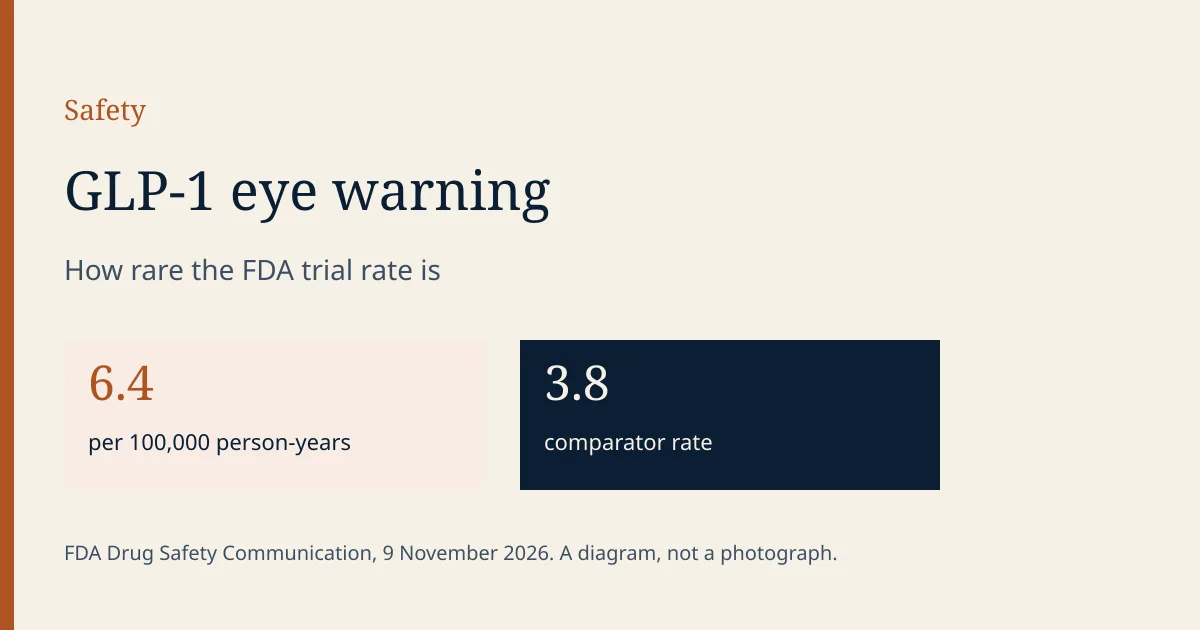
The FDA's New GLP-1 Eye Warning: How Rare It Really Is
The GLP-1 eye warning is a new FDA label change for a rare optic nerve event. The agency calls it a potential increased risk, and the trial rate is still very low.
Research /
Tirzepatide Muscle Loss: A New Trial Shows Lifting Keeps Strength Up
Tirzepatide muscle loss is a real concern. A new 40-week randomized trial in 120 adults found supervised lifting kept more lean mass and raised strength, while weight loss stayed the same.
Educational use only. This database summarizes published research and is not medical advice. Where a dose appears it is a record of what a trial or clinic ran, or what people describe doing, with its source attached. Nothing here is a recommendation for personal use. Sellers named on the price pages are ranked by certificate tier, then price. No seller pays this site anything today. Naming a seller is not a recommendation to buy or use anything.