Safety / Published / Reviewed / 13 min read
The FDA's New GLP-1 Eye Warning: How Rare It Really Is
Written by Aaron CuhaReviewed Nov 11, 2026
The GLP-1 eye warning is a new FDA label change for a rare optic nerve event. The agency calls it a potential increased risk, and the trial rate is still very low.
In this article
- What is the GLP-1 eye warning?
- How rare did the FDA find this event?
- What did the pooled trials actually count?
- What does the FDA tell patients to do?
- Which medicines are on the FDA list?
- What is this eye event, in plain words?
- What do the records studies show?
- What did European regulators conclude in 2025?
- Does the warning cover retatrutide?
- What this warning does not show
- Frequently asked questions
- Sources
From the archive
Read the semaglutide profile for the trial record behind Ozempic and Wegovy.
Read it on the archiveWhat is the GLP-1 eye warning?
Direct answer
It is an FDA label change, dated 9 November 2026, about a rare optic nerve event called NAION. The FDA says there is a potential increased risk. It does not say the drugs cause the event.
If you take Ozempic, Wegovy, Mounjaro, or Zepbound, the new label is about your medicine. The numbers below come from the FDA page. The wider GLP-1 field guide keeps each drug next to its own trial.
On 9 November 2026 the FDA posted a Drug Safety Communication. Its words are a potential increased risk of non-arteritic anterior ischemic optic neuropathy, or NAION. NAION is a rare event. It can cause sudden, painless loss of vision in one eye, and that loss can be permanent.
The agency is requiring the companies that hold the approvals to add this to the Warnings and Precautions section. The order covers all approved GLP-1 receptor agonists. It is a label change. It is not a ban, and it is not a recall.
How rare did the FDA find this event?
Direct answer
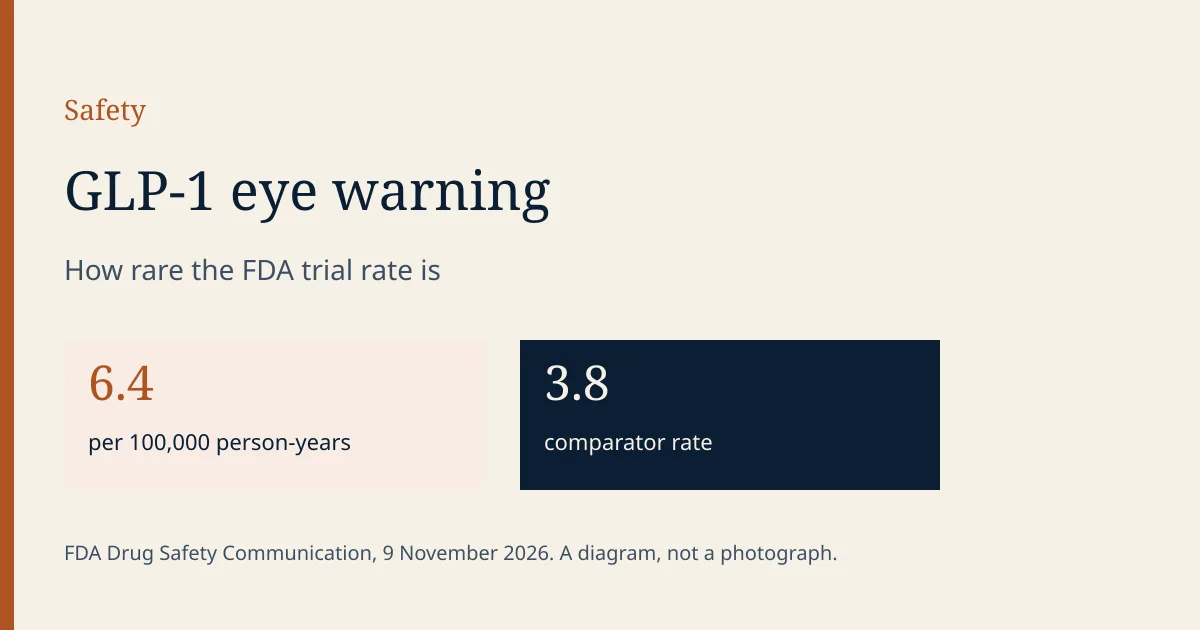
In 126 randomized trials, the FDA found 6.4 cases per 100,000 person-years on a GLP-1 drug and 3.8 in the other group or another diabetes drug. That is rare. It is a higher rate than the comparison group.
A person-year is one person for one year. The FDA reports 6.4 versus 3.8 cases per 100,000 person-years, on a GLP-1 drug versus the other group or another diabetes drug.
Divide 100,000 by 6.4 and you get 15,625. That is about one case per 15,625 person-years on a GLP-1 drug, against about one per 26,316 on the comparator. The gap is 2.6 extra cases per 100,000 person-years. It is not a forecast for you.
| Group | What the FDA reported | Rate |
|---|---|---|
| GLP-1 drug arms | 10 probable events in 156,947 person-years. | 6.4 per 100,000 person-years. |
| Comparator arms | 5 events, all in the other group, in 131,932 person-years. | 3.8 per 100,000 person-years. |
| Adults older than 50 | A published range the FDA cites. Not from these trials. | 2.3 to 10.2 per 100,000 people a year. |
| Sentinel, type 2 diabetes | A records study from 2019 to 2024. Observational. | 26 to 32 per 100,000 person-years. |
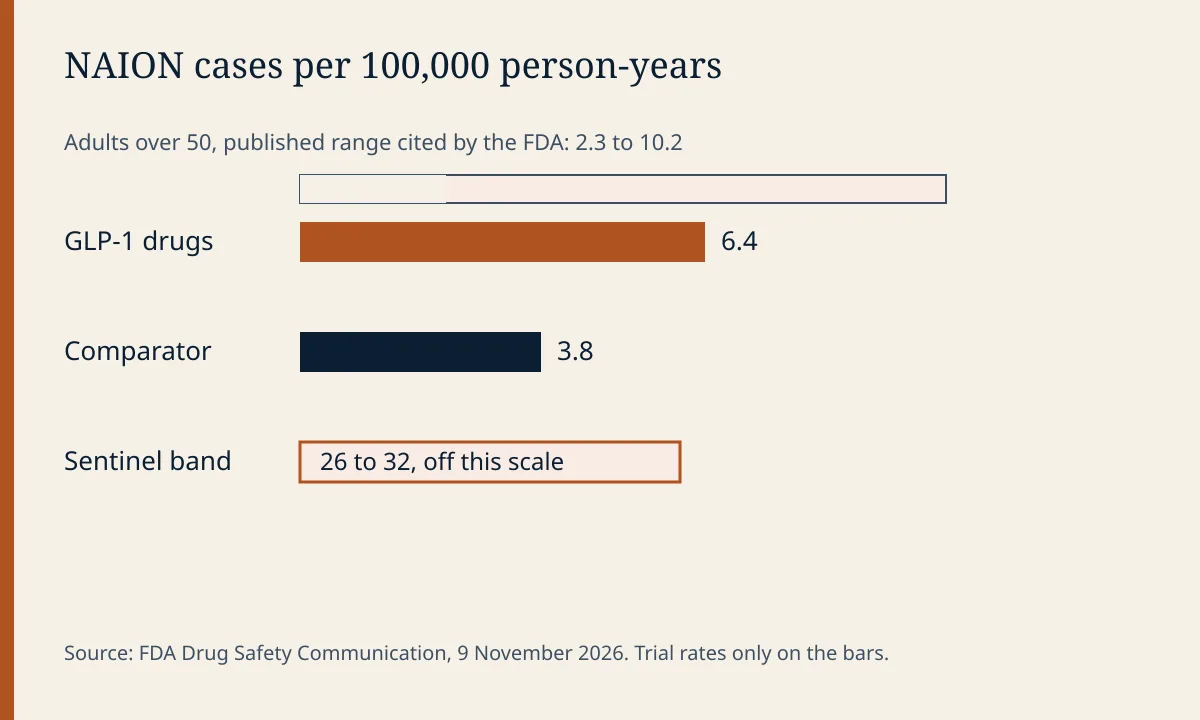
The FDA cites 2.3 to 10.2 cases per 100,000 persons a year in adults older than 50, and it does not name those papers. The gap it highlights is 6.4 against 3.8.
What did the pooled trials actually count?
Direct answer
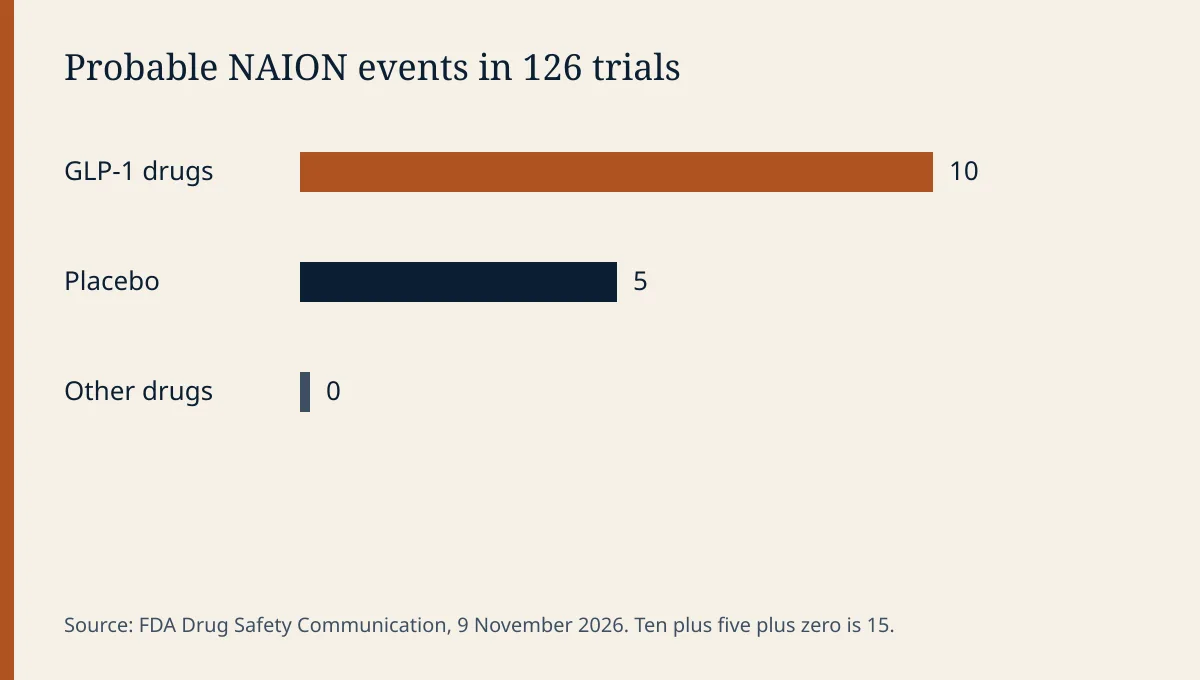
The FDA counted 15 probable events in 134,253 people. Ten were on a GLP-1 drug. Five were in the other group. None were on the other diabetes drugs used as a comparison.
The FDA pooled 126 trials: 78,217 people on a GLP-1 drug and 56,036 on a comparator, with 156,947 versus 131,932 person-years. Ten events were on a GLP-1 drug and five were in the other group. The 3.8 rate uses every comparator person-year.
FDA case reports were hard to read. NAION risk factors overlap with illnesses common in this group. The label change does not rest on those reports alone.
In the animal data the FDA reviewed, no mechanism was found. That line is about animals. The rates above are from people.
What does the FDA tell patients to do?
Direct answer
The FDA says to contact a clinician right away for sudden vision loss in one eye. After a NAION event, it says to discuss whether to continue the medicine or stop it. Do not treat the notice as a stop order from this site.
The communication lists symptoms to watch for. They can show up in one eye, and some people notice them on waking.
- Sudden, painless vision loss in one eye.
- Blurred vision, or missing pieces of the visual field, such as a blind spot or tunnel vision.
- Colors that look distorted.
- A blurry or hazy spot that dulls the sharp center of vision.
The page does not say to stop the medicine on your own before that talk. If NAION has already hit one eye, the other eye is at higher risk.
- 01The FDA's step for sudden vision changes: contact a clinician right away.
- 02The FDA's step if NAION is suspected: the clinician should refer you to an ophthalmologist promptly.
- 03The FDA's step after a NAION event: discuss whether the benefits of staying on the drug clearly outweigh the risk.
For clinicians, the page says to consider stopping the drug after NAION, unless the benefits clearly outweigh the risk. The choice stays with the clinician and the patient.
From the archive
Get the weekly evidence update when a label or a trial changes.
Read it on the archiveWhich medicines are on the FDA list?
Direct answer
The order covers every approved GLP-1 drug on the FDA table, from Byetta in 2005 through Foundayo in 2026. That includes Ozempic, Wegovy, Mounjaro, and Zepbound. Retatrutide is not on the list.
The communication prints this table of FDA-approved GLP-1 receptor agonists. The same label change applies to each of them. Semaglutide is the generic name in Ozempic, Rybelsus, and Wegovy. Tirzepatide is the generic name in Mounjaro and Zepbound.
| Trade name | Generic name | Approval year |
|---|---|---|
| Byetta | exenatide | 2005. |
| Victoza | liraglutide | 2010. |
| Trulicity | dulaglutide | 2014. |
| Saxenda | liraglutide | 2014. |
| Xultophy | liraglutide plus insulin degludec | 2016. |
| Soliqua | lixisenatide plus insulin glargine | 2016. |
| Ozempic | semaglutide | 2017. |
| Rybelsus | semaglutide | 2019. |
| Wegovy | semaglutide | 2021. |
| Mounjaro | tirzepatide | 2022. |
| Zepbound | tirzepatide | 2023. |
| Foundayo | orforglipron | 2026. |
The page says Byetta was withdrawn by choice, not for safety, on 4 August 2025, and that only generic exenatide remains. Tirzepatide also hits the GIP receptor. Foundayo is oral orforglipron. See the oral GLP-1 note and the approved list.
What is this eye event, in plain words?
Direct answer
NAION is sudden, usually painless vision loss in one eye from low blood flow to the front of the optic nerve. It can be permanent. It is not diabetic retinopathy, which is retina damage from diabetes.
The optic nerve carries sight to the brain. The FDA says NAION is low blood flow at the front of that nerve, and the cause is not fully understood.
The page lists risk factors that may include smoking, diabetes, high blood pressure, sleep apnea, anemia, and kidney disease. Many people who take a GLP-1 drug already have diabetes, high blood pressure, or sleep apnea. That overlap is why a raw count of case reports cannot settle cause.
Diabetic retinopathy is retina damage from diabetes. The FDA notice is about the optic nerve. It does not describe retinopathy.
- NAION: sudden, usually painless, often one eye, optic nerve blood flow.
- Diabetic retinopathy: retina vessel damage in diabetes, a different condition.
- A clinic percentage from a referral practice is not the same unit as cases per 100,000 person-years.
What do the records studies show?
Direct answer
A 2024 clinic study found a higher NAION rate in people prescribed semaglutide. A larger 2025 records study did not. Both are observational: each shows an association, not cause. They do not agree.
Hathaway and colleagues, in JAMA Ophthalmology, 2024, screened 16,827 patients from December 2017 through November 2023. It is observational: it shows an association, not cause. In diabetes, the 36-month rate was 8.9 percent in 194 people on semaglutide versus 1.8 percent in 516 others (hazard ratio 4.28, 1.62 to 11.29). In overweight or obesity it was 6.7 percent in 361 people versus 0.8 percent in 618 (hazard ratio 7.64, 2.21 to 26.36). That clinic is not the trial rate.
Chou and colleagues, in Ophthalmology, 2025, are observational: it shows an association, not cause. In 297,220 people, no one-to-three-year ratio was significant. At three years in diabetes it was 1.51 (0.71 to 3.25). Sentinel rates were 30 to 32, 31, and 26 per 100,000 person-years. The ratios were 1.43 (1.02 to 2.01) versus DPP-4 inhibitors and 1.19 (0.91 to 1.54) versus SGLT-2 inhibitors.
What did European regulators conclude in 2025?
Direct answer
In June 2025, Europe's safety committee called NAION a very rare side effect of semaglutide. That review covers Ozempic, Rybelsus, and Wegovy. It is narrower than the FDA class-wide label change.
On 6 June 2025 the EMA safety committee, PRAC, published its semaglutide conclusion. The page names Ozempic, Rybelsus, and Wegovy. It does not name tirzepatide. PRAC's words are stronger than the FDA's potential increased risk. It calls NAION a very rare side effect, meaning it may affect up to 1 in 10,000 people taking semaglutide.
Large studies suggested about a two-fold risk in type 2 diabetes, or one extra case per 10,000 person-years. They are observational: it shows an association, not cause. That is 10 per 100,000, against an FDA trial gap of 2.6. If NAION is confirmed, the EMA says stop semaglutide. The FDA says to discuss it.
A 13 June 2025 revision removed a line about a binding Commission decision. PRAC's recommendations go to the CHMP.
Does the warning cover retatrutide?
Direct answer
No. Retatrutide is still investigational, and the FDA page does not name it. The two diabetes trial abstracts opened for this post do not name NAION. Those trials are too small to rule a rare event in or out.
Retatrutide is still in trials, and it is not FDA approved. The 9 November 2026 FDA page does not mention retatrutide or LY3437943. The order is for approved drugs, so it does not cover retatrutide. Weight results are in the phase 3 post.
TRIUMPH-2 put 292, 284, and 287 adults on retatrutide for 80 weeks. Lilly funded NCT05929079. The abstract does not name NAION. TRANSCEND-T2D-1 put 134, 133, and 136 on retatrutide for 40 weeks (NCT06354660, also Lilly). A PubMed search that day found no retatrutide NAION record. No retinopathy rate is quoted.
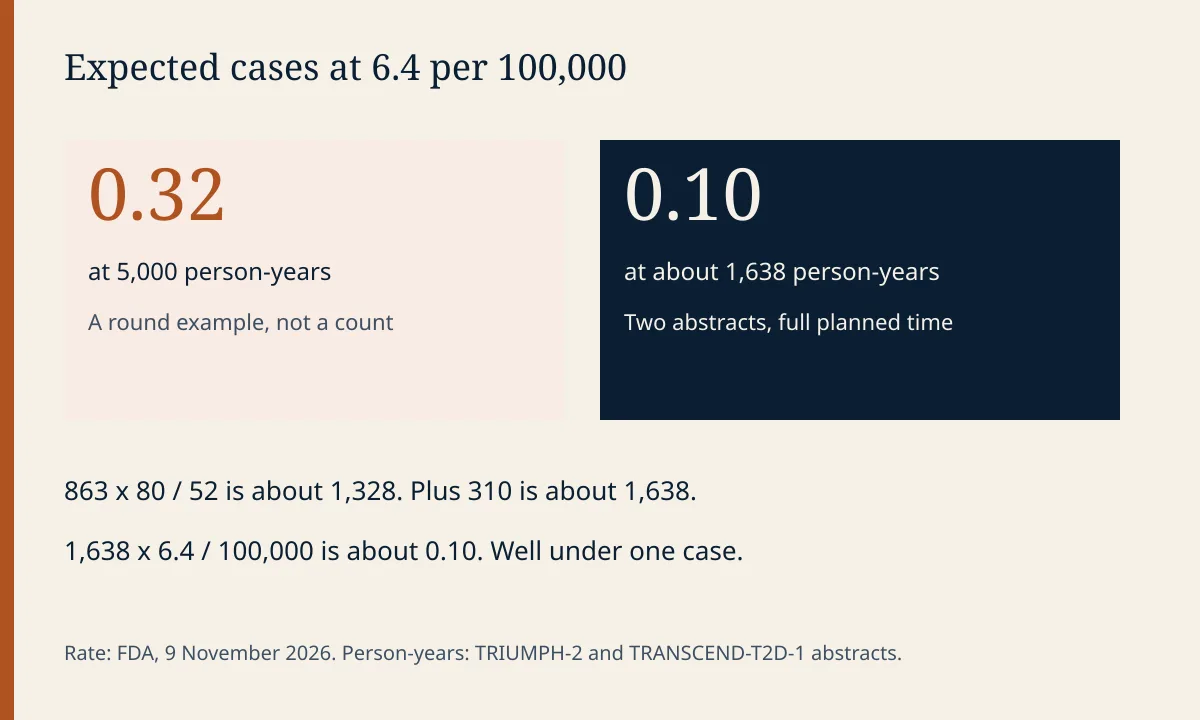
Five thousand person-years times 6.4, divided by 100,000, is 0.32 cases. Here, 863 people times 80 weeks, divided by 52, is about 1,328 person-years, plus 310 person-years, about 1,638 in all. That is about 0.10 expected cases.
What this warning does not show
Direct answer
It does not show that the drugs cause NAION. It does not give you a personal risk number. It does not cover unapproved drugs. And it is not, by itself, an order to stop a medicine you were prescribed.
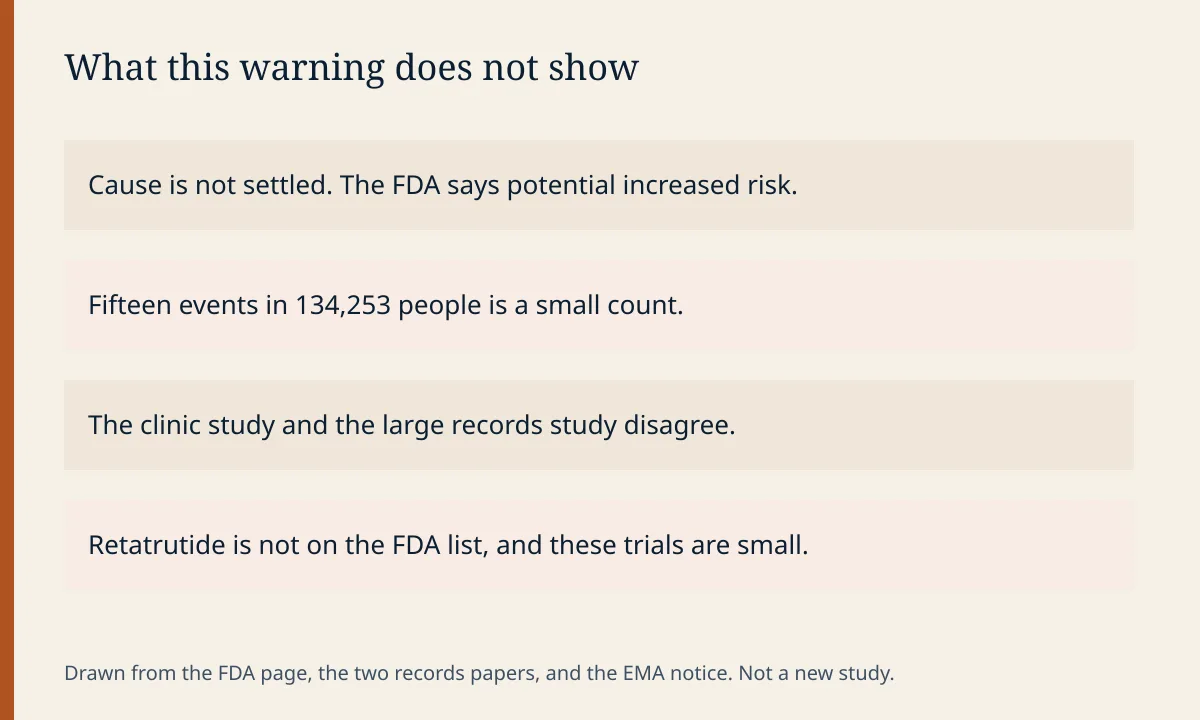
- The FDA's phrase is potential increased risk. Cause is not settled.
- Fifteen probable events in 134,253 people is a small count. Small counts move around.
- The clinic study and the multinational study disagree. Both are observational.
- Europe's 2025 conclusion is about semaglutide. The FDA order is about the approved class.
- Retatrutide is outside the order. The abstracts opened here cannot detect an event this rare.
Reported cases are not a rate. The FDA form, 1-800-332-1088, or fax 1-800-FDA-0178 is how to file one.
Size the worry with the FDA trial rate, not the referral-clinic percent. The muscle and eating page is a separate topic.
Key takeaways
- 01The FDA calls this a potential increased risk, and it does not call it a cause.
- 02Pooled trials showed 6.4 versus 3.8 cases per 100,000 person-years.
- 03The label change covers every approved GLP-1 drug on the FDA list.
- 04The FDA says to call a clinician about sudden vision changes.
- 05Retatrutide is not approved, and it is not on this FDA list.
Frequently asked questions
What is the GLP-1 eye warning?
It is the FDA Drug Safety Communication of 9 November 2026. Approved GLP-1 drugs must add a Warnings and Precautions note on a potential increased risk of NAION. The FDA does not say the drugs cause it.
How rare is NAION in the GLP-1 trials?
The FDA pooled 126 trials and 134,253 patients. The rate was 6.4 cases per 100,000 person-years on a GLP-1 drug and 3.8 on a comparator, from 10 events versus 5 in the other group. One case at 6.4 per 100,000 is about 15,625 person-years.
Does Ozempic cause sudden vision loss?
The FDA does not say Ozempic causes it. Ozempic is semaglutide, and it is on the label-change list, along with Rybelsus and Wegovy. A 2024 clinic study found an association. A 2025 study of 297,220 people did not find a significant one. Both are observational: each shows an association, not cause.
Does the warning cover Wegovy, Mounjaro, and Zepbound?
Yes. Wegovy is semaglutide, approved in 2021. Mounjaro and Zepbound are tirzepatide, approved in 2022 and 2023. The same list includes older drugs and Foundayo, orforglipron, in 2026.
What does the FDA say if vision changes suddenly?
The FDA says to contact a clinician right away for sudden painless vision loss in one eye, a missing part of the field, distorted colors, or a hazy center. If NAION has happened, discuss continuing or stopping. The page does not say to stop on your own first.
Is NAION the same as diabetic retinopathy?
No. NAION is low blood flow to the front of the optic nerve, usually sudden and in one eye. Diabetic retinopathy is retinal vessel damage in diabetes. The FDA notice is about NAION only.
Does the FDA warning cover retatrutide?
No. Retatrutide is not approved and is not on the FDA page. The TRIUMPH-2 and TRANSCEND-T2D-1 abstracts do not name NAION. At 6.4 per 100,000 person-years, a few thousand person-years expect well under one case.
What did European regulators say about semaglutide and NAION?
On 6 June 2025, the EMA's PRAC called NAION a very rare side effect of semaglutide, meaning up to 1 in 10,000 people. The page cites about one extra case per 10,000 person-years in adults with type 2 diabetes. The review names Ozempic, Rybelsus, and Wegovy. If NAION is confirmed, the EMA says semaglutide treatment should be stopped.
From the archive
Start with a blood test plan before a clinic visit about a medicine you already take.
Read it on the archiveCompound profiles mentioned
- SemaglutideStrong. At least two finished studies in people, and at least 1,000 people who took it. 12 completed trials, 42,363 people given it.Metabolic
- TirzepatideStrong. At least two finished studies in people, and at least 1,000 people who took it. 9 completed trials, 22,802 people given it.Metabolic
- RetatrutideStrong. At least two finished studies in people, and at least 1,000 people who took it. 12 completed trials, 9,065 people given it.Metabolic
Sources
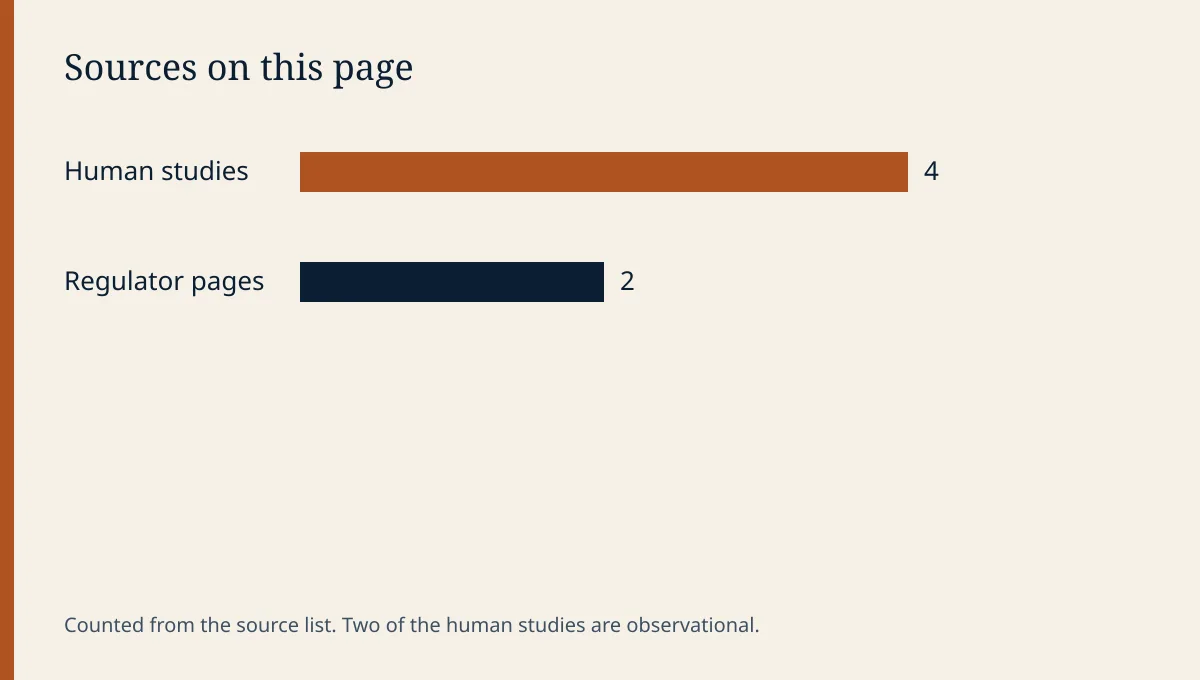
- Review of studies2026
FDA Requires Safety Labeling Changes for Glucagon-Like Peptide-1 Receptor Agonists (GLP-1 RAs) Due to Potential Increased Risk of Rare But Serious Eye Condition
9 November 2026 label change for all approved GLP-1 RAs. Pooled 126 trials, 134,253 patients, 6.4 versus 3.8 NAION cases per 100,000 person-years. Potential increased risk, not a stated cause.
FDA Drug Safety Communication - Study in people2024
Risk of Nonarteritic Anterior Ischemic Optic Neuropathy in Patients Prescribed Semaglutide
Observational matched cohort at one neuro-ophthalmology practice, 16,827 patients screened. 36-month cumulative incidence 8.9% versus 1.8% in type 2 diabetes (HR 4.28) and 6.7% versus 0.8% in overweight or obesity (HR 7.64). Association, not cause.
JAMA Ophthalmology - Study in people2025
Association between Semaglutide and Nonarteritic Anterior Ischemic Optic Neuropathy: A Multinational Population-Based Study
Observational cohorts from 160 organizations in 21 countries, 297,220 people. No significant NAION association at 1, 2, or 3 years. Confidence intervals include both harm and no harm.
Ophthalmology - Review of studies2025
PRAC concludes eye condition NAION is a very rare side effect of semaglutide medicines Ozempic, Rybelsus and Wegovy
6 June 2025 PRAC conclusion for semaglutide only. Very rare means up to 1 in 10,000. About one additional case per 10,000 person-years in type 2 diabetes. Page revised 13 June 2025.
European Medicines Agency - Study in people2026
Retatrutide in adults with obesity and type 2 diabetes (TRIUMPH-2): a double-blind, parallel-group, randomised, placebo-controlled, phase 3 trial
Lilly-funded phase 3 trial, NCT05929079, 1,152 adults, 80 weeks. Abstract does not name NAION. Retatrutide arms 292, 284, and 287 people.
The Lancet - Study in people2026
Efficacy and safety of retatrutide, a GIP, GLP-1, and glucagon receptor agonist, in people with type 2 diabetes and inadequate glycaemic control with diet and exercise (TRANSCEND-T2D-1): a double-blind, randomised, phase 3 trial
Lilly-funded phase 3 trial, NCT06354660, 537 adults, 40 weeks. Abstract does not name NAION. Retatrutide arms 134, 133, and 136 people.
The Lancet
Read next
Research /
Retatrutide Trial Results Are Now in the Journals
Retatrutide phase 3 results are now in peer-reviewed journals. Three Lilly-funded human trials report weight loss, blood sugar, knee pain, and side effects. The drug is still investigational and is not FDA approved.
Metabolic /
Oral GLP-1s in 2026: Wegovy Pill vs Foundayo (Orforglipron) vs Rybelsus, and What Is Coming
The three approved GLP-1 pills, why one needs an empty stomach and another doesn't, how much weight people lost in the studies behind each approval, the warning box they all carry, and what's coming: aleniglipron, elecoglipron, HRS-7535, and the pill Pfizer walked away from. Plain English.
Safety /
Peptide Side Effects by Class: What Is Documented, What Is Anecdotal
A group-by-group table that separates side effects counted in studies and on FDA labels (GLP-1 drugs, bremelanotide, MK-677, elamipretide) from the stories that fill forums about BPC-157, TB-500, copper peptides and brain peptides. Plain English.
Educational use only. This database summarizes published research and is not medical advice. Where a dose appears it is a record of what a trial or clinic ran, or what people describe doing, with its source attached. Nothing here is a recommendation for personal use. Sellers named on the price pages are ranked by certificate tier, then price. No seller pays this site anything today. Naming a seller is not a recommendation to buy or use anything.