Longevity / Published / Reviewed / 13 min read
Rapamycin Aging Results: The Best So Far, in Mice and People
Written by Aaron CuhaReviewed Nov 20, 2026
Rapamycin aging results are strongest in mice, where it adds years of mouse life, and real in people, where older adults got stronger immune responses and fewer infections.
In this article
- What are the best rapamycin aging results so far?
- How much longer did mice live on rapamycin?
- Is there a German rapamycin analog that slows aging in people?
- What has rapamycin done for aging in people?
- What did PEARL and the smaller rapamycin trials find?
- Why has nobody tested rapamycin on human lifespan?
- What rapamycin results are coming next?
- So should you care about rapamycin for aging?
- Review: the rapamycin scoreboard in five lines
- Frequently asked questions
- Sources
Before we start: I am not a doctor, and I am not suggesting anything. This is for research purposes only.
You keep hearing that rapamycin is the best anti-aging drug we have. Then someone says it has never been shown to do anything in people. Both camps are loud. Neither one shows you the scoreboard. It is part of my running guide to longevity science, and if you want the deep dive on PEARL and the weekly dosing fight, read the rapamycin dosing debate next.
In mice, late-start rapamycin lengthened life, and with trametinib median lifespan rose about 35 percent in females.
In people, older adults had stronger flu vaccine responses and fewer infections, and women in a year-long trial gained lean tissue.
If the headline left out the species, it left out the finding.
From the archive
See what actually slows aging in people, ranked by evidence. Open the longevity guide
Read it on the archive
What are the best rapamycin aging results so far?
Direct answer
In mice: longer lives, started late, at three separate labs, and up to about 35 percent longer median life when paired with a second drug.
In people: stronger flu vaccine responses and fewer infections in older adults, plus lean tissue gains in women in a year-long trial.
Mice are not a footnote you can skip on the way to a human headline. Fewer infections in older adults is a human result, and it is not a mouse result with a new caption.
Rapamycin blocks a growth switch inside cells called mTOR. Turn it down, and in animal after animal, life gets longer. It is the oldest and best tested drug that does this.
Here is how the evidence stacks up:
- Mouse lifespan: repeated, large, and started late in life.
- Human immune aging: several randomized trials in older adults, with real wins and one big miss.
- Human body and well-being: one 48-week randomized trial in healthy adults.
- Human lifespan: never tested. Not "tested and failed." Never run.
How much longer did mice live on rapamycin?
Direct answer
A lot, and the start date is the shock. Mice that began rapamycin at 600 days old, already old for a mouse, lived longer than untreated mice at three separate test sites. Paired with a second drug, trametinib, median lifespan rose by about 35 percent in females.
According to Harrison and colleagues in Nature (2009), rapamycin started at 600 days raised age at 90 percent mortality by 14 percent in female mice and 9 percent in male mice. The effect showed up at all three labs, in genetically mixed mice picked so one strain's quirks could not fake the result.
That was the paper that made rapamycin famous. Nobody had extended a mammal's lifespan with a drug started that late.
Then the German team went further. Researchers at the Max Planck Institute for Biology of Ageing in Cologne tested rapamycin with trametinib, a cancer drug that blocks a second growth pathway. According to Gkioni and colleagues in Nature Aging (2025), the combination raised median lifespan by 34.9 percent in female mice and 27.4 percent in male mice, more than either drug alone.
| Mouse study | What was given | Median lifespan gain | Other results |
|---|---|---|---|
| Harrison, Nature 2009 | Rapamycin, started at 600 days | 14% (females) and 9% (males), measured at 90% mortality | Same disease pattern as controls, three labs |
| Gkioni, Nature Aging 2025 | Rapamycin alone, alternate weeks | 17.4% (females), 16.6% (males) | Both sexes about equal |
| Gkioni, Nature Aging 2025 | Rapamycin plus trametinib | 34.9% (females), 27.4% (males) | Fewer liver tumors, less inflammation in brain, kidney, spleen and muscle |
Sources: Harrison DE et al, Nature 2009, PMID 19587680; Gkioni L et al, Nat Aging 2025, PMID 40437307. All results in mice.
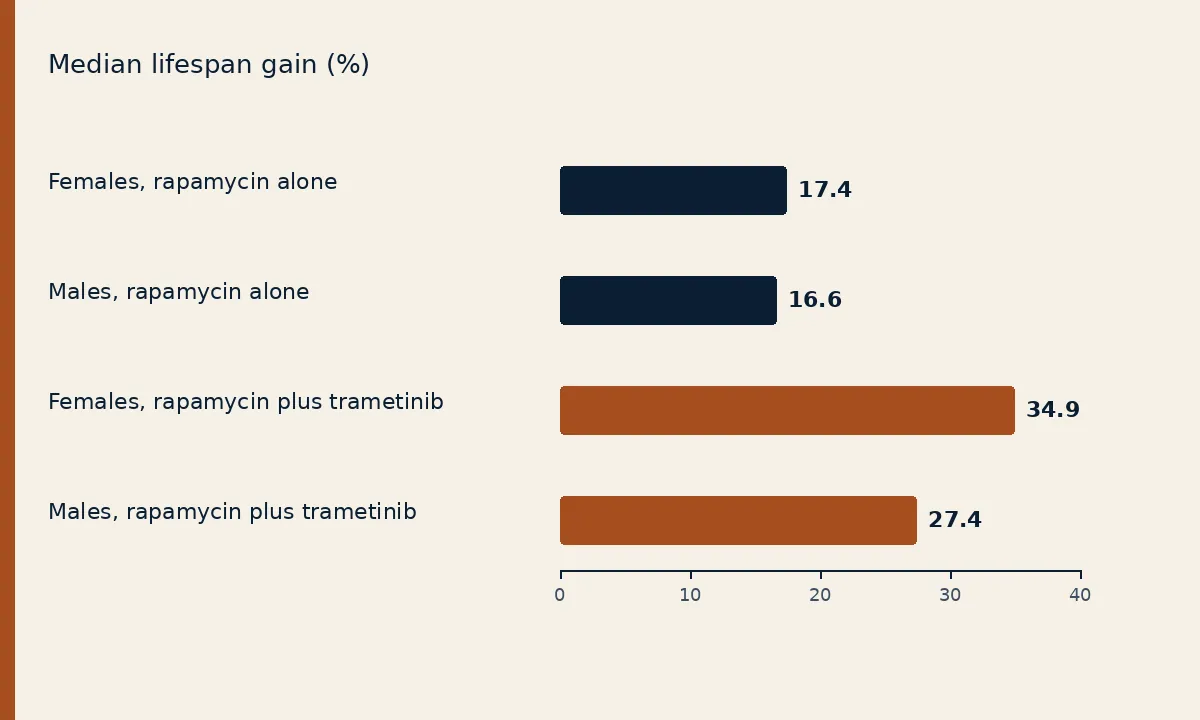
The combo mice also had fewer liver tumors in both sexes and less inflammation in the brain, kidney, spleen and muscle. That is healthspan, not just a longer stay in the cage.
Is there a German rapamycin analog that slows aging in people?
Direct answer
No. A post going around says a German team found a rapamycin analog that slows aging in people. We checked the record: the German work is in mice, and here is what people have actually shown.
We searched PubMed and ClinicalTrials.gov for any German human trial of a new rapamycin analog for aging. Nothing. The German result that does exist is the Cologne mouse combo above, and it is a strong result on its own. It does not need to be dressed up as a human trial.
The real analog program is American. In February 2026, the US health research agency ARPA-H awarded Cambrian BioPharma up to $30.8 million to test whether a daily oral "novel rapamycin analog" improves aging outcomes in older Americans. It has just started. No results yet.
What has rapamycin done for aging in people?
Direct answer
The clearest human wins are in the immune system. In randomized trials of older adults, low doses of rapamycin-type drugs raised flu vaccine responses by about 20 percent, cut the infection rate over the next year, and switched on antiviral genes.
Your immune system ages right along with you. That is why a cold you shook off at 30 can flatten you at 75. So these results matter, even if the word "lifespan" never shows up in them.
According to Mannick and colleagues in Science Translational Medicine (2014), everolimus raised older volunteers' flu vaccine response by about 20 percent. It also cut the share of T cells carrying PD-1, a brake signal that rises with age.
The follow-up was bigger. According to Mannick and colleagues (2018), 264 older adults got a low-dose mTOR combo or the comparison for 6 weeks. The drug group reported significantly fewer infections for a full year afterward (P = 0.001), with more antiviral gene activity and a better flu vaccine response.
Six weeks of pills. A year of fewer infections. Show me a supplement aisle that can claim that with a other group.
Then the big test. According to Mannick and colleagues in Lancet Healthy Longevity (2021), in the phase 2b trial of 652 older adults, the best drug group had lab-confirmed respiratory infections at 19 percent versus 28 percent in the other group. The phase 3 trial in 1,024 older adults did not repeat that on its new endpoint, symptoms with or without a lab test. Antiviral genes still went up in both trials.
One miss on a looser endpoint does not erase three trials of immune signal. It means the endpoint changed and the result got blurrier.
Funding, plainly: Novartis ran the 2014 and 2018 trials. resTORbio, which made the drug, and the National Institute on Aging funded the 2021 trials.
From the archive
Know your starting numbers before you try to move them. Build a blood test plan
Read it on the archiveWhat did PEARL and the smaller rapamycin trials find?
Direct answer
PEARL, the longest trial in healthy adults, found rapamycin was safe over 48 weeks, with lean tissue and pain better in women on the higher dose. Smaller trials showed short-term safety and lower DNA-damage markers in immune cells. One exercise trial came up short.
According to Moel and colleagues in Aging (2025), PEARL (NCT04488601) ran 48 weeks, randomized. Visceral fat, the main goal, did not change. Side effects matched the other group. Women on the higher weekly dose gained lean tissue and reported less pain. The lower dose group reported better emotional well-being and general health.
Who ran it: AgelessRx, a telehealth company that prescribes rapamycin. The authors are its employees and shareholders. That does not make them wrong. It means you read the numbers yourself, which you just did. The full PEARL breakdown lives in the rapamycin dosing debate.
The smaller trials, in plain English:
- 01Kraig 2018, 25 adults aged 70 to 95, 8 weeks. Randomized against the other group. No serious problems, and no change in thinking, grip strength or walking speed in two months. Kraig and colleagues called it safe in the short term.
- 02Kell 2026, 9 older men, 4 months. Randomized against the other group, tiny. Immune cells on rapamycin carried less p21, a marker of DNA damage driven cell aging. Tiny group, interesting signal.
- 03RAPA-EX-01 2026, 40 adults aged 65 to 85, 13 weeks. Weekly sirolimus (rapamycin) added nothing to home exercise gains on chair stands and brought more minor side effects.
That last one is a real result, and it belongs on the scoreboard. It is also one 13-week trial of one schedule paired with exercise. It answers "does this schedule boost a beginner workout plan?" It does not answer "does rapamycin slow aging?"
| Human trial | People | Design | What moved | What did not |
|---|---|---|---|---|
| Mannick 2014 | Older volunteers | Randomized | Flu vaccine response up about 20% | Not a lifespan study |
| Mannick 2018 | 264 older adults | Randomized, 6 weeks | Fewer infections for a year, P = 0.001 | Not a lifespan study |
| Mannick 2021 | 652 (phase 2b), 1,024 (phase 3) | Randomized | Infections 19% vs 28% in phase 2b | Phase 3 endpoint not met |
| PEARL 2025 | Healthy adults, 48 weeks | Randomized | Lean tissue and pain (women), well-being | Visceral fat |
| RAPA-EX-01 2026 | 40 adults aged 65 to 85 | Randomized, 13 weeks | Nothing beyond exercise | Chair stand gains |
Sources: PMIDs 25540326, 29997249, 33977284, 40188830, 41985884. All human trials.
Why has nobody tested rapamycin on human lifespan?
Direct answer
Because a lifespan trial in people takes decades and a fortune, and rapamycin is an old, cheap, generic drug. Nobody owns it, so nobody pays to prove it. The trials we do have measure what is cheap to measure: vaccines, infections, fat scans.
That is a funding problem, not a biology verdict.
Think about what "no human lifespan data" really means. It does not mean rapamycin failed. It means the experiment was never run. Mice live a couple of years. People live for decades. Run that math on a grant budget.
So the honest read is this. The mouse data is about as strong as aging biology gets. The human immune data points the same way. The human lifespan question is still open, and it is open because of money and time, not because the drug lost.
What rapamycin results are coming next?
Direct answer
Three things to watch: a finished everolimus trial in older adults with prediabetes, a funded US program testing a new daily rapamycin analog, and more PEARL follow-up work. None has posted human aging results yet.
- EVERLAST (NCT05835999). The University of Wisconsin tested everolimus in adults aged 55 to 80 with insulin resistance or prediabetes. According to ClinicalTrials.gov (record checked November 20, 2026), 106 people enrolled and the trial finished on July 22, 2026. No results posted yet.
- PrevenTOR. The Cambrian BioPharma analog program, funded February 2026. Early days.
- The mouse combo. The Cologne team called rapamycin plus trametinib a candidate for human testing. No human trial of the pair exists yet.
If you want to know the day any of these lands, that is exactly what my weekly update is for.
So should you care about rapamycin for aging?
Direct answer
Yes. It has one of the strongest mouse lifespan records of any drug, and real immune results in older people. It is also a prescription drug, so if it interests you, find a way with a doctor rather than around one.
Here is my position. Mainstream medicine loves to say "no evidence in humans" and stop there. That line is lazy. There is human evidence: randomized trials with hundreds of older adults and fewer infections to show for it. What is missing is a lifespan trial nobody is willing to fund.
It is not a miracle, and it is not a scam. The best part of the human story is still unwritten.
Want the rest of the field ranked the same way? Read the 2026 mouse lifespan retest, where eight other compounds came up empty, and the senolytics evidence for the other big drug idea in aging. You can also check the rapamycin and everolimus profiles. Human fitness cohorts are the other longevity piece: VO2 max and longevity.
Review: the rapamycin scoreboard in five lines
- Late-start rapamycin lengthened mouse lives at three labs in 2009.
- Adding trametinib pushed median mouse lifespan gains to about 35 percent in females.
- Low-dose mTOR drugs left older people with fewer infections for a whole year.
- Women in PEARL gained lean tissue, and side effects tracked the other group.
- No human lifespan trial exists; cost and time explain it, not failure.
This is education, not medical advice. I am not a doctor, and I am not suggesting anything. Talk to a licensed clinician before you start, stop, or change anything.
Frequently asked questions
Does rapamycin slow aging in humans?
Nobody has run a human lifespan trial, so that exact question is still open. What people have shown: in randomized trials, older adults on low-dose mTOR drugs had stronger flu vaccine responses and fewer infections, and PEARL found lean tissue gains in women over 48 weeks.
How much does rapamycin extend life in mice?
In the 2009 Nature study, rapamycin started at 600 days raised age at 90 percent mortality by 14 percent in females and 9 percent in males. In a 2025 Max Planck study in mice, rapamycin alone raised median lifespan about 17 percent, and adding trametinib raised it about 35 percent in females.
What is the rapamycin and trametinib study?
It is a 2025 Nature Aging study from the Max Planck Institute for Biology of Ageing in Cologne, Germany. In mice, the two drugs together extended median lifespan by 34.9 percent in females and 27.4 percent in males, cut liver tumors and lowered inflammation. It has not been tested in people.
Is there a German rapamycin analog in human trials?
We found none in PubMed or ClinicalTrials.gov. The German result is the Cologne mouse study. The human analog program we found is American: ARPA-H funded Cambrian BioPharma in February 2026 to test a daily oral rapamycin analog in older adults, with no results yet.
What did the PEARL rapamycin trial find?
PEARL ran 48 weeks, randomized, in healthy adults. Visceral fat did not change, side effects matched the other group, women on the higher dose gained lean tissue and reported less pain, and the lower dose group reported better well-being. AgelessRx ran it.
Does rapamycin help your immune system as you age?
In randomized trials, yes on the measures tested. Everolimus raised older adults' flu vaccine response by about 20 percent, and a 6-week low-dose combo cut infections for a year in 264 older adults. A 1,024-person phase 3 trial missed its looser symptom endpoint.
Is rapamycin a prescription drug?
Yes. Rapamycin (sirolimus) and everolimus are prescription drugs.
From the archive
Get the next rapamycin result the week it lands, with the numbers checked. Get the weekly evidence update
Read it on the archiveCompound profiles mentioned
Sources
- Animal study2009
Rapamycin fed late in life extends lifespan in genetically heterogeneous mice.
started at 600 days; age at 90% mortality up 14% (females) and 9% (males) at three test sites.
Nature - Animal study2025
The geroprotectors trametinib and rapamycin combine additively to extend mouse healthspan and lifespan.
combination raised median lifespan 34.9% (females) and 27.4% (males); rapamycin alone 17.4% and 16.6%; fewer liver tumors, less inflammation.
Nat Aging - Study in people2014
mTOR inhibition improves immune function in the elderly.
everolimus raised flu vaccine response about 20% and cut PD-1 positive T cells in older volunteers. Novartis.
Sci Transl Med - Study in people2018
TORC1 inhibition enhances immune function and reduces infections in the elderly.
264 older adults, 6 weeks; fewer infections over a year (P = 0.001), more antiviral gene expression, better flu vaccine response. Novartis.
Sci Transl Med - Study in people2021
Targeting the biology of ageing with mTOR inhibitors to improve immune function in older adults: phase 2b and phase 3 randomised trials.
phase 2b, 652 people, lab-confirmed respiratory infections 19% vs 28% pooled the other group (p = 0.02); phase 3, 1,024 people, symptom endpoint not met (26% vs 25%); antiviral genes up in both. resTORbio and NIA funded.
Lancet Healthy Longev - Study in people2025
Influence of rapamycin on safety and healthspan metrics after one year: PEARL trial results.
48 weeks; visceral fat unchanged; adverse events similar to the other group; lean tissue and pain improved in women on 10 mg weekly; well-being and general health improved on 5 mg. AgelessRx.
Aging (Albany NY) - Study in people2018
A randomized control trial to establish the feasibility and safety of rapamycin treatment in an older human cohort: Immunological, physical performance, and cognitive effects.
25 adults aged 70 to 95, 8 weeks; short-term safe; no change in cognition, physical performance or self-rated health.
Exp Gerontol - Study in people2026
Rapamycin Exerts Its Geroprotective Effects in the Ageing Human Immune System by Enhancing Resilience Against DNA Damage.
9 older men (4 rapamycin, 5 the other group), 4 months; p21 lower in immune cells on rapamycin.
Aging Cell - Study in people2026
Exercise and Weekly Sirolimus (Rapamycin) in Older Adults: RAPA-EX-01 Randomised, Double-Blind, Placebo-Controlled Trial.
40 adults aged 65 to 85, 13 weeks; no added chair-stand gain over exercise alone; more minor adverse events.
J Cachexia Sarcopenia Muscle - Study in people2026
Everolimus Aging Study (EVERLAST)
everolimus in adults 55 to 80 with insulin resistance or prediabetes; 106 enrolled; completed July 22, 2026; no results posted.
ClinicalTrials.gov NCT05835999
Read next
Longevity /
The Rapamycin Dosing Debate: What PEARL Tested, the Bioavailability Problem, and What Is Unproven
A plain-English review of the rapamycin evidence in people: the 48-week PEARL study (Aging, 2025), the finding that pharmacy-made rapamycin gets only about 31 percent as much drug into the blood as brand-name pills, the 333-person user survey, the case for weekly dosing, the mouse lifespan results, and why nobody has shown it lengthens human life.
Research /
2026 Mouse Lifespan Retest: Eight Compounds, No Gains
In 2026 the US mouse lifespan testing program retested astaxanthin, meclizine, mitoglitazone, pioglitazone, alpha-ketoglutarate, mifepristone, methotrexate and atorvastatin with telmisartan. None made mice live longer. What changed, and why dose and starting age matter.
Longevity /
Senolytics in 2026: Dasatinib plus Quercetin, Fisetin, and What Human Trials Have Shown
Every senolytic study in people that has reported as of September 2026: the fisetin studies (one failed, two still unfinished), foselutoclax in the eye, RLS-1496 on skin, and the small dasatinib plus quercetin tests in lung scarring and kidney disease. Plus why the capsules sold as senolytics have nothing to do with any of it. Plain English.
Educational use only. This database summarizes published research and is not medical advice. Where a dose appears it is a record of what a trial or clinic ran, or what people describe doing, with its source attached. Nothing here is a recommendation for personal use. Sellers named on the price pages are ranked by certificate tier, then price. No seller pays this site anything today. Naming a seller is not a recommendation to buy or use anything.