Regulation / Published Nov 9, 2026 / Reviewed Nov 9, 2026 / 12 min read
Compounded Peptides: The 10 Conditions in HHS's New 503A Policy, and What Evidence Sits Behind Them
Written by Aaron CuhaReviewed Nov 9, 2026
Compounded peptides now have a federal rulebook. HHS's October 2026 draft policy names six peptides and ten conditions for pharmacies. It is enforcement discretion, not approval.
Key takeaways
- 01HHS's draft policy names six peptides: BPC-157, Epitalon, KPV, MOTS-c, Semax and TB-500. None is FDA approved.
- 02It is enforcement discretion, not approval. HHS says it may revisit the policy if a safety signal appears.
- 03Pharmacies must meet ten conditions, including a valid certificate of analysis and a single active ingredient per product.
- 04Human evidence is thin. One 2026 review found three BPC-157 studies in 30 people, rated very low certainty.
- 05Public comments close the evening of November 13, 2026 (Mountain time) on docket HHS-OASH-2026-0496.
If you have been wondering whether compounded peptides are now allowed, the short answer is: partly, under conditions, and not as an approval. This page walks through what the policy actually says, using the document itself.
From the archive
Check where each peptide stands on our legal status tracker.
Read it on the archiveWhat is the HHS policy on compounded peptides?
Direct answer
On October 30, 2026 the Federal Register published a draft HHS policy on 503A compounding with certain peptides. HHS says it does not intend to take enforcement action against a state-licensed pharmacy, federal facility or licensed physician that meets its conditions. The policy is not binding and not an approval.
The notice is 91 FR 68526, document 2026-22192. It calls the policy a draft. It says the policy covers the period while the official list of allowed compounding ingredients, the 503A bulks list, is developed through rulemaking.
The policy text, which HHS publishes as a PDF with its appendices, says compounded drugs are not FDA approved. The FDA does not review their safety, effectiveness or quality before they are sold. The same PDF says HHS may revisit the policy if a safety signal or a product quality problem shows up.
For the vote history and the April 2026 list changes, read our tracker, FDA peptide status in 2026. This post goes deeper on one thing the tracker could not cover: the conditions inside the policy.
Which six peptides does the policy name?
Direct answer
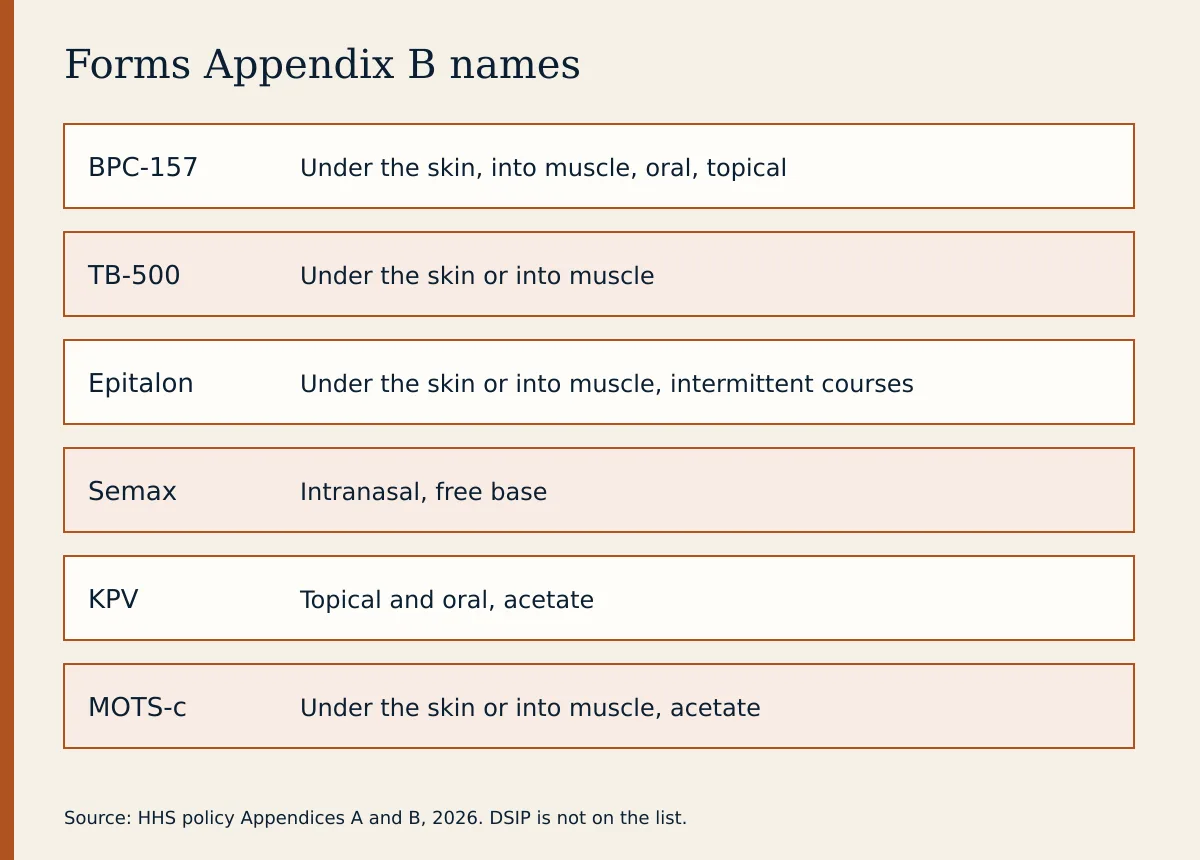
Appendix A of the HHS policy lists six peptide bulk drug substances: BPC-157, Epitalon, KPV, MOTS-c, Semax and TB-500. DSIP is not on the list. For each one, the policy limits which forms the pharmacy may make.
The routes below are a record of what Appendix B of the HHS policy describes. They are not advice for any person.
| Peptide | Forms named in Appendix B | Extra limit HHS names |
|---|---|---|
| BPC-157 | Injected under the skin or into muscle, oral, topical | Made from API with a qualifying certificate |
| TB-500 | Injected under the skin or into muscle | Injectable forms only |
| Epitalon | Injected under the skin or into muscle | Intermittent courses, not continuous use |
| Semax | Intranasal | Free base form |
| KPV | Topical and oral | Acetate form |
| MOTS-c | Injected under the skin or into muscle | Acetate form |
HHS also writes that the Pharmacy Compounding Advisory Committee (PCAC) voted in favor of each peptide on this list. An advisory vote, not a decision, is what that was. The policy leans on those votes as one of its stated reasons.
What are the ten conditions for 503A peptides?
Direct answer
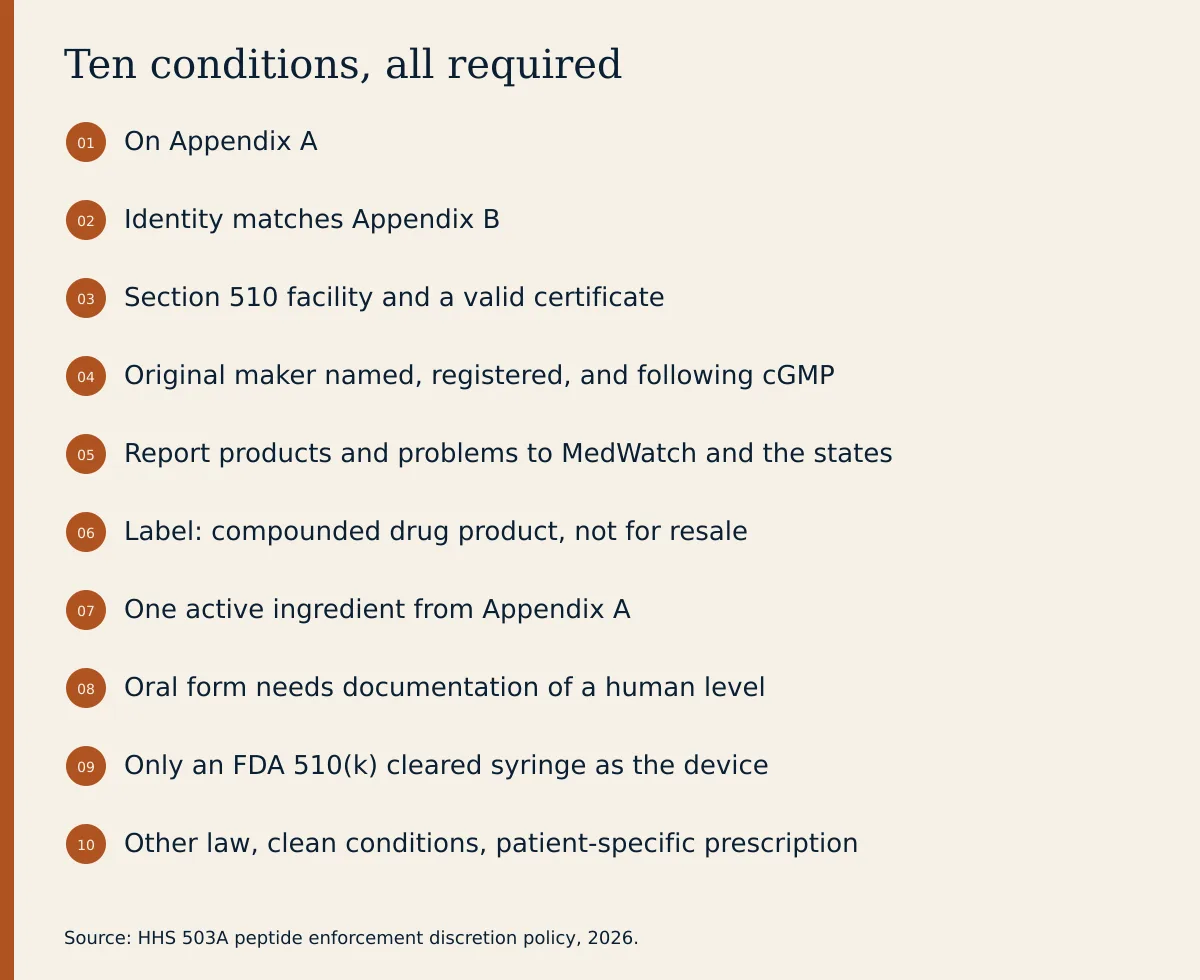
The policy applies only when all ten circumstances are present. They cover the list itself, identity, a lab certificate, the manufacturer, reporting, labeling, one active ingredient per product, oral claims, the syringe, and general law. Miss one and the protection HHS describes does not apply.
Here is the list, in plain English, from the policy's own wording.
- 01The peptide must appear in Appendix A.
- 02It must match the identity and route limits in Appendix B, including sequence, structure and molecular weight.
- 03It must come from a facility registered with the FDA under section 510 and have a valid certificate of analysis.
- 04The original maker, not just a reseller, must be registered, follow current good manufacturing practice, and be named on the certificate.
- 05The pharmacy must report products made, serious adverse events and quality problems to the FDA's MedWatch program and to the states involved.
- 06The label must say: "This is a compounded drug product. Not for resale."
- 07Each product may contain only one active ingredient from Appendix A.
- 08An oral form needs documentation that it reaches an adequate level in the human body.
- 09The only delivery device packed with the product is an FDA 510(k) cleared syringe.
- 10The product must follow every other part of the law, including clean conditions and a patient-specific prescription.
Condition 10 matters most for readers. A patient-specific prescription is what 503A compounding is. Nothing in the policy turns a vial labeled for research into a legal product.
Why is the certificate of analysis the center of the policy?
Direct answer
HHS says its policy is meant to discourage widespread use of research-use-only peptides from foreign manufacturers, which it calls a safety risk. Its tool is documentation. A certificate of analysis lets a pharmacy show what is in the material and what was tested.
In the policy's words, the limited compounding it allows gives patients "a more controlled alternative" to research-use-only products. That is HHS's stated reason, and you can read it in the policy PDF. Whether it works in practice is a separate question the document does not answer.
The testing standard in Appendix B is long. It lists tests for identity, assay, peptide-related impurities, residual solvents, elemental impurities, bioburden and bacterial endotoxins. It also asks for the certificate to name the method used and the reference standards behind it.
If you want to understand what a good certificate looks like, our guide how to read a peptide certificate of analysis walks through each line. The same ideas apply here.
From the archive
Get the weekly evidence update.
Read it on the archiveWhat does human evidence say about these peptides?
Direct answer
Very little controlled human evidence exists for these six. A 2026 systematic review of BPC-157 found three small studies in 30 people and rated the certainty of evidence very low. A 2026 review of Epitalon found no adequately powered randomized trial.
According to a systematic review in Acta Orthopaedica Belgica (October 2026), only three studies in 30 people met its criteria for BPC-157. They were a retrospective study of knee injections (16 people), a retrospective pilot in interstitial cystitis (12 people) and a pilot of intravenous safety (2 people). The authors rated the studies poor in quality and the overall certainty very low.
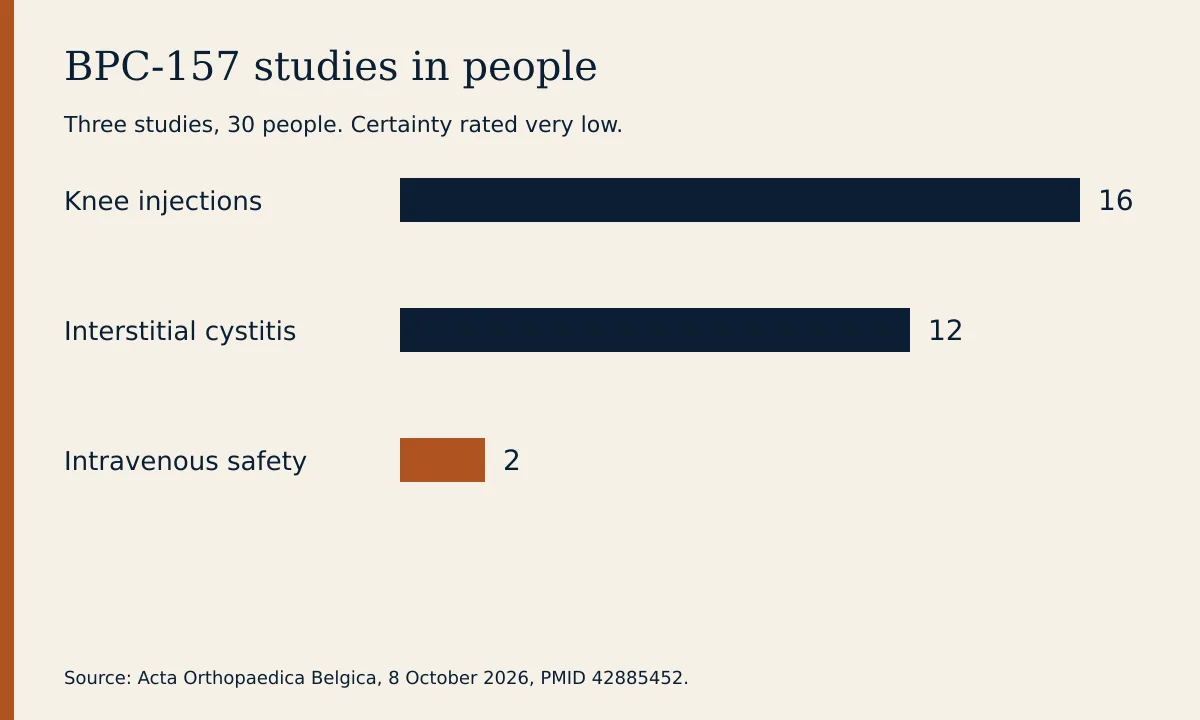
Those authors also wrote that BPC-157 should not be used clinically in humans outside ethically approved, regulated, high-quality trials. That is their conclusion, and it sits uneasily next to a policy that allows compounding. Both facts are worth holding at once.
An earlier review, published in HSS Journal in 2025, found 36 studies on BPC-157, of which 35 were preclinical and one was clinical.
For Epitalon, a 2026 narrative review in the International Journal of Molecular Sciences says human evidence is limited to small physiological or biomarker studies and an older controlled study in retinitis pigmentosa. It also says no adequately powered randomized trial has established therapeutic benefit, and that dose-ranging and long-term safety data remain inadequate.
For MOTS-c, the policy cites a randomized placebo-controlled trial of an analogue. We could verify one early study of an analogue called CB4211: NCT03998514 is a randomized, double-blind, placebo-controlled phase 1 study, sponsored by CohBar, with 88 people enrolled. The registry lists the study as completed. It tests safety and how the body handles the drug. An analogue is a different molecule, so it does not show what MOTS-c itself does.
What do animal studies add?
Direct answer
Animal studies show biological activity, not benefit for people. For KPV, the mouse data are about gut inflammation. They are a reason to run human trials, and they do not replace them.
In mice, a 2008 study in Inflammatory Bowel Diseases found that the tripeptide KPV reduced inflammation in two models of colitis, and that treated mice recovered weight sooner. This was an animal study. It did not test people.
HHS itself leans on mechanism and absence of reported harm for several peptides. For example, its policy describes the FDA staff's safety concerns for TB-500, Epitalon and Semax as "inferential" or "mechanistic" rather than observed. That is HHS's reading. The policy also records that the FDA's drug center (CDER) recommended against listing each of them.
A concern that has not been seen is not the same as a safety record. Neither side of this debate has the large human trials that would settle it.
What does the policy not do?
Direct answer
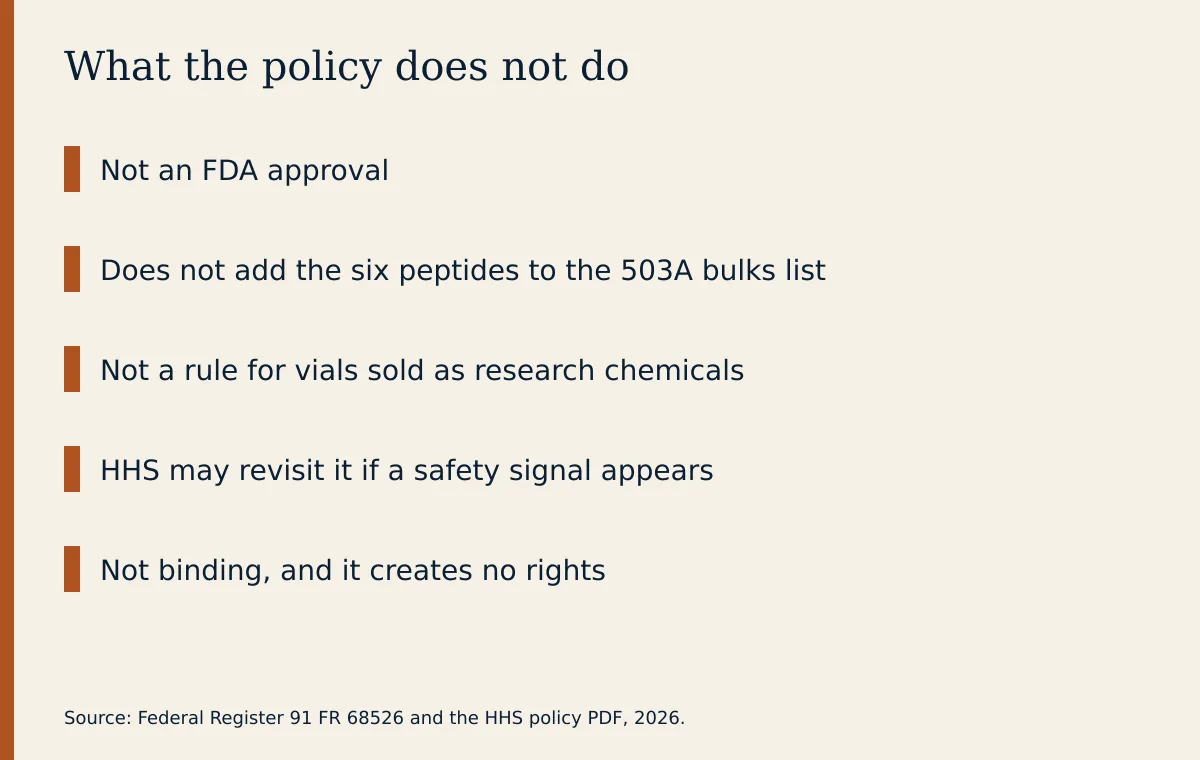
The policy does not approve any peptide, does not add one to the 503A bulks list, does not bind state pharmacy boards, and does not cover vials sold for research use. It says it creates no rights for any person and is not binding on HHS or the public.
- It is enforcement discretion, not approval. The FDA has not reviewed these products for safety or effectiveness.
- It does not add the six peptides to the 503A bulks list. That needs rulemaking.
- It covers 503A compounding with a prescription. It is not a rule for online research vials.
- It can change. HHS says it may revisit the policy if a safety signal or quality problem arises.
- It does not tell you what is right for your body. Only a clinician who knows you can do that.
Some readers will see the policy as long-overdue access. Others will see it as moving ahead of the science. The document supports parts of both views, and we try to show each one fairly.
What questions are worth bringing to a clinician or pharmacy?
Direct answer
If a clinician offers a compounded peptide, the conditions above give you concrete questions. They focus on the source of the material, the certificate, the single ingredient, and how problems get reported.
- Is the product a single active ingredient from the Appendix A list?
- Can the pharmacy show a certificate of analysis that names the original manufacturer?
- Does the label say it is a compounded drug product?
- How are side effects and quality problems reported to the FDA?
- What evidence in people supports this use, and how strong is it?
- Are you being told this is approved? It is not.
These are questions, not a checklist for treatment. Your clinician decides what applies to you. Reported effects by drug class, kept separate from this policy, are in peptide side effects by class.
Baseline lab work can also help a conversation, and our bloodwork plan is free.
When do public comments close on the HHS peptide policy?
Direct answer
The Federal Register notice allows written comments for two weeks after its October 30, 2026 publication. Regulations.gov lists the comment period ending at 04:59 UTC on November 14, 2026, which is the evening of November 13 in Mountain time.
Comments go to docket HHS-OASH-2026-0496 on regulations.gov. HHS says public comments may give the FDA additional evidence to consider in rulemaking, so the evidence you can point to is the part that counts.
On November 9, 2026, the date of this page, the regulations.gov API showed the comment period as open. The notice itself calls the policy a draft. A draft can change after comments, and the PDF already says HHS may revisit the policy if a safety signal or a quality problem appears.
From the archive
See which peptides the FDA has actually approved.
Read it on the archiveFrequently asked questions
Are compounded peptides legal now?
Not as approved drugs. HHS's draft policy says it does not intend to enforce against 503A compounders who meet ten conditions for six named peptides. It is enforcement discretion, it is not binding, and it can change.
Which peptides are on the HHS 503A list?
Appendix A names BPC-157, Epitalon, KPV, MOTS-c, Semax and TB-500. DSIP is not on it. Appendix B limits the forms for each peptide.
Is BPC-157 FDA approved?
No. A 2026 systematic review found three human studies in 30 people and rated the certainty very low. The HHS policy is not an approval.
Does this policy cover peptides sold as research chemicals?
No. The policy applies to 503A compounding with a patient-specific prescription. HHS says it wants to move people away from research-use-only peptides from foreign manufacturers.
What is a certificate of analysis in peptide compounding?
It is a lab report on a lot of raw material. HHS's policy requires a valid one that lists tests such as identity, impurities and endotoxins, and names the original manufacturer.
Why does the policy allow only one active ingredient per product?
HHS says single-ingredient products make it easier to link side effects or results to one substance, which helps safety monitoring. Blends are outside the policy.
When do comments on the peptide policy close?
Two weeks after October 30, 2026. Regulations.gov shows the period ending November 14, 2026 at 04:59 UTC, which is the evening of November 13 in Mountain time.
Compound profiles mentioned
- BPC-157Limited. People have taken it in a published study, but fewer than 100 of them. 3 completed trials, 31 people given it.Healing & Recovery
- TB-500Preliminary. Studied in people, but no published study has had people take it. 1 registered with no result.Healing & Recovery
- KPVAnimal or lab only. Only animal or lab studies on this page. No study in people yet. 2 animal studies, no human study.Healing & Recovery
- MOTS-cLimited. People have taken it in a published study, but fewer than 100 of them. 1 completed trial, 30 people given it.Longevity
- EpitalonModerate. At least one finished study in people, and at least 100 people who took it. 5 completed trials, 266 people given it.Anti-aging
- SemaxModerate. At least one finished study in people, and at least 100 people who took it. 4 completed trials, 354 people given it.Nootropic & CNS
Sources
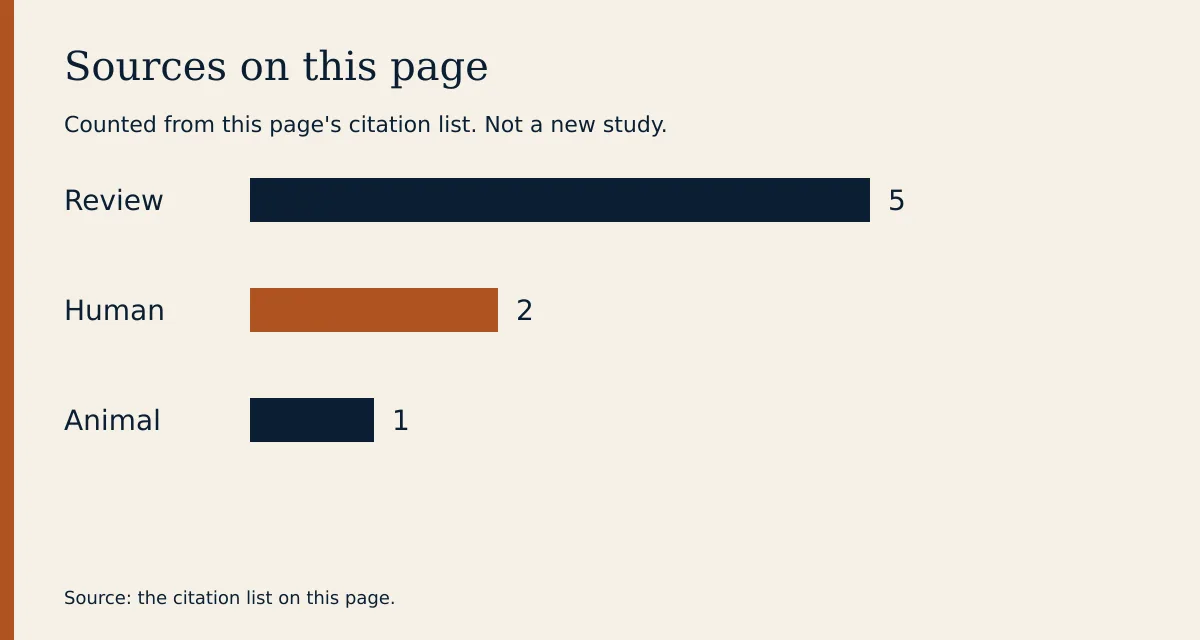
- Review of studies2026
Enforcement Discretion Policy Regarding 503A Compounding Using Certain Peptide Bulk Drug Substances (91 FR 68526)
Draft HHS policy published October 30, 2026. Comments for two weeks. Not binding.
Federal Register - Review of studies2026
HHS Enforcement Discretion Policy Regarding 503A Compounding Using Certain Peptide Bulk Drug Substances, with Appendices A and B
Ten conditions, six named peptides, route limits and the testing standard.
HHS - Review of studies2026
Docket HHS-OASH-2026-0496
Comment period open, ending at 04:59 UTC on November 14, 2026.
Regulations.gov - Study in people2026
Human evidence for BPC-157 in orthopaedic and regenerative medicine: a systematic review of efficacy and safety
Three studies, 30 people, poor quality, very low certainty of evidence.
Acta Orthopaedica Belgica - Review of studies2025
Emerging Use of BPC-157 in Orthopaedic Sports Medicine: A Systematic Review
36 studies included, 35 preclinical and 1 clinical.
HSS Journal - Review of studies2026
Epitalon and Epithalamin: A Narrative Review of Mechanistic, Preclinical, and Clinical Evidence
Human evidence limited to small studies. No adequately powered randomized trial.
International Journal of Molecular Sciences - Animal study2008
Melanocortin-derived tripeptide KPV has anti-inflammatory potential in murine models of inflammatory bowel disease
In mice, KPV reduced inflammation in two colitis models.
Inflammatory Bowel Diseases - Study in people2021
A Phase 1a/1b Study of CB4211 in Healthy Non-obese Subjects and Subjects With Nonalcoholic Fatty Liver Disease
Randomized, double-blind, placebo-controlled phase 1 study of a MOTS-c analogue, 88 enrolled, sponsor CohBar.
ClinicalTrials.gov
Read next
Regulation / Sep 8, 2026
FDA Peptide Status in 2026: The Category 2 Removals, the July Votes, and What Actually Changed
A dated tracker of where BPC-157, TB-500, KPV, MOTS-c, Epitalon, Semax and DSIP stand after the April 2026 list change, the July advisory votes, and the October 28, 2026 HHS enforcement discretion policy. Not FDA approval.
Safety / Sep 8, 2026
How to Read a Peptide Certificate of Analysis: HPLC Purity, Mass Spec Identity, Endotoxin, and Janoshik Verification
What each line on a peptide lab certificate means, what a purity number does and does not tell you, how to check a Janoshik report, and the warning signs the FDA's own 2026 review found in products on the market. Plain English. No seller recommendations.
Safety / Sep 8, 2026
Peptide Side Effects by Class: What Is Documented, What Is Anecdotal
A group-by-group table that separates side effects counted in studies and on FDA labels (GLP-1 drugs, bremelanotide, MK-677, elamipretide) from the stories that fill forums about BPC-157, TB-500, copper peptides and brain peptides. Plain English.
Educational use only. This database summarizes published research and is not medical advice. Where a dose appears it is a record of what a trial or clinic ran, or what people describe doing, with its source attached. Nothing here is a recommendation for personal use. Sellers named on the price pages are ranked by certificate tier, then price, and any affiliate income is disclosed there. Naming a seller is not a recommendation to buy or use anything.