Research / Published / Reviewed / 12 min read
Testosterone Therapy and Heart Risk: What 31 Trials Show

Written by Aaron CuhaReviewed Nov 20, 2026
Testosterone therapy did not raise heart attack or stroke risk in TRAVERSE, a 5,246-man randomized trial, and a new 31-trial pool found better heart markers. The one real signal: a modest rise in heart rhythm problems.
In this article
- Does testosterone therapy raise heart risk?
- What did the TRAVERSE trial find about heart attacks and strokes?
- Where did the "testosterone causes heart attacks" fear come from?
- What do the bigger trial pools show?
- Does getting your level back to normal matter?
- What about atrial fibrillation and heart rhythm?
- What should you check before and during testosterone therapy?
- Where do I land on testosterone and the heart?
- Review
- Frequently asked questions
- Sources
Quick note before we start: this is education and my opinion, not medical advice. Talk to a licensed clinician before you start, stop, or change anything.
You finally get your energy back, your drive back, your edge back. Then someone at a family barbecue tells you testosterone is going to give you a heart attack. Thanks, brother-in-law. Very helpful. I'm on TRT myself, so I went straight to the trials. If you want my bigger take on cholesterol and heart disease, that has its own page. This one stays on testosterone and your heart.
From the archive
See what human trials measured for testosterone, all in one place. Read the testosterone profile
Read it on the archive
Does testosterone therapy raise heart risk?
Direct answer
Not for heart attacks, strokes or heart deaths in the randomized trials. The biggest one, TRAVERSE, came out even between testosterone and the comparison. A new pool of 31 trials in 9,437 men found better heart markers, and it also recorded more rhythm problems.
The new paper comes from a Chinese team writing in the journal Endocrine in October 2026. They pooled every randomized trial they could find in middle-aged and older men with low or low-normal testosterone, published up to July 2024. Treatment ran from 40 days to 36 months.
Here's what jumped out at me. They looked at signs of how the heart and arteries were actually doing, not just at symptoms:
- Chest pain on a treadmill: men on testosterone went about 67 seconds longer before their heart tracing showed strain (the ST-segment drop doctors watch for), in trials lasting from a single dose to 14 weeks.
- Artery wall thickness: the carotid artery wall got slightly thinner, by 0.03 mm, in trials of 12 to 36 months.
- Rhythm: of the nonfatal heart events they tracked, rhythm problems were the one safety signal they flagged (more on that below).
According to Qin and colleagues (Endocrine, 2026), the pooled trials covered 9,437 men, and the authors concluded testosterone "appears to reduce overall cardiovascular risk factors" in these men. The authors declared no competing interests.
What did the TRAVERSE trial find about heart attacks and strokes?
Direct answer
TRAVERSE is the trial that should have ended this argument. It put 5,246 men with low testosterone and existing heart disease or high heart risk on testosterone gel or the comparison. Heart attacks, strokes and heart deaths came out even.
The details matter, because this was the toughest test you could design. More than half the men already had heart disease (2,847 of them). Most had high blood pressure and diabetes. Their starting testosterone sat at a median of 227 ng/dL. If testosterone were a heart grenade, this is the crowd where it would go off.
It didn't. According to Lincoff and colleagues (NEJM, 2023), a major heart event hit 182 men (7.0 percent) on testosterone and 190 men (7.3 percent) in the other group, a hazard ratio of 0.96. Men were followed for an average of 33 months. You can check the registry record yourself at ClinicalTrials.gov (NCT03518034).
Two things most write-ups skip:
- 01Lots of men quit. About 61 percent of men in each group stopped their gel at some point, according to the full paper. Even with that noise, there was still no heart-attack or stroke signal.
- 02It was a gel trial. TRAVERSE used a daily skin gel, with the amount adjusted to keep blood levels in a set range. It did not test injections.
Who paid for it? A group of testosterone makers led by AbbVie. That doesn't make it wrong. It means you read the numbers, not the press release. And the numbers say no excess heart attacks.
From the archive
Get the weekly evidence update: new human trials, no hype. Get The Dispatch
Read it on the archiveWhere did the "testosterone causes heart attacks" fear come from?
Direct answer
Mostly from one small trial stopped early in 2010 and two observational studies in 2013 and 2014. None of them were built to answer the heart question, and the bigger, better trials that came later did not repeat their results.
Here's the short history of the panic:
- The TOM trial (2010): 209 frail men, average age 74, many with high blood pressure, diabetes and obesity. It was stopped early after 23 men on testosterone versus 5 in the other group had heart-related events. According to Basaria and colleagues (NEJM, 2010), the authors themselves wrote that the small size and unusual group "prevent broader inferences." The trial is registered as NCT00240981.
- The VA angiogram study (2013): observational: it shows an association, not cause. It followed 8,709 veterans with low testosterone. The published paper was later corrected, and the corrected absolute difference had a confidence range from minus 1.4 to plus 13.1 percent (Vigen and colleagues, JAMA, 2013). That range includes zero.
- The prescription database study (2014): observational. It compared heart attack rates in the 90 days after a first testosterone prescription with the year before, in 55,593 men (Finkle and colleagues, PLoS One, 2014).
That's the evidence base that scared a generation of men off their own hormone. Then the randomized data showed up and the story fell apart.
What do the bigger trial pools show?
Direct answer
They line up with TRAVERSE: no rise in heart attacks, strokes or deaths. A 2024 pool of 30 trials and a 2022 pool built on raw patient data both came out even between testosterone and the comparison.
According to Hudson and colleagues (Lancet Healthy Longevity, 2022), the analysis covered 35 trials with 5,601 men, and 17 of those trials handed over individual patient data. Deaths were 6 of 1,621 men on testosterone versus 12 of 1,537 in the other group. That gap was not statistically significant, so I won't sell it as a win. But it sure isn't the death sentence people warned about. This one was funded by the UK's National Institute for Health Research, not a drug company.
The 2024 pool is bigger. According to Jaiswal and colleagues (Progress in Cardiovascular Diseases, 2024), 30 randomized trials with 11,502 patients showed no difference between testosterone and the comparison for heart attack (odds ratio 1.05), stroke (1.01), heart death (0.87) or death from any cause (0.94).
Here's every study in this post in one place:
| Study | Design | Men | Heart attacks, strokes, heart deaths |
|---|---|---|---|
| Qin 2026, Endocrine | Pool of 31 randomized trials | 9,437 | Event counts not in the abstract; slower treadmill strain, thinner artery wall, rhythm signal |
| TRAVERSE 2023, NEJM | Randomized trial, gel versus the other group | 5,246 | Even on major heart events (hazard ratio 0.96) |
| Jaiswal 2024, Progress in Cardiovascular Diseases | Pool of 30 randomized trials | 11,502 | Heart attack odds ratio 1.05, stroke 1.01 |
| Hudson 2022, Lancet Healthy Longevity | Pool of 35 randomized trials | 5,601 | 7.5% vs 7.2%; deaths 6 vs 12 |
| Sharma 2015, European Heart Journal | Observational, veterans | 83,010 | Lower heart attack and stroke when levels normalized |
| TOM 2010, NEJM | Small randomized trial, stopped early | 209 | 23 vs 5 heart-related events |
Source: the PubMed records linked in each row's section of this post.
Does getting your level back to normal matter?
Direct answer
In the biggest real-world dataset, yes. Veterans whose testosterone was brought back into the normal range had fewer heart attacks, fewer strokes and fewer deaths than untreated men. Men who were treated but never reached normal had no fewer heart attacks or strokes than untreated men.
This is observational: it shows an association, not cause. But look at the size. According to Sharma and colleagues (European Heart Journal, 2015), the study followed 83,010 male veterans with low testosterone. Compared with untreated men, the men whose levels normalized had a hazard ratio of 0.76 for heart attack, 0.64 for stroke and 0.44 for death from any cause.
A 2026 study followed 358,957 men who started testosterone. Over 10 years, heart events were recorded in 16.53 percent of the men with no record of low testosterone, and in 11.83 percent of the men who started it for documented low testosterone. The study is observational (Kerniss and colleagues, eBioMedicine, 2026). It records an association, not a cause.
The Sharma study, above, compared veterans whose levels reached the normal range with untreated men. The Kerniss study compared men who started testosterone with a documented low level with men who started it without that record. Those are two different comparisons.
What about atrial fibrillation and heart rhythm?
Direct answer
In the 31-trial pool, rhythm problems were more common on testosterone, with an odds ratio of 1.58 across 6,598 men. In TRAVERSE, atrial fibrillation was recorded in 3.5 percent of men on testosterone and 2.4 percent in the other group.
Those TRAVERSE numbers come from the full paper: 91 men on testosterone and 63 in the other group developed atrial fibrillation. The trial also recorded more acute kidney injury and more pulmonary embolism (a clot in the lung) on testosterone. The authors of the 31-trial pool called the clinical meaning of the rhythm difference "uncertain."
That is the rhythm result the trials recorded. The pool's authors left its clinical meaning uncertain. The papers report the counts. They do not turn the counts into instructions.
What should you check before and during testosterone therapy?
Direct answer
Start with bloodwork, not a guess. Confirm low testosterone on more than one morning test, know your red blood cell numbers, and keep checking them once you're on treatment. TRAVERSE built those checks right into its design.
Look at how the biggest heart trial ran things. TRAVERSE required two fasting morning testosterone levels under 300 ng/dL to get in. It adjusted each man's gel to keep his blood level in a set range, and it stopped treatment if hematocrit (the share of your blood made of red cells) went above 54 percent, according to the NEJM trial report.
The fastest way to get organized is our free blood test plan builder. While you're testing, Lp(a) is the inherited heart marker most men never check, and I broke down the pelacarsen Lp(a) trial results here. And if your wife or partner is asking about this too, read testosterone for women, because the evidence there is a different story.
Where do I land on testosterone and the heart?
Direct answer
I think the testosterone heart scare was built on weak evidence and kept alive by habit. The randomized trials, thousands of men deep, do not show more heart attacks or strokes. Test it, treat it, monitor it.
I'm on TRT. "Testosterone wrecks your heart" is not what the trials found. The men in TRAVERSE were older, sicker and higher risk than most guys reading this, and they still came out even on heart attacks and strokes.
The trials have limits, and here they are in one place: most ran under three years, TRAVERSE tested a gel and not injections, and the men studied had low or low-normal testosterone to begin with. Nobody has run a 10-year randomized heart trial. That's a funding gap, not a verdict.
Review
- Pooled trials of 30 or more studies show no excess heart attacks or strokes on TRT.
- TRAVERSE tested high-risk men for about three years and came out even on major heart events.
- The early scare rested on a stopped 209-man trial and two observational studies.
- Normalizing low testosterone tracked with fewer heart attacks and deaths in 83,010 veterans.
- Rhythm problems, including atrial fibrillation, were more common on testosterone in the trials.
This post is education and my opinion, not medical advice. The trials above have the limits I listed: mostly short, mostly gel or mixed products, and only in men with low or low-normal levels. Talk to a licensed clinician before you start, stop, or change anything.
Frequently asked questions
Does testosterone therapy increase the risk of heart attack?
Not in the randomized trials. In TRAVERSE, 5,246 men with low testosterone and high heart risk came out even on major heart events. A 2024 pool of 30 trials in 11,502 patients also found no rise in heart attacks.
Is TRT safe for men who already have heart disease?
TRAVERSE is the best answer we have. It enrolled 2,847 men who already had heart disease, and the overall result showed no excess heart attacks, strokes or heart deaths over about 33 months of follow-up.
Does testosterone cause atrial fibrillation?
It was more common on testosterone in the trials. TRAVERSE recorded atrial fibrillation in 3.5 percent of men on testosterone and 2.4 percent in the other group, and the 31-trial pool found an odds ratio of 1.58 for rhythm problems. The pool's authors called the clinical meaning of that difference uncertain.
Why did people think testosterone caused heart attacks?
Mostly because of the small TOM trial in 2010, which was stopped early after 23 versus 5 heart-related events in 209 frail older men, plus two observational studies in 2013 and 2014. Later randomized trials and trial pools with thousands of men did not repeat those results.
Does testosterone therapy reduce artery plaque?
The 31-trial pool found the carotid artery wall got thinner by 0.03 mm in trials lasting 12 to 36 months. Men on testosterone also lasted about 67 seconds longer on a treadmill before their heart tracing showed strain. Those are markers, not counts of heart attacks.
Does testosterone thicken your blood?
Red blood cell levels are one of the main things tracked on testosterone. TRAVERSE checked hematocrit throughout and stopped treatment in any man whose hematocrit stayed above 54 percent even at the lowest amount. That's why ongoing bloodwork matters.
What blood tests should I get before starting TRT?
TRAVERSE required two fasting morning testosterone levels under 300 ng/dL before enrolling anyone, and it tracked hematocrit. Our free blood test plan builder helps you organize the list.
From the archive
Know your testosterone, hematocrit and heart markers before anyone writes a prescription. Start with a blood test plan
Read it on the archiveCompound profiles mentioned
Sources
- Review of studies2026
Cardiovascular safety in middle-aged and older men under testosterone replacement therapy: a systematic review and meta-analysis.
31 RCTs, 9,437 men; ST-depression time +67.37 s; CIMT -0.03 mm; arrhythmia OR 1.58 (6,598 men); no competing interests.
Endocrine - Study in people2023
Cardiovascular Safety of Testosterone-Replacement Therapy.
5,246 men; MACE 7.0% vs 7.3%, HR 0.96; AF 3.5% vs 2.4%; more AKI and PE; funded by AbbVie and other testosterone makers. NCT03518034.
New England Journal of Medicine - Review of studies2022
Adverse cardiovascular events and mortality in men during testosterone treatment: an individual patient and aggregate data meta-analysis.
35 trials, 5,601 men; CV events 7.5% vs 7.2% (OR 1.07); deaths 6 vs 12 (OR 0.46, ns).
Lancet Healthy Longevity - Study in people2015
Normalization of testosterone level is associated with reduced incidence of myocardial infarction and mortality in men.
83,010 veterans; normalized vs untreated HR 0.44 death, 0.76 MI, 0.64 stroke.
European Heart Journal - Study in people2010
Adverse events associated with testosterone administration.
209 men, mean age 74; CV-related adverse events 23 vs 5. NCT00240981.
New England Journal of Medicine - Study in people2013
Association of testosterone therapy with mortality, myocardial infarction, and stroke in men with low testosterone levels.
8,709 veterans; corrected absolute risk difference 5.8% (95% CI -1.4% to 13.1%).
JAMA - Study in people2014
Increased risk of non-fatal myocardial infarction following testosterone therapy prescription in men.
55,593 men; post/pre 90-day MI rate ratio 1.36.
PLoS One - Review of studies2024
Association between testosterone replacement therapy and cardiovascular outcomes: A meta-analysis of 30 randomized controlled trials.
30 RCTs, 11,502 patients; MI OR 1.05, stroke 1.01, all-cause death 0.94, CVD death 0.87 (all ns).
Progress in Cardiovascular Diseases - Study in people2026
Off-label testosterone therapy is associated with higher long-term cardiovascular risk in men.
358,957 initiators; no documented hypogonadism vs documented: MACE 16.53% vs 11.83%, HR 1.51.
eBioMedicine
Read next

Research /
Testosterone for Women: The Hormone Medicine Handed to Men
You train, you eat right, and you still feel flat, soft and checked out. "Just aging," they say. I say look hard at testosterone for women before you accept that.
Research /
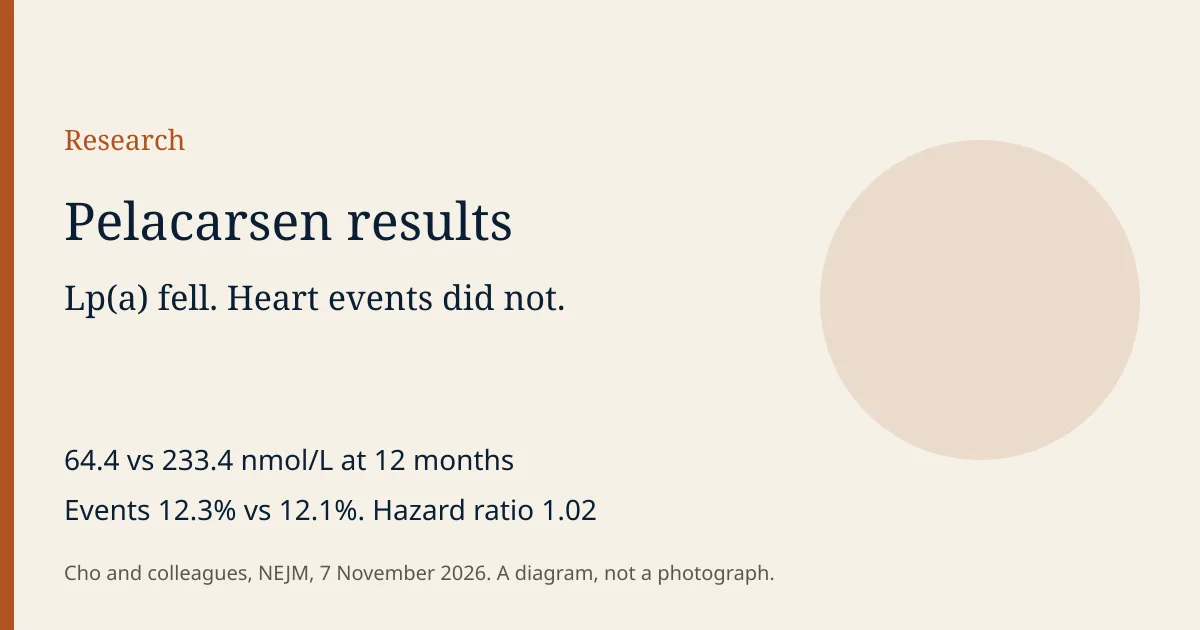
They Cut Lp(a) by 72 Percent. Heart Events Did Not Fall.
Pelacarsen results from a large human trial are in. Lp(a) fell sharply. Heart attacks, strokes, and urgent heart procedures did not. A high Lp(a) still marks risk.
Longevity /
What Reduces Arterial Plaque: Nattokinase, K2, D3, Berberine and the Surprises
What shrank arterial plaque on a scan: nattokinase at 10,800 FU a day in 1,062 people, vitamin K2 and D3 trials from 2026, berberine, aged garlic, EPA, interval training, the Mediterranean diet, intensive lifestyle change and cocoa flavanols. Doses, numbers, bleeding risks, every study linked.
Educational use only. This database summarizes published research and is not medical advice. Where a dose appears it is a record of what a trial or clinic ran, or what people describe doing, with its source attached. Nothing here is a recommendation for personal use. Sellers named on the price pages are ranked by certificate tier, then price. No seller pays this site anything today. Naming a seller is not a recommendation to buy or use anything.