Research / Published / Reviewed / 13 min read
They Cut Lp(a) by 72 Percent. Heart Events Did Not Fall.

Written by Aaron CuhaReviewed Nov 12, 2026
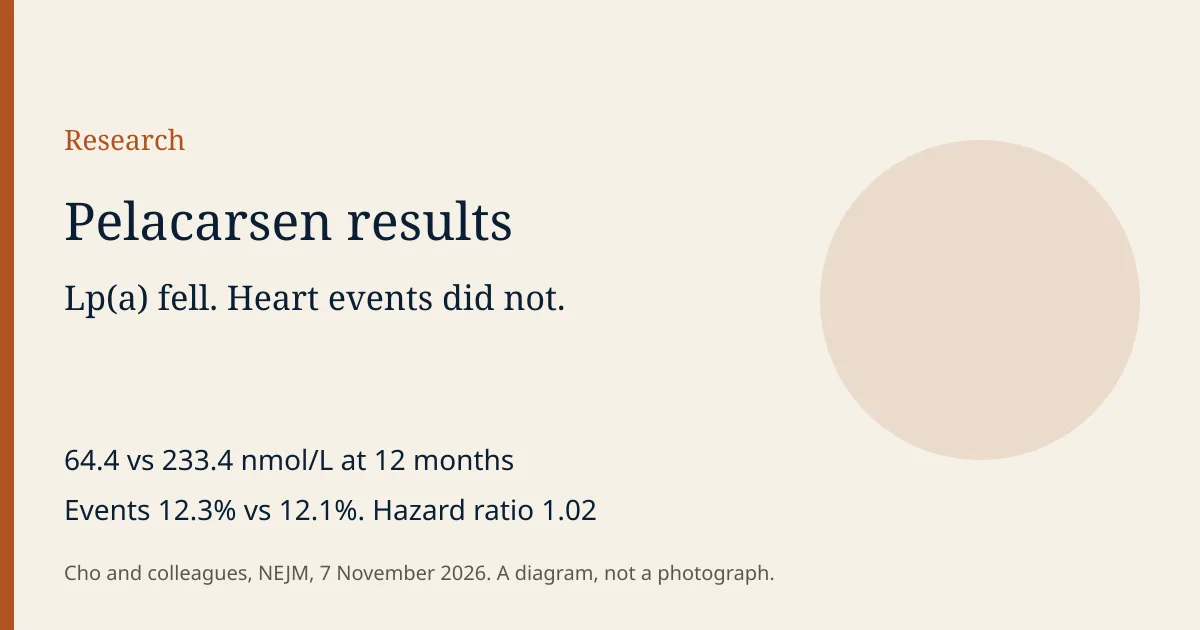
Pelacarsen results from a large human trial are in. Lp(a) fell sharply. Heart attacks, strokes, and urgent heart procedures did not. A high Lp(a) still marks risk.
In this article
- What do the pelacarsen results mean if your Lp(a) is high?
- Who was in this human phase 3 trial?
- How far did Lp(a) fall?
- Did heart events fall in the pelacarsen results?
- What did the extra pelacarsen results show?
- Why did a heart benefit seem likely?
- Did a second pelacarsen study count heart events?
- Which other Lp(a) trials are still running?
- What does a high Lp(a) still mean for you?
- Frequently asked questions
- Sources
From the archive
Read what an Lp(a) test measures, and what a single number cannot settle.
Read it on the archiveWhat do the pelacarsen results mean if your Lp(a) is high?
Direct answer
If your Lp(a) is high, these pelacarsen results say the blood number can fall hard without fewer heart events. The trial was in adults who already had heart disease. It does not make Lp(a) harmless. This first outcomes test missed the benefit people expected.
You may have been told a drug can bring a high Lp(a) down and protect your heart. This is the first large outcomes test of a drug built to do that. Scans of supplements, including nattokinase and vitamin K2, are a separate record in what reduces arterial plaque.
In the pelacarsen results, the blood level fell. Major heart events did not. That misses the expected benefit. It does not erase the finding that a high Lp(a) tracks with risk.
Lp(a) is lipoprotein(a), a cholesterol particle with an extra protein. Genes set most of the level. The Lp(a) page treats it as a number to know once.
Who was in this human phase 3 trial?
Direct answer
Adults with heart disease and an Lp(a) of at least 70 mg/dL got a monthly shot of pelacarsen or the comparison. It was a human phase 3 trial. Novartis funded it and is developing the drug. The result is an event count, not a schedule to copy.
Pelacarsen is an antisense drug. It blocks the liver from making part of the Lp(a) particle. The outcomes paper says Novartis funded the trial.
According to the Lp(a)HORIZON record on ClinicalTrials.gov, the sponsor is Novartis Pharmaceuticals, the study is phase 3, the status is completed, and actual enrollment is 8,323. Actual primary completion was 16 July 2026.
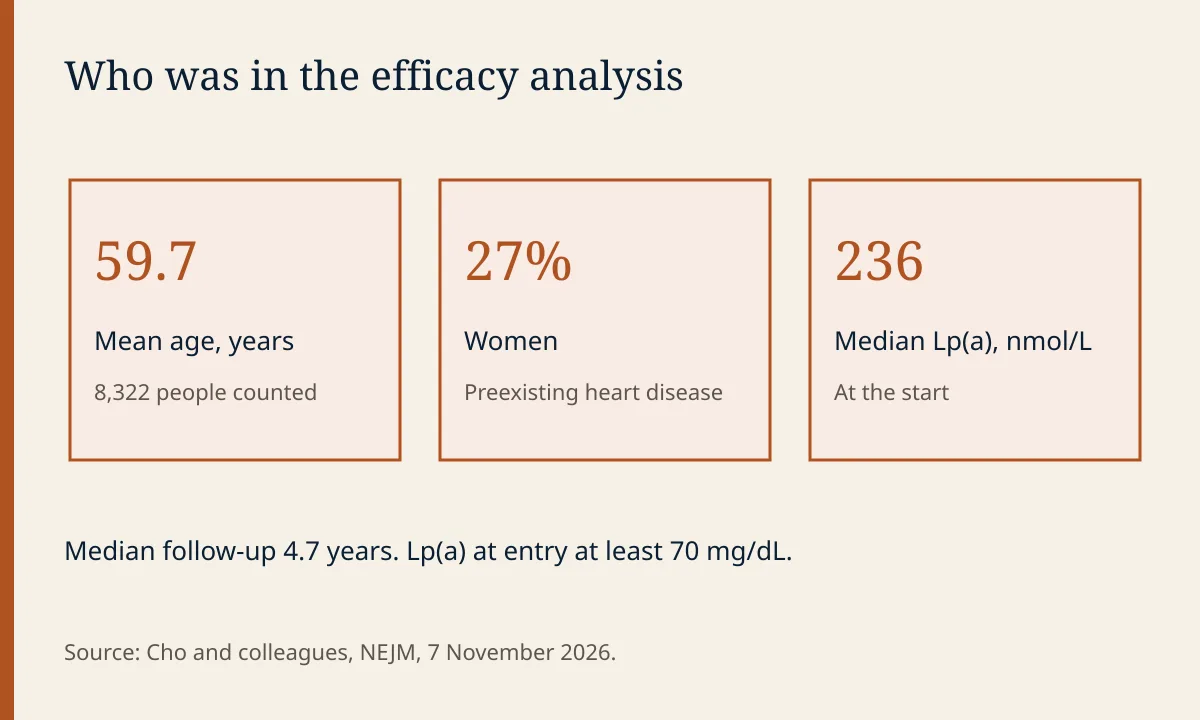
The paper uses a different enrollment count. It says 8,350 people were randomized, and 8,322 were in the efficacy analysis: 4,157 on pelacarsen and 4,165 in the other group. The event rates below come from the paper.
- International randomized trial, drug versus the other group.
- People already had cardiovascular disease. Entry Lp(a) was at least 70 mg/dL.
- Mean age 59.7 years. Women were 27.0 percent of the group.
- Median Lp(a) at the start was 236 nmol/L. Median follow-up was 4.7 years.
Every count below is from people. Pelacarsen is investigational. On 12 November 2026 a public Drugs@FDA search for the name pelacarsen returned no record. A trial report is not an approval.
How far did Lp(a) fall?
Direct answer
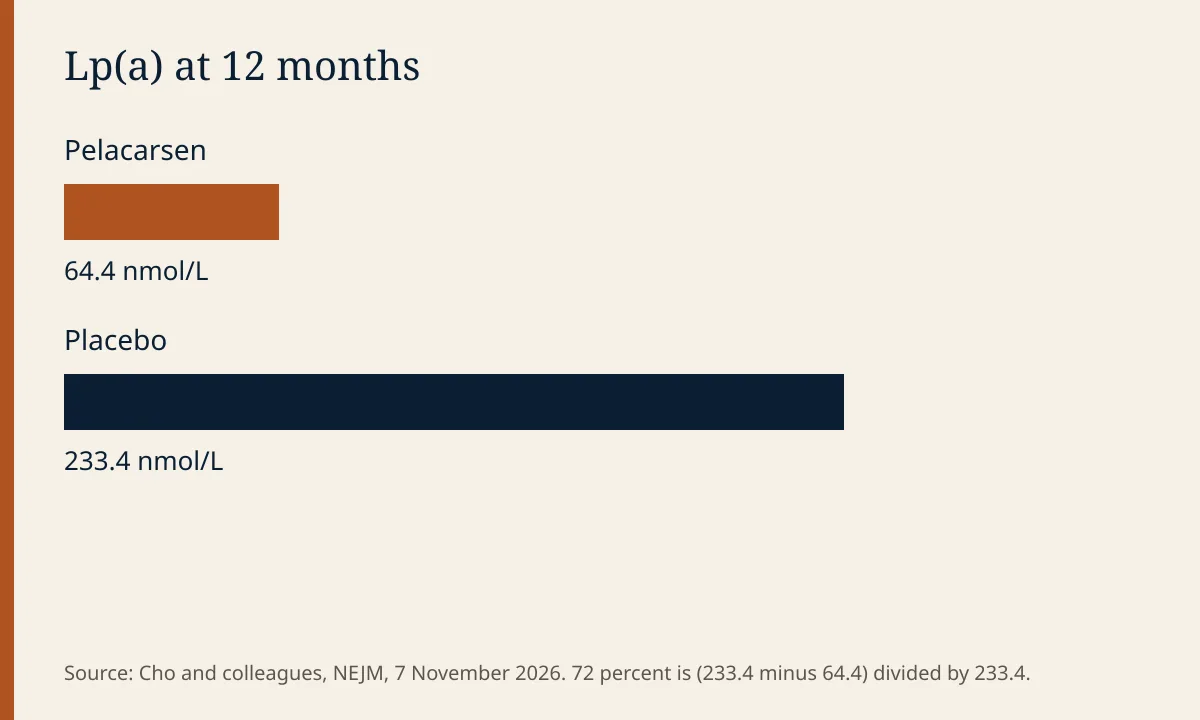
At 12 months, Lp(a) was 64.4 nmol/L on pelacarsen and 233.4 nmol/L in the other group. The paper prints those two levels. It does not print 72 percent. That figure is 233.4 minus 64.4, divided by 233.4.
The gap is 169 nmol/L. Divided by the other group level, that is about 0.72, or about 72 percent lower than the other group at the same visit. It is not each person's drop from their own starting level.
The starting median was 236 nmol/L. the other group was still near that, at 233.4. The drug group was far below both. Check those two levels before you repeat the percent. mg/dL and nmol/L do not share one conversion, so this page does not turn 169 nmol/L into mg/dL.
Did heart events fall in the pelacarsen results?
Direct answer
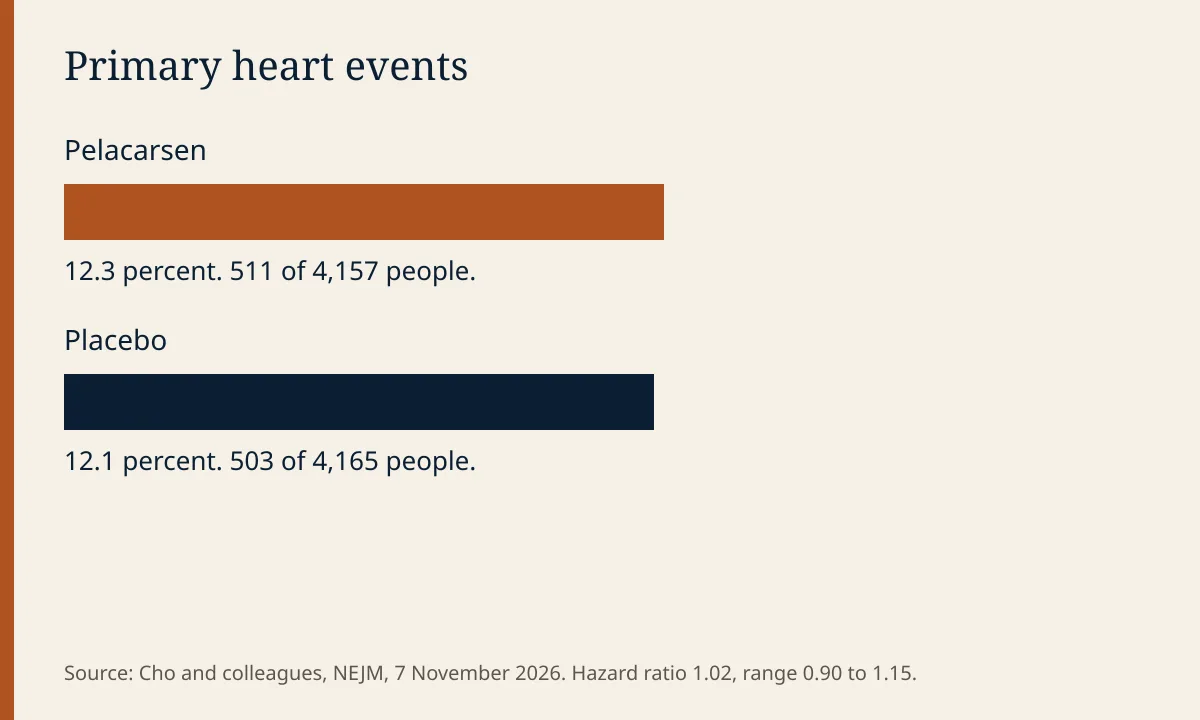
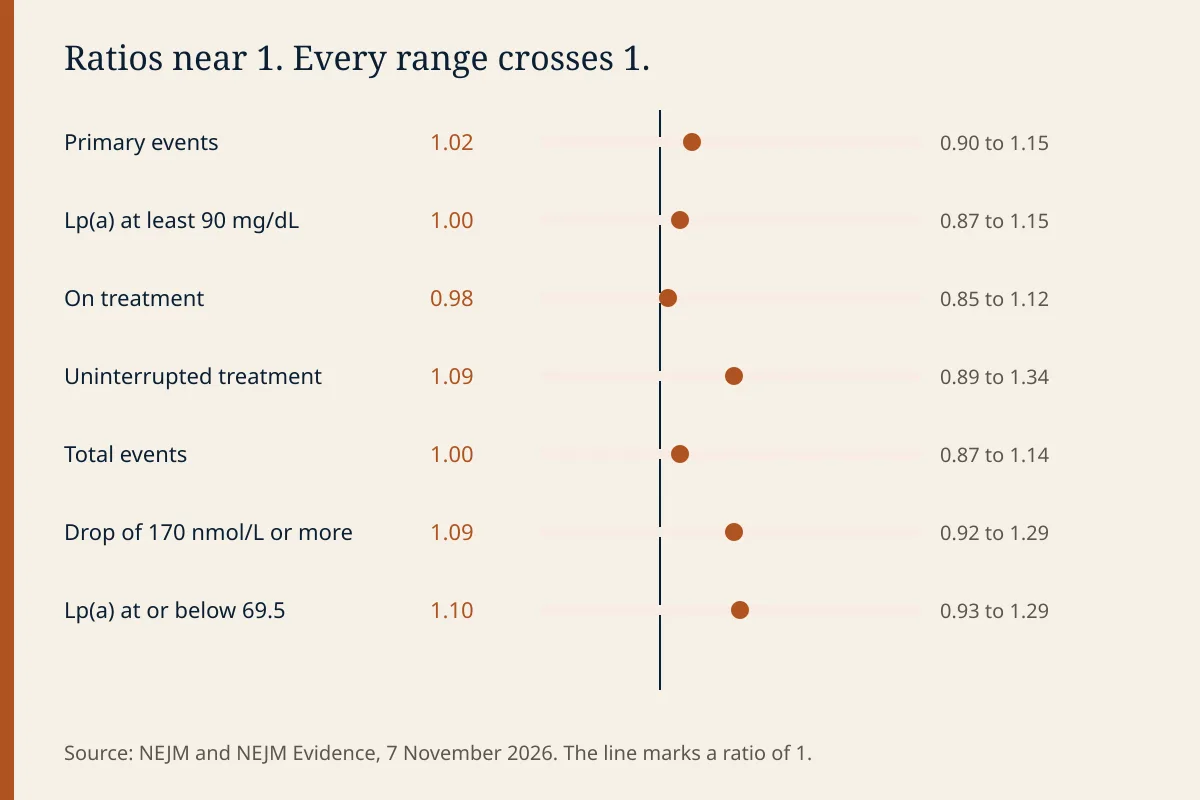
No. A primary event hit 12.3 percent of people on pelacarsen and 12.1 percent for comparison. The hazard ratio was 1.02. The range, 0.90 to 1.15, includes 1. Over a median of 4.7 years, events did not fall.
The primary endpoint was cardiovascular death, a nonfatal heart attack, a nonfatal stroke, or an urgent coronary procedure.
According to Cho and colleagues in the New England Journal of Medicine, a primary event occurred in 511 of 4,157 people on pelacarsen (12.3 percent) and in 503 of 4,165 in the other group (12.1 percent). The hazard ratio was 1.02, the range was 0.90 to 1.15, and P was 0.76.
In people with Lp(a) of at least 90 mg/dL at the start, events were 402 of 3,266 (12.3 percent) versus 403 of 3,274 (12.3 percent). The hazard ratio was 1.00, the range was 0.87 to 1.15, and P was 0.99.
| What was counted | Pelacarsen | the other group | Comparison |
|---|---|---|---|
| Lp(a) at 12 months | 64.4 nmol/L | 233.4 nmol/L | About 72 percent lower than the other group. |
| Primary heart events | 511 of 4,157 (12.3 percent) | 503 of 4,165 (12.1 percent) | Hazard ratio 1.02. Range 0.90 to 1.15. |
| Lp(a) at least 90 mg/dL at the start | 402 of 3,266 (12.3 percent) | 403 of 3,274 (12.3 percent) | Hazard ratio 1.00. Range 0.87 to 1.15. |
| Serious adverse events | 1,553 of 4,166 (37.3 percent) | 1,709 of 4,154 (41.1 percent) | Safety count, not the heart endpoint. |
Safety uses 4,166 and 4,154 people. Efficacy uses 4,157 and 4,165. Serious adverse events were less common on the drug. That is not the heart result.
What did the extra pelacarsen results show?
Direct answer
Extra cuts of the same trial still sit near a tie. On-treatment use, uninterrupted treatment, repeat events, and bigger Lp(a) drops all failed to show a clear benefit. The ranges around those ratios include 1.
NEJM Evidence published these extra counts the same week. They recount the same people.
According to Nissen and colleagues in NEJM Evidence, on-treatment events occurred in 380 people on pelacarsen (9.1 percent) and in 434 in the other group (10.4 percent). The hazard ratio was 0.98, and the range was 0.85 to 1.12.
With uninterrupted treatment, events occurred in 167 on pelacarsen (11.0 percent) and in 204 in the other group (10.1 percent). The hazard ratio was 1.09, and the range was 0.89 to 1.34. First events plus repeats totaled 644 versus 646. The rate ratio was 1.00, and the range was 0.87 to 1.14.
Among people still event-free at 3 months, a drop of at least the median 170 nmol/L had a hazard ratio of 1.09 (range 0.92 to 1.29). An Lp(a) at or below the median 69.5 nmol/L had a hazard ratio of 1.10 (range 0.93 to 1.29). No key group showed a benefit, including starting Lp(a), LDL cholesterol, hs-CRP, and time since the qualifying heart event.
From the archive
Get the weekly evidence update when a heart trial reports.
Read it on the archiveWhy did a heart benefit seem likely?
Direct answer
Genetic studies find that people born with lower Lp(a) have fewer cases of coronary disease. That is why a drug that lowers Lp(a) was expected to help. This trial tests a drug for a few years. It does not redo a lifetime of genes.
According to Burgess and colleagues in JAMA Cardiology, a 10 mg/dL lower genetically predicted Lp(a) lined up with a 5.8 percent lower chance of coronary disease. The odds ratio was 0.942, and the range was 0.933 to 0.951. Those people were of white European ancestry. The mean age was 57.5 years.
The same analysis estimated that a change of about 101.5 mg/dL in Lp(a), range 71.0 to 137.0, matched the heart link of lowering LDL cholesterol by 38.67 mg/dL. Older trials that lowered Lp(a) by 25 to 35 percent had not shown a coronary benefit. Those were not this drug.
The pelacarsen results do not wipe out that genetic link. They say this drug, in this group, for a median of 4.7 years, did not cut major events. The notes below are open questions, not conclusions.
- This drug blocks a gene message in the liver. Other Lp(a) drugs are different drugs. A miss here is not their result.
- People already had cardiovascular disease. Splits by LDL cholesterol still showed no benefit. The abstract does not say what share were on a statin.
- Burgess used mg/dL and a lifetime genetic gap. This trial reports nmol/L. Even drops of 170 nmol/L or more showed no benefit here.
- Heart events have more than one path. This trial did not test blood pressure care, or drugs aimed at ApoB, as its question.
Did a second pelacarsen study count heart events?
Direct answer
No. Lp(a)FRONTIERS measured the blood level for 12 months in US Black and Hispanic adults with heart disease. Lp(a) fell. That study had no heart attack or stroke endpoint. A lower lab number is not an outcomes result.
According to Ferdinand and colleagues in Circulation: Population Health and Outcomes, the other group-adjusted Lp(a) reduction at one year was 86 percent. The trial analyzed 422 adults with atherosclerotic cardiovascular disease and an Lp(a) of at least 125 nmol/L. It was a human phase 3b study.
Serious adverse events occurred in 17.0 percent on pelacarsen and 15.0 percent in the other group. Stops for adverse events were 6.0 percent versus 3.6 percent. Registry record NCT06267560 lists Novartis Pharmaceuticals as the sponsor. Status is completed. Actual enrollment is 422. Heart attacks and strokes were not endpoints. Twelve months of a lower lab number is not a heart-event follow-up.
Which other Lp(a) trials are still running?
Direct answer
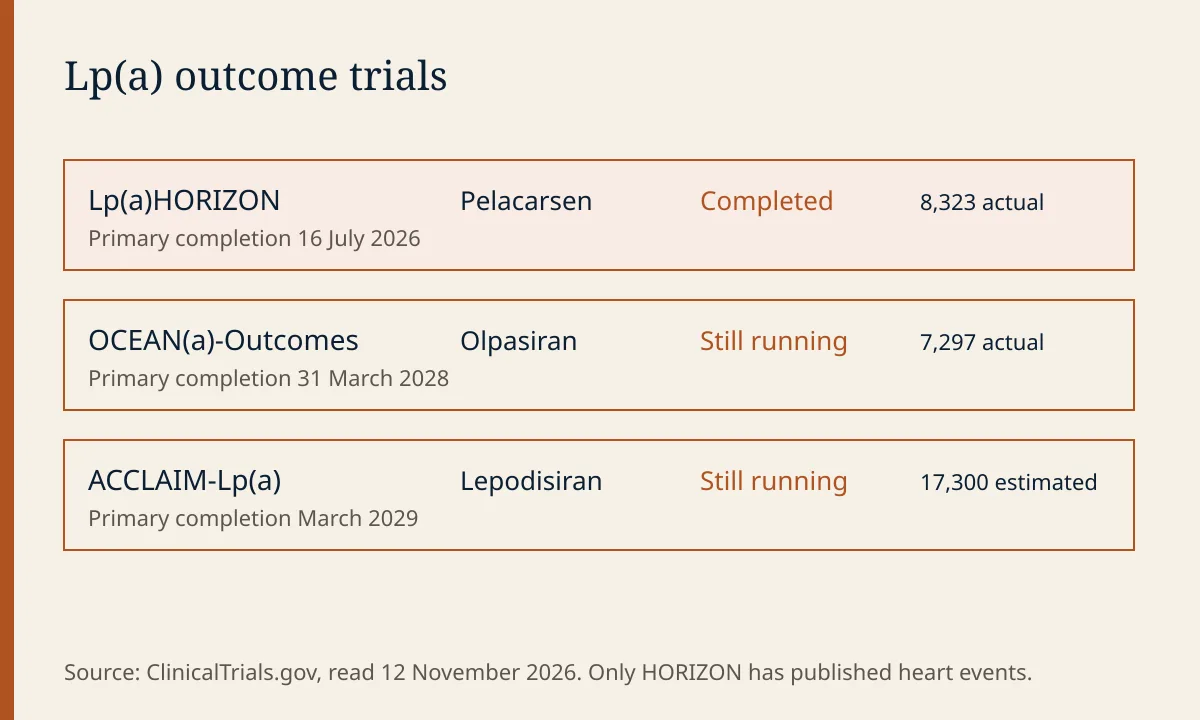
Two other large human trials are still running. Olpasiran and lepodisiran are different drugs, from Amgen and Eli Lilly. They have not reported heart events. A miss for pelacarsen is not their result.
Each row was read from ClinicalTrials.gov on 12 November 2026. An estimated date is not a promise.
| Trial | Drug and sponsor | Status | Enrollment | Primary completion |
|---|---|---|---|---|
| Lp(a)HORIZON, NCT04023552 | Pelacarsen. Novartis. | Completed. | 8,323 actual. | 16 July 2026, actual. |
| OCEAN(a)-Outcomes, NCT05581303 | Olpasiran. Amgen. | Active, not recruiting. | 7,297 actual. | 31 March 2028, estimated. |
| ACCLAIM-Lp(a), NCT06292013 | Lepodisiran. Eli Lilly. | Active, not recruiting. | 17,300 estimated. | March 2029, estimated. |
Both running trials are phase 3. A JAMA news piece on 10 November 2026 asked what comes next. That piece is commentary, not the source of these counts. Those trials are not more pelacarsen results.
What does a high Lp(a) still mean for you?
Direct answer
Lp(a) is still worth knowing once, as a risk marker. You cannot read these pelacarsen results as showing that lowering the number with this drug prevents events. ApoB, LDL cholesterol, and blood pressure stay separate questions.
This does not show the result in people without cardiovascular disease. It does not show a longer follow-up. It does not show that olpasiran or lepodisiran will miss. It does not hand you a dose.
ApoB counts plaque-building particles. Lp(a) is only part of that count. The cholesterol section files the LDL trials already checked here. The heart topic asks what has been shown on heart risk. Heart attack and stroke outcomes are why an event count outranks a blood number. A high ApoB has its own short note. Those pages keep their own sources.
If you're on TRT and wondering about your heart, read what 31 trials show on testosterone and the heart.
Novartis funded the trial and is developing the drug. The heart count in the pelacarsen results does not favor the drug. That is what the paper printed.
- 01Ask what your Lp(a) was, and in which unit, if it has never been measured.
- 02Ask how this trial fits a person with your history, including whether you already have heart disease.
- 03Ask which of your other risks have outcome trials behind them, apart from Lp(a).
- 04Do not treat a research chemical sold under this name as the drug in the Novartis trial.

Key takeaways
- 01Pelacarsen results: Lp(a) fell sharply. Major heart events did not.
- 02At 12 months, Lp(a) was 64.4 nmol/L versus 233.4 for comparison.
- 03Heart events hit 12.3 percent on the drug and 12.1 percent for comparison.
- 04Extra analyses, including bigger Lp(a) drops, still showed no benefit.
- 05Other Lp(a) outcome trials are still running. This drug is not approved.
Frequently asked questions
Did pelacarsen work?
The blood number moved. The heart events did not. In the main analysis, 12.3 percent of people on pelacarsen and 12.1 percent in the other group had a primary event. The hazard ratio was 1.02. The range, 0.90 to 1.15, includes 1.
Is pelacarsen FDA approved?
No. It is investigational. The New England Journal of Medicine paper is a human phase 3 trial report, not an approval. On 12 November 2026 a public Drugs@FDA search for pelacarsen returned no record.
Should I still test my Lp(a)?
A high Lp(a) still tracks with heart risk in genetic studies. This trial did not erase that. Know the number once. Do not treat this drug trial as evidence that lowering it prevents events.
What other Lp(a) drugs are in trials?
Olpasiran, from Amgen, is in OCEAN(a)-Outcomes, NCT05581303. Lepodisiran, from Eli Lilly, is in ACCLAIM-Lp(a), NCT06292013. Both were active and not recruiting on 12 November 2026. Neither has an outcomes result here.
Did pelacarsen lower Lp(a)?
Yes, in this trial. At 12 months the level was 64.4 nmol/L on pelacarsen and 233.4 nmol/L in the other group. That is about 72 percent lower than the other group level. The paper prints the two levels. The percent is the division.
Were serious side effects higher on pelacarsen?
Not in the outcomes paper. Serious adverse events were 37.3 percent on pelacarsen and 41.1 percent in the other group. In the smaller US Black and Hispanic study, serious events were 17.0 percent versus 15.0 percent, and stops for side effects were 6.0 percent versus 3.6 percent.
Does this mean high Lp(a) is harmless?
No. People born with lower Lp(a) still show less coronary disease in genetic studies. This trial says one drug, in adults who already had heart disease, did not lower major events over a median of 4.7 years.
What do the pelacarsen results leave unresolved?
Whether a different drug, a longer follow-up, or a different group would cut events. Larger Lp(a) drops inside this trial still showed no benefit. Olpasiran and lepodisiran are the next outcomes tests, and they are not done.
From the archive
Plan blood tests with a clinician before any medicine change.
Read it on the archiveSources
- Study in people2026
Pelacarsen and Cardiovascular Outcomes in Patients with High Lipoprotein(a).
Human phase 3 randomized trial, Lp(a)HORIZON, DOI 10.1056/NEJMoa2610159, funded by Novartis. 8,350 randomized, 8,322 in the efficacy analysis. At 12 months Lp(a) was 64.4 nmol/L on pelacarsen versus 233.4 for comparison. Primary events 511 (12.3 percent) versus 503 (12.1 percent), hazard ratio 1.02, range 0.90 to 1.15, P = 0.76. Median follow-up 4.7 years.
The New England Journal of Medicine - Study in people2026
Extended Analyses of Pelacarsen and Cardiovascular Outcomes in Patients with High Lipoprotein(a).
Extra analyses of the same human trial, DOI 10.1056/EVIDoa2600373. On treatment: 380 (9.1 percent) versus 434 (10.4 percent), hazard ratio 0.98, range 0.85 to 1.12. Uninterrupted treatment: 167 (11.0 percent) versus 204 (10.1 percent), hazard ratio 1.09, range 0.89 to 1.34. Total events 644 versus 646, rate ratio 1.00. No benefit in the large-drop or key subgroup cuts.
NEJM Evidence - Study in people2026
Assessing the Impact of Lipoprotein (a) Lowering With Pelacarsen (TQJ230) on Major Cardiovascular Events in Patients With CVD
NCT04023552, Lp(a)HORIZON. Sponsor Novartis Pharmaceuticals. Phase 3. Status completed. Actual enrollment 8,323. Actual primary completion 16 July 2026.
ClinicalTrials.gov - Study in people2026
Efficacy and Safety of Pelacarsen in Black/African American and Hispanic Participants with Elevated Lipoprotein(a) and Established Atherosclerotic Cardiovascular Disease: The Randomized Controlled Lp(a)FRONTIERS EXPANSION Study.
Human phase 3b trial, DOI 10.1161/CIRCOUTCOMES.126.014453, NCT06267560, not an outcomes trial. 422 adults analyzed. the other group-adjusted Lp(a) reduction 86 percent at one year. Serious adverse events 17.0 percent versus 15.0 percent. Stops for adverse events 6.0 percent versus 3.6 percent. Registry sponsor is Novartis Pharmaceuticals.
Circulation: Population Health and Outcomes - Study in people2018
Association of LPA Variants With Risk of Coronary Disease and the Implications for Lipoprotein(a)-Lowering Therapies: A Mendelian Randomization Analysis.
Genetic analysis, not a drug trial, DOI 10.1001/jamacardio.2018.1470. A 10 mg/dL lower genetically predicted Lp(a) lined up with 5.8 percent lower coronary risk (odds ratio 0.942, range 0.933 to 0.951). About 101.5 mg/dL (range 71.0 to 137.0) matched a 38.67 mg/dL LDL change. White European ancestry, mean age 57.5.
JAMA Cardiology - Review of studies2026
Lp(a)-Reducing Agent Pelacarsen Misses the Mark in Phase 3-Now What?
News commentary, 10 November 2026, DOI 10.1001/jama.2026.20002. Not a data source for the trial counts on this page.
JAMA - Study in people2026
Olpasiran Trials of Cardiovascular Events and Lipoprotein(a) Reduction (OCEAN(a)) - Outcomes Trial
NCT05581303. Sponsor Amgen. Phase 3. Status active, not recruiting. Actual enrollment 7,297. Estimated primary completion 31 March 2028. Heart-event results not reported on this page.
ClinicalTrials.gov - Study in people2026
A Study to Investigate the Effect of Lepodisiran on the Reduction of Major Adverse Cardiovascular Events in Adults With Elevated Lipoprotein(a) - ACCLAIM-Lp(a)
NCT06292013, ACCLAIM-Lp(a). Sponsor Eli Lilly and Company. Phase 3. Status active, not recruiting. Estimated enrollment 17,300. Estimated primary completion March 2029. Heart-event results not reported on this page.
ClinicalTrials.gov - Study in people2026
Lp(a) Lowering Study of Pelacarsen (TQJ230) in US Black/African American and Hispanic Participants With Elevated Lp(a) and Established ASCVD
NCT06267560, Lp(a)FRONTIERS. Sponsor Novartis Pharmaceuticals. Phase 3 on the registry. Status completed. Actual enrollment 422. The journal paper is the lab-level result, not a heart-event trial.
ClinicalTrials.gov
Read next
Longevity /
What Reduces Arterial Plaque: Nattokinase, K2, D3, Berberine and the Surprises
What shrank arterial plaque on a scan: nattokinase at 10,800 FU a day in 1,062 people, vitamin K2 and D3 trials from 2026, berberine, aged garlic, EPA, interval training, the Mediterranean diet, intensive lifestyle change and cocoa flavanols. Doses, numbers, bleeding risks, every study linked.
Research /
Retatrutide Trial Results Are Now in the Journals
Retatrutide phase 3 results are now in peer-reviewed journals. Three Lilly-funded human trials report weight loss, blood sugar, knee pain, and side effects. The drug is still investigational and is not FDA approved.

Research /
Testosterone Therapy and Heart Risk: What 31 Trials Show
Testosterone therapy did not raise heart attack or stroke risk in TRAVERSE, a 5,246-man randomized trial, and a new 31-trial pool found better heart markers. The one real signal: a modest rise in heart rhythm problems.
Educational use only. This database summarizes published research and is not medical advice. Where a dose appears it is a record of what a trial or clinic ran, or what people describe doing, with its source attached. Nothing here is a recommendation for personal use. Sellers named on the price pages are ranked by certificate tier, then price. No seller pays this site anything today. Naming a seller is not a recommendation to buy or use anything.